


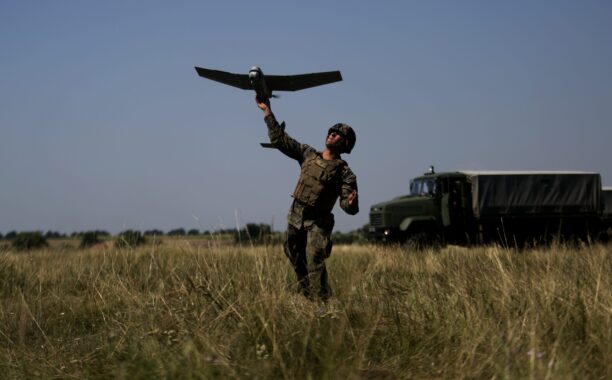
As Washington pushes for secure drone supply chains, a growing number of U.S.-Ukraine partnerships suggest a new model may already be taking shape.
Recent reports indicate that Ukraine is awaiting White House approval for a major drone production agreement with the United States. According to statements by Ukrainian President Volodymyr Zelensky, the proposed arrangement would involve cooperation on drones and air defense systems developed to counter large-scale aerial attacks.
The announcement arrives at a pivotal moment for the drone industry. Over the past several years, U.S. policymakers have increasingly focused on supply-chain security, trusted manufacturing, and reducing reliance on technology from geopolitical adversaries. The debate has often centered on what technologies and suppliers should be excluded from critical infrastructure and government operations.
A different question is now emerging: Who will help build the next generation of trusted drone systems?
Increasingly, Ukraine appears to be part of that answer.
The Search for Trusted Alternatives
Federal drone policy has evolved rapidly in recent years. Measures ranging from the FCC Covered List to broader supply-chain security initiatives reflect growing concern about the origin of critical technologies and components.
For the drone industry, however, identifying technologies to avoid is only part of the challenge. Policymakers, operators, and defense organizations also need viable alternatives capable of delivering advanced capabilities at meaningful scale.
That challenge has proven difficult. China remains deeply embedded in the global drone manufacturing ecosystem. Replacing that capacity requires more than policy. It requires technology, production expertise, and industrial partners.
Against that backdrop, Ukraine’s drone sector has attracted growing attention.
From Battlefield User to Technology Developer
Since Russia’s full-scale invasion in 2022, Ukraine has become one of the world’s most active centers of drone development.
The country has deployed drones across a wide range of missions, including intelligence gathering, strike operations, electronic warfare, maritime missions, logistics, and air defense. The pace of innovation has been unusually fast, driven by operational necessity and constant adaptation to changing battlefield conditions.
As a result, Ukraine is no longer viewed solely as a drone operator. It has become a source of drone designs, software, electronic warfare technologies, and manufacturing expertise.
That evolution has not gone unnoticed. Western defense firms, investors, and government agencies have increasingly looked to Ukraine’s drone ecosystem for technologies that have been tested under real-world combat conditions.
The Partnerships Are Already Underway
Importantly, cooperation between Ukrainian and American drone companies is not a future concept. It is already happening.
One of the clearest examples emerged earlier this year when Ukrainian drone manufacturer General Cherry announced a joint venture with New Hampshire-based Wilcox Industries. The partnership calls for production of FPV and interceptor drones in the United States using Ukrainian-developed systems and American manufacturing capabilities.
The arrangement offers a glimpse of a new model. Rather than importing completed drones, the partnership combines Ukrainian engineering and operational experience with U.S.-based production and supply chains.
Additional collaborations have also been reported. American defense startups have partnered with Ukrainian manufacturers to adapt combat-proven technologies for potential use by U.S. military customers. Industry reporting has also indicated growing Pentagon interest in evaluating Ukrainian drone technologies and electronic warfare systems.
Investor interest is also beginning to follow Ukraine’s drone sector. In June, the Washington Times highlighted the Nasdaq debut of Ukrainian drone technology company Swarmer, whose software enables a single operator to control large numbers of drones simultaneously. The company’s public listing, along with growing Western investment in Ukrainian defense technology firms, suggests that international markets are increasingly viewing Ukraine not only as a wartime innovator but as a source of commercially viable drone technology. For U.S. industry, that shift could create new opportunities for partnerships, technology licensing, and joint development programs beyond traditional defense procurement.
Taken together, these developments suggest that the proposed U.S.-Ukraine drone agreement would expand an existing trend rather than create an entirely new one.
A Different Supply Chain Model
The significance of these partnerships extends beyond individual products.
For years, discussions about drone supply chains have often been framed as a choice between Chinese manufacturing and domestic production. Recent developments suggest a more nuanced model may be emerging.
In this framework, Ukrainian companies contribute drone designs, operational knowledge, and rapidly evolving technologies. American companies provide manufacturing capacity, funding, procurement channels, and access to secure supply chains.
The General Cherry-Wilcox partnership illustrates this approach in practice. The value lies not only in where the drones are manufactured, but also in how expertise and technology move between allied nations.
Reports surrounding the proposed U.S.-Ukraine agreement point in a similar direction. Discussions have reportedly included technology sharing, production cooperation, and potential manufacturing partnerships rather than simple purchases of finished aircraft.
If that model expands, it could create new pathways for bringing combat-tested technologies into trusted manufacturing environments.
What It Means in the FCC Covered List Era
For the drone industry, the broader significance may lie in how policymakers think about trusted suppliers.
The FCC Covered List and related initiatives are often viewed through the lens of exclusion. Which companies and technologies present unacceptable risks?
That conversation remains important. Yet the next phase may focus increasingly on inclusion.
Which companies, countries, and manufacturing ecosystems can help build a secure and resilient drone industry?
The emerging U.S.-Ukraine partnerships do not answer that question by themselves. Nor do they eliminate the challenges associated with scaling production, securing components, or integrating new technologies into existing procurement systems.
They do, however, demonstrate that trusted international partnerships are becoming an important part of the discussion.
Looking Ahead
Whether the current drone production agreement receives final approval remains to be seen.
What is already visible, however, is a growing pattern of cooperation between Ukrainian drone developers and American industry. Partnerships, joint ventures, technology evaluations, and production agreements are moving beyond concept and into execution.
For an industry focused on secure supply chains and scalable alternatives, that may be the more important story.
The question is no longer whether Ukraine can contribute to the future of the U.S. drone ecosystem.
The evidence suggests it already is.
Read more:

Miriam McNabb is the Editor-in-Chief of DRONELIFE and CEO of JobForDrones, a professional drone services marketplace, and a fascinated observer of the emerging drone industry and the regulatory environment for drones. Miriam has penned over 3,000 articles focused on the commercial drone space and is an international speaker and recognized figure in the industry. Miriam has a degree from the University of Chicago and over 20 years of experience in high tech sales and marketing for new technologies.
For drone industry consulting or writing, Email Miriam.
TWITTER:@spaldingbarker
Subscribe to DroneLife here.

