


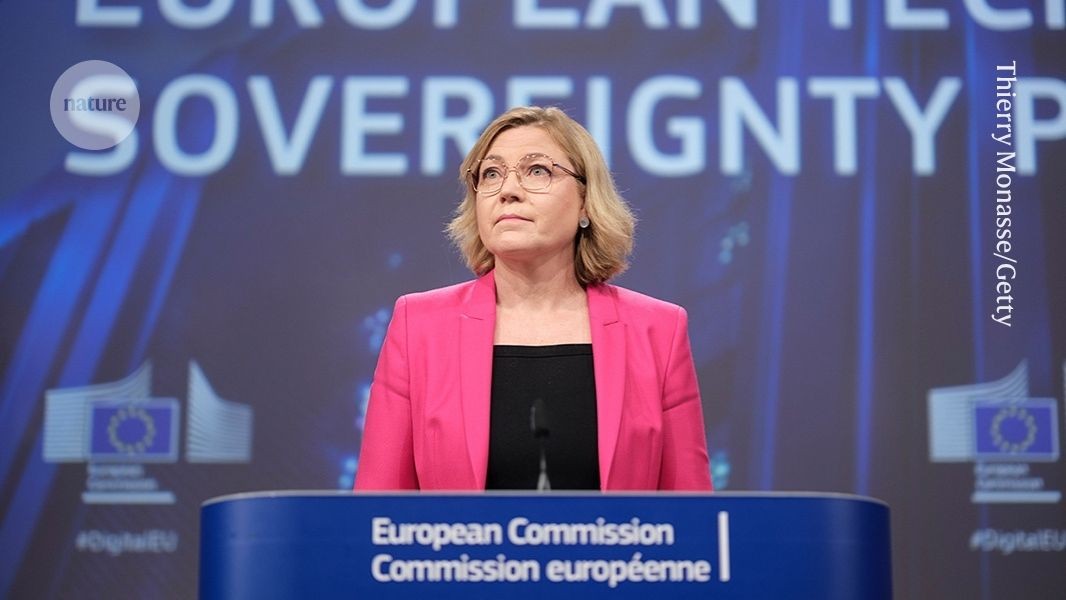
Henna Virkkunen, executive vice-president for tech sovereignty, security and democracy at the European Commission, announced the plans in the European Tech Sovereignty Package.Credit: Thierry Monasse/Getty
Across Europe, governments are reducing their reliance on US technology companies. On 3 June, the European Commission laid out plans in the European Tech Sovereignty Package, which includes several proposals to enhance digital autotomy, including plans to boost home-grown cloud services and artificial intelligence and promote use of open-source technologies.
“We live in a world where geopolitics and technology are inseparable,” Henna Virkkunen, the commission’s executive vice-president for tech sovereignty, security and democracy, said in a statement accompanying the announcement. “It is time for Europe to be in control of its data, of its supply chains and of its future in a clean and sustainable way.”
Europe must become a research epicentre as US system gets undermined
Several European countries have already been moving away from US technologies, and some researchers are feeling the effects of these shifts. This year, the French government announced plans to ditch non-European information-technology (IT) service providers — for example, by replacing the operating system Windows, made by Microsoft in Redmond, Washington, with the open-source alternative Linux and requiring all state services to replace video conferencing from Zoom, made by Zoom Communications in San Jose, California, to Visio, a platform developed by France’s Interministerial Directorate for Digital Affairs. Similar changes are underway in parts of Germany, Denmark and elsewhere.
Some research institutions in Europe have already cancelled contracts for US digital products, and many others are actively discussing how to become more digitally independent. Some researchers are also ending their reliance on US tech on their own accords.
For many, these actions are driven by concerns around political developments in the past few years, such as worries over data privacy and the decline in academic freedom in countries such as the United States, says Pierre Senellart, vice-president of digital infrastructure and IT convergence at PSL University in Paris. “There is an increasing understanding that it might be a good idea to move away from systems managed by US companies.”
Seeking independence
Some research institutions in France have been making broad shifts to decouple their digital systems from non-European providers. In December, the country’s largest public research organization, the French National Centre for Scientific Research (CNRS), banned its employees from using consumer chatbots built outside Europe, such as ChatGPT from OpenAI in San Francisco, California, and Google’s Gemini. Instead, the CNRS offered its staff access to Emmy, a generative AI tool from Mistral AI in Paris, describing it as a secure alternative to large language models built in the United States and China.
Some of these changes are starting to be felt at other academic institutions in France. At PSL University, where most researchers are members of CNRS laboratories, many scholars began using Visio after CNRS terminated its contract with Zoom Communications.
For now, there are few other shifts to European digital technologies — but many universities are discussing how to become less dependent on US providers, says Senellart. Many French universities are hugely reliant on IT services offered by US tech giants such as Microsoft, so determining when and how to replace these is not a simple matter, Senellart says.

How Europe aims to woo US scientists and protect academic freedom
In Germany, too, a handful of municipal and state governments are uncoupling from US tech firms. The government of the state of Schleswig-Holstein, for example, has been replacing Microsoft’s tools with open-source ones. At one institution in this state, Kiel University, active discussions about digital sovereignty — such as how to strengthen independence when it comes to digital services and processing sensitive data — have been ongoing for several months, says Veronika Penner, the university’s chief digital officer. She adds that, when it comes to procuring new tools, the university is increasingly considering open-source and digitally sovereign alternatives to commercial products.
Other stakeholders in the academic community are also working to increase digital sovereignty. Earlier this year, the German Research Foundation DFG, the country’s largest research funder, put forward recommendations for the scholarly community to build more-resilient data infrastructure, which, among other things, included a call for researchers to prioritize using open-source European products responsibly. The DFG has also launched a funding initiative to preserve endangered data sets that are held in foreign repositories but are crucial to researchers in Europe — and the first four of its funded projects all involve US data sets.

