


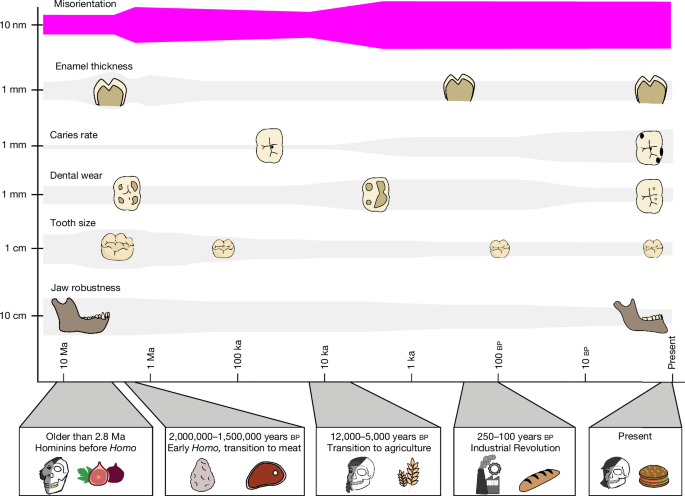
Sample
The nine species analysed in this study are listed in Supplementary Table 1. The 12 tooth samples, locations of origin, date, collection ID and precise tooth analysed are listed in Supplementary Table 2. Whenever possible, we selected lower first molars (LM1) and the mesio-buccal cusp, which experiences crushing and grinding forces and is the first to wear53,54 (Extended Data Fig. 2). When an LM1 was not available (for example, fossil samples), we used the functional cusp of the available molar or premolar, which is equivalent to an LM1’s mesio-buccal cusp in its masticatory function (Extended Data Fig. 2). In all cases, analysis was restricted to molar or premolar teeth and focused on the occlusal region proximal to the dentine horn to control for functional use and avoid worn enamel.
Histological sample preparation
Previous studies generated histological sections of PA, Arch1, Arch2, MH, Pt, Pp and Ca, but all used a standard set of histological methods55,56. Details of materials and consumables used for each sample can be found in their respective published articles (Supplementary Table 2). We identified no pathologies or taphonomic features in any sample. When wear was present, it was minimal and did not reach the dentine horn. All samples are permanent posterior teeth from adult individuals, with the exception of Ca, which was a subadult. Teeth were embedded in epoxy resin before being sectioned. Each tooth was sectioned through a plane intersecting the two mesial cusps (in the case of premolars, the two primary cusps; Extended Data Fig. 2) using a precision saw. The section was mounted on a microscope slide and used for other studies. For this study, we used the ‘off-cut’, which is the remaining portion of the tooth that was not mounted to the microscope slide. This off-cut was re-embedded, ground and polished as described below (‘Sample preparation for PEEM’).
The histological sectioning and analysis of the Eh sample was published in ref. 57; Vm was published in ref. 58; Hh, He and Pb were published in ref. 59. C. M. Dean led the histological preparation for these five samples, following standard protocols55,56. For these samples, no pathologies or taphonomic features were identified; when wear was present, it was minimal and did not reach the dentine horns.
Sample preparation for PEEM
Samples arrived sectioned; we re-embedded, then ground and polished them. For re-embedding, we soaked blocks or slides in anhydrous ethanol and placed them face-down in two-part plastic moulds (Ted Pella) and covered them with freshly mixed EpoFix (EMS; 25 g epoxy, 3 g hardener, mixed with a Thinky planetary mixer, mixing for 1 min and defoaming for 1 min. We cycled the moulds three times through vacuum with a diaphragm pump kit (Ted Pella) and vented with nitrogen, to remove ethanol, ensure full epoxy penetration and burst surface bubbles. EpoFix cured overnight in air.
All grinding and polishing used water as a coolant, but supersaturated with either 1 g l−1 CaCl2 or 0.2 g l−1 Na3PO4 (pH 9) in MilliQ water to prevent hydroxyapatite dissolution, dispensed by a peristaltic pump (Drive MFLX07522-30, Head MLFX07519-06, Tubing MFLX96410-14, all by MasterFlex, Avantor). We ground tooth surfaces with 600, 1,200 and 4,000 grit SiC paper (Buehler) using 5 N, 30 s each, 40/140 rpm co-rotating on a Buehler AutoMet 250 PM. We then polished the tooth surfaces on the same Buehler AutoMet 250 PM with 300-nm alumina (MicroPolish 0.3 µm, Buehler) using 10 N, 2 min, 40/140 rpm counter-rotating, then with 50-nm alumina (MasterPrep, Buehler) with 10 N, 1 min, 30/30 rpm counter-rotating. Both 300-nm and 50-nm suspensions were dispensed automatically via burst modules (Buehler). This protocol yields mirror-flat surfaces with ≤1 nm residual roughness, as previously verified by atomic force microscopy. When possible, we thinned the samples to 2 mm thickness, which is ideal for PEEM experiments. For the fossil samples (Vm, Eh, Hh, He and Pb) this was not possible; thus, we used a modified sample holder for the PEEM experiment. We trimmed the epoxy blocks to remove excess EpoFix resin and then cleaned them repeatedly with anhydrous ethanol and a new TexWipe Dry Cotton Cleanroom Wiper using gentle force until clean under differential interference contrast (DIC) microscopy (×20 objective). This step is key to obtaining perfect surfaces for the surface-sensitive PEEM method.
We then transferred all samples to ultrahigh vacuum (approximately 10−8 mbar) to remove any residual water. Several samples took many hours to outgas: we attempted the PA sample during 3 beamtimes over 2 years and it failed until we built a dedicated ultrahigh-vacuum chamber, called the Dalì chamber (Supplementary Fig. 1). The ultrahigh-vacuum chamber included a 660 l s−1 turbo pump ceramic-bearing turbomolecular Agilent Twistorr 704 (Agilent Technologies). The pump is mounted at the bottom of the Dalì chamber, equipped with a fast-entry flange on a side, and a drawer that comes out to receive the sample, and goes back into the chamber directly above the turbo, where the sample sits while pumping down.
We coated all samples twice using a Cressington 208HR (Cressington, Ted Pella) sputter coater. First, we coated the samples with 40 nm platinum and a 4 mm × 4 mm silicon wafer mask (MTI) to cover the functional cusp of the tooth and expose everything else to platinum, with no motion of the sample stage. Then, we removed the silicon mask and coated the whole sample with 1 nm platinum while spinning and tilting it. This coating method makes it possible to analyse with photoemission spectroscopy and microscopy any insulating sample including minerals60, biominerals61,62 and most importantly enamel22,63,64,65,66. At the calcium L edge, the maximum probing depth of the PEEM experiment is 3 nm (ref. 67); hence, a 1-nm coating enables much of the signal to originate from the sample under investigation. The 40 nm surrounding coating ensures good electrical contact between sample and sample holder, so that the sample can float at −18 kV without arcs and sparks, and the photoelectrons it emits can be accelerated towards the electrostatic optics column.
We defined the region of interest identically in all samples. Whenever possible, we focused PELICAN analysis on specific occlusal regions of lower first molars (LM1) near the dentine horn to control for functional use, and selected the mesio-buccal cusp of each tooth because this region experiences both crushing and grinding forces53,54 (Extended Data Fig. 2). When an LM1 was not available (for example, fossil samples), we used the ‘functional cusp’ of the available molar or premolar, which is closest in its masticatory function to an LM1’s mesio-buccal cusp (Extended Data Fig. 2). The region selected for analysis in all tooth cross-sections was well below the surface of the functional cusp tip; the region of interest was approximately 200–300 µm occlusal to the apex of the dentine horn where both parazones and diazones of Hunter–Schreger bands in the decussation pattern were visible (Extended Data Fig. 2). We also analysed regions 200–300 µm lateral to the apex of the dentine horn for some samples. We precisely recorded the precise location of each area analysed in PEEM into a high-resolution optical image of each sample using Adobe Photoshop. Extended Data Figs. 5c and 6c, and Supplementary Fig. 2c provide examples of this precise localization in Photoshop, including the tooth cusp, the dentine horn, and the location of occlusal and lateral areas analysed with PEEM. The optical images were obtained with either DIC microscopy68 or polarized light microscopy (PLM), and show the whole sample surface. Extended Data Figs. 5c and 6c, and Supplementary Fig. 2c show examples of the DIC images. The PLM images used crossed polarizers on the illumination and reflected light channels at 90° ± 30° from one another. All DIC and PLM images were acquired using a Zeiss Axioscope 7 (CTK Instruments) and stitched together automatically using the Zeiss software.
Scanning electron microscopy
We acquired scanning electron microscopy (SEM) images using a Zeiss EVO LS10 microscope, operated at 10 kV accelerating voltage and 9.5 mm working distance, in either secondary electrons or backscattered electrons mode. The SEM images in Extended Data Fig. 1 present both the secondary electrons or the backscattered electrons of the same region of a Ca sample. We imaged the sample as it had been coated for the PEEM experiment; thus, the SEM, PEEM and PELICAN images are all directly comparable from precisely the same sample and accurately the same region of sample surface, even though the greater penetration and scattering depths in SEM and the larger depth of field provide the impression of more topography in SEM than in surface-sensitive PEEM.
PEEM beamtime experiments
We acquired all data using the PEEM-3 microscope at the Advanced Light Source at Lawrence Berkeley National Laboratory. PEEM-3 is the end-station of beamline 11.0.1.1 at the Advanced Light Source and is a photoemission electron microscope38,39, with the sample floating at high voltage (−18 kV), fully electrostatic lenses69 magnifying the image formed by photoemitted electrons under soft-X-ray illumination, and a best resolution of 20 nm (ref. 40).
PEEM-3 has an elliptically polarizing undulator source, which enables rotating the linear polarization of the soft-X-rays illuminating the sample surface. For this work, we acquired stacks of 38 full-field PEEM images while rotating the polarization from horizontal to vertical in 5° intervals. At each of 19 polarizations, we acquired 2 images at 2 photon energies on either side of the sharpest and most intense calcium L2 peak, termed peak 1, typically at 352.6 eV. We acquired the 2 images either 0.2 eV above and below peak 1, or +0.1 and −0.3 eV, whichever gave the greatest contrast in ratio images at each particular beamtime22,65. Both settings are effective, but the optimal choice varies every time the undulator, the monochromator or the beamline optics are tweaked and must be determined each time. The beam was shuttered off between exposures to prevent radiation damage70,71.
Data-taking and normalization for PELICAN
It is important for PELICAN quantitative analysis5 to use image ratios, so that the relative intensity is normalized and the amplitude of the cos2 curve in each pixel is representative, as much as possible, of the crystal orientation in that pixel, not of the unevenly distributed illumination, polarization or sample-dependent image brightness. This is never perfect, but it improves substantially with normalized images. The image ratio can be acquired on-peak and off-peak if only one peak is dichroic, or on two anticorrelated dichroic peaks. Example energies for the oxygen K edge in carbonates are on-peak of the π* peak at 534 eV and off-peak in the pre-edge at 530 eV. For the calcium L edge in calcium phosphates, instead, the L2 peak is the superposition of multiple anticorrelated peaks; thus, the peak appears to shift in energy with polarization by 0.4 eV (ref. 65). In Supplementary Fig. 3, we highlight two energies, 0.4 eV apart, where they usually give the greatest contrast, 0.1 eV above and 0.3 eV below the L2 peak at 352.6 eV. In either case, after normalization by ratio of these two images, each pixel has a cos2 dependence on the elliptically polarizing undulator polarization angle. Immediately after acquisition, we aligned all 38.P3B PEEM images in PeemVision (https://sites.google.com/lbl.gov/bl11-peem3-als/tools), then ratioed them so that at each elliptically polarizing undulator polarization angle, the higher energy image is divided by the lower energy one, then saved as 19.P3B images.
We recorded the precise position where each dataset was acquired during data acquisition in the beamtime notebook as x, y coordinates. We recorded and saved both the PEEM coordinates and the visually identified features in PEEM and DIC or PLM images in the Photoshop file.
For each area, we acquired a 3 × 3 map, with 50 ± 5 µm field of view, 1,030 pixels horizontally and 1,054 pixels vertically. Each pixel was therefore 50 ± 5 nm, which matches the cross-section of enamel nanocrystal. The 9 stacks in a 3 × 3 area were partly overlapping, as the sample position was shifted by 40 µm between images.
PELICAN analysis
We describe the PELICAN analysis in detail in Supplementary Methods and we have published the software and the manual to use it on Zenodo5, where a link to GitHub is provided. PELICAN is a method developed for this study to quantitatively measure the orientation angle of the crystallographic c-axis of crystals that exhibit X-ray linear dichroism. This method significantly improves on polarization-dependent imaging contrast22,40,62,65,72; it now calculates and displays the inferred c-axis orientation in spherical polar coordinates θsp and ϕsp in each pixel, calculates the misorientation angle of the two c-axes in two adjacent pixels, and calculates the histograms of all values for each spherical polar coordinate as well as the histogram of misorientations of adjacent pixels. PELICAN analysis runs in Igor Pro 8 (WaveMetrics) or a later version, and uses the Gilbert Group Macros (GG Macros), freely available via Zenodo5. For all areas, we calculated the histograms using identical PELICAN parameters (amax = 1, bmin = 1, bmax = 120 and ϕzy min = 45). For display purposes, however, we modified the parameters for several images, as described in Supplementary Methods, and the colour legends differ for each area in Figs. 2, 4 and 5, Extended Data Figs. 1 and 4–6, but in all figures they display precisely the range in which θsp and ϕsp vary. In a nutshell, ϕzy min was either 45°, 80° or 90°, the ϕsp range was identical for all between 50° and 150° displayed as brightness, the θsp range was either −45° to 45°, −25° to 70° or −75° to 45° and displayed as hue. In addition, most PELICAN maps were adjusted in brightness with the ‘b brightness’ tool in PELICAN, which displays the value of b as brightness. The effect of ‘b brightness’ is similar to ‘levels’ and ‘Auto’ in Photoshop. This was done for all samples except for Ca and Vm.
Once we obtained nine PELICAN maps per area, with colour showing the orientation of c-axes semi-quantitatively, we mounted and stitched the nine partly overlapping maps manually, using Adobe Photoshop. We positioned maps manually by placing the nine maps in nine separate Photoshop layers, then we blended the nine layers using the Photoshop tool ‘Auto Blend Layers’, with ‘Panorama’ option, and merged them into one layer called ‘merged’.
Histograms of misorientations
PELICAN saves a.csv histogram file for each stack, which represents the 1 million misorientation maxima. PELICAN also fits the peak, that is, the mode of the histogram of 1 million misorientations with a log normal function (Supplementary Fig. 10, bottom left), and saves the fitted peak position and calls it ‘mode (°)’ at 100% of the fitted height, the full-width at half-maximum called ‘width (°)’ at 50% of the fitted height, and the ‘footprint (°)’ at 10% of the fitted height, as presented in Figs. 2, 4 and 5, and Extended Data Figs. 4–6. The histograms are all normalized to 1, such that the area under the curve is always 1; thus, the histograms can be compared with one another. In Figs. 3, 5 and 6, and Extended Data Figs. 4–6, we present the average histograms, obtained by adding the nine histograms from each area and then dividing by nine in Microsoft Excel. Complete data are provided in Supplementary Data 1, which contains a summary sheet (‘all samples, PELICAN results’) with all mode (°), width (°) and footprint (°) and their means and standard deviation for all areas. The histogram outputs of PELICAN are also included on a separate sheet for each sample. Each sample’s sheet contains nine histograms and the calculated average histogram. All histograms are normalized to 1, such that the area under the curve is 1, so all histograms or average histograms can directly be compared with one another.
Statistical analysis of misorientation histograms
We performed all statistical analyses in IBM SPSS Statistics 30. As PELICAN histograms are not Gaussian, we characterized each dataset’s histogram by 3 parameters: mode (100% of the peak or maximum), width (full-width at 50% maximum) and footprint (full-width at 10% maximum). We compared these parameters across the 3 × 3 = 9 datasets in each area. Shapiro–Wilk tests found that these 3 parameters in 12 occlusal areas were normally distributed for most (31 out of 36), but not all cases (5 out of 36) (Supplementary Table 9); thus, we used non-parametric statistics. We calculated the means and standard deviations in Fig. 2 and Supplementary Data 1 across these n = 9 values.
We used two-sided Kruskal–Wallis tests with Bonferroni correction (α = 0.05) to compare histogram parameters between samples (Supplementary Tables 10–13). We used two-sided Jonckheere–Terpstra tests to assess directional trends in misorientation with increasing dietary hardness in non-Homo samples (Fig. 4 and Supplementary Table 11) and temporal trends within Homo samples (Fig. 6g, Supplementary Table 14 and Extended Data Fig. 3).
We established dietary hardness categories for non-Homo samples based on the mechanical properties of diet documented in the literature (Fig. 2 and Supplementary Tables 3–8) as soft (Pt), intermediate (Pp, Pb), fossil frugivore (Vm, Eh) and very hard (Ca). Jonckheere–Terpstra analyses identified trends across these categories in all non-Homo samples (n = 54) and extant primates only (n = 27) (Fig. 4 and Supplementary Table 11). Then, we performed PCA on mode, width and footprint parameters across all 12 samples. This yielded a new, single composite measure (PC1), which explains 97.5% of variation with comparable loadings across all 3 variables (range 0.980–0.995). We calculated the PC1 factor score for each of the 108 occlusal datasets (12 samples with 9 occlusal datasets per sample; Supplementary Data 1). We then ran Jonckheere–Terpstra and Kruskal–Wallis tests on PC1 factor scores across the four dietary hardness categories (Fig. 4 and Supplementary Table 12). We assigned the six Homo samples to four time periods and ran Jonckheere–Terpstra and Kruskal–Wallis tests on their PC1 factor scores to identify trends and pairwise differences (Fig. 6 and Supplementary Tables 13–16). Finally, we ran two-sided Spearman’s rho correlations between the three histogram parameters (mode, width and footprint) compared with published metrics from Supplementary Table 8 (Supplementary Table 15).
Ethics permissions
UCL-Kent collection (MH): ethical approval for histology research on this sample of teeth was obtained from the UK National Health Service research ethics committee (REC reference: 16/SC/0166; project ID: 203541). The Newcastle collection (PA, Arch2, Pp, Pt) consists of existing thin sections produced at Newcastle University by Dr. Don Reid. Skeletal Biology collections (Arch1) are archaeological, and an ethics license is not needed. Fossil research (Hh, He, Pb, Eh, Vm) was authorized in Kenya with NACOSTI permits NACOSTI/P/22/20091 and NACOSTI/P/24/36662.
Reporting summary
Further information on research design is available in the Nature Portfolio Reporting Summary linked to this article.

