


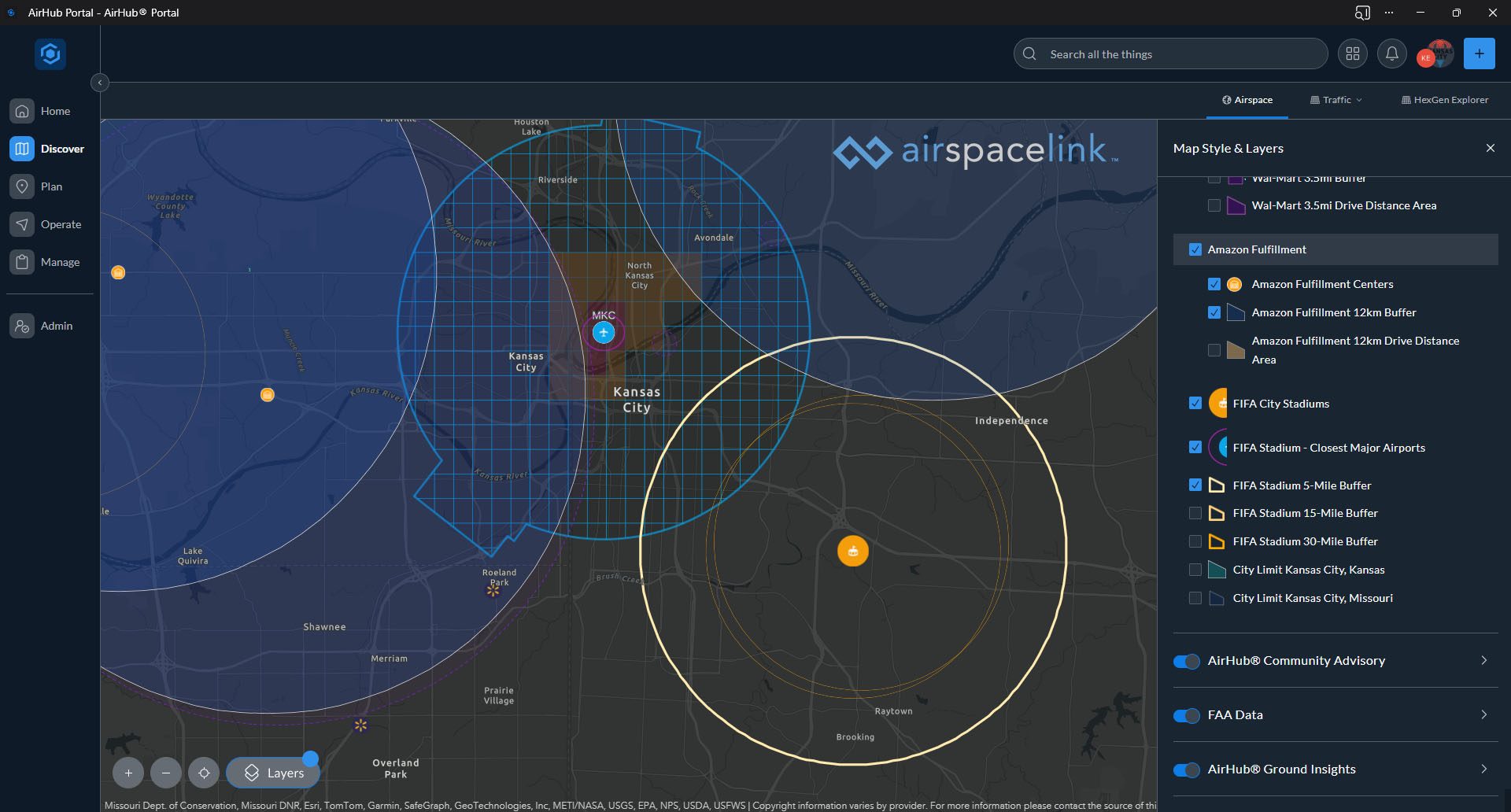
Airspace Link and regional public safety agencies deploy a shared drone coordination and counter-UAS platform designed to support FIFA World Cup security and future urban drone operations.
by DRONELIFE Features Editor Jim Magill
Kansas City Missouri has become one of the first regions in the U.S. to deploy an integrated drone-traffic coordination and counter-UAS platform, just in time to help provide airspace security for the start of the FIFA World Cup 2026 events in June.
On May 14,the Kansas City Police Department (KCPD), in partnership with Airspace Link and several regional public safety stakeholders, announced the launch of the platform, which has been designed to protect World Cup venues and fan zones, as well as other public spaces across the Kansas City metropolitan area.
In an interview with DroneLife, Airspace Link CEO Michael Healander said the Kansas City platform will integrate multiple counter-UAS systems already in place, including those of Australian defense technology company DroneShield. These systems are currently being deployed by several regional law enforcement agencies and at Arrowhead Stadium, where six World Cup matches are scheduled to take place.
“As you can imagine, a lot of these agencies already have their own detection,” Healander said. “We’re integrating all those different sensor systems into that same system so you don’t have to go to 10 different city networks to look at what drones are flying through the area.”
In addition, he said the Kansas City platform, which helps establish an air traffic coordination system for the region, will deploy radar as well as low-altitude ADS-B for tracking manned aircraft.
“What it does is it gives you a holistic system into who’s planning to fly where, what and when,” Healander said. The system will enable operators to identify drones that are operating in the airspace, and to determine which UAVs are flying in accordance with FAA airspace restrictions and which are not. The latter category could include recreational drones that are inadvertently violating the rules as well as more suspicious drones being flown with a possible harmful intent.
Integrated system one of the first
Kansas City’s new system, which represents one of the most comprehensive integrated urban drone operations platforms yet established in a U.S. World Cup host city, is anchored by Airspace Link’s AirHub Portal as the shared operational airspace coordination layer, and DroneShield’s counter-UAS detection and threat-response platform, creating a unified framework for drone awareness, coordination, identification and security.
The deployment supports multi-agency and multi-jurisdictional coordination among police and other public service agencies as well as other security officials supporting FIFA operations and public safety response across the Kanas City region. In addition, the system will include the participation of media companies operating drones to cover World Cup events and other commercial drone operators, such as Amazon Prime Air, which operates UAV delivery services in the area.
Healander said Airspace Link is working with some of the 10 other World Cup host cities to develop similar airspace coordination and counter-UAS systems, although the one in Kansas City is the first to be brought on line. He added that the company would likely be able to release further details about its projects in other cities in the near future.
“But I would say many of them are not as far along in this type of scenario as Kansas City is.” He said that Kansas City officials had gotten all their paperwork in to the appropriate government agencies the day before the partial government shutdown, which curtailed the operations of the Department of Homeland Security (DHS), started in February. The shutdown, which ended on April 30, is thought to have slowed some efforts to establish counter-drone security systems in time for the start of the World Cup games, which get under way next month.
Healander said the Kansas City integrated drone security platform will remain in place following the end of the World Cup games and will serve as the basis for establishing drone traffic management and counter-UAS systems on a wider basis in the future. He said police departments in the region will be able to use the platform to support their respective Drones as First Responders programs and to support their own counter-UAS systems.
Platform’s use to expand in future
In addition, the establishment of the drone coordination platform in the region will help pave the way for community officials to work with commercial drone operators to help integrate future UAS operations into the U.S. airspace system. “With this infrastructure in place, we are talking about big bucks from retailers that are targeting these FIFA cities,” he said. “The technology makes it easier for them to integrate into those metro areas.”
According to the joint press release, Airspace Link’s AirHub “provides the operational command environment for authorized drone activity across the metro area, integrating live FAA airspace data, Remote ID telemetry, UTM [UAS traffic management] coordination workflows, approved flight operations, emergency response activities and Identification Friend or Foe (IFF)-style operational awareness capabilities into a common operating picture accessible by participating agencies.
“The platform is designed to support coordinated drone operations among law enforcement, fire response, critical infrastructure operators, commercial drone services, media organizations and authorized event operators throughout the World Cup environment.”
Counter-UAS systems integrated into the comprehensive platform “include DroneShield as the primary detection and threat-response layer, along with Cyber-over-RF mitigation technology and additional counter-UAS capabilities deployed within select supporting communities and operational zones throughout the broader regional security environment,” the press statement says.
“The system is designed not only for temporary event security, but for long-term management of increasingly complex low-altitude airspace operations already emerging across the Kansas City region,” the statement says.
“Kansas City’s investment positions it as a model for how cities across the country can build drone-ready infrastructure that serves both the demands of major events and the permanent drone economy taking shape in American cities right now.”
In an emailed statement, the KCPD said it continues to work closely with its local, state and federal partners on security planning for the FIFA World Cup and other large-scale events planned for the region. As part of those efforts, KCPD personnel have participated in federal counter-UAS training initiatives, the department said.
“In addition to those coordination efforts, KCPD is expanding its use of technology related to drone detection and airspace awareness. This includes enhanced radar and radio-frequency detection capabilities designed to improve situational awareness and help identify unauthorized drone activity in restricted areas during major events,” the statement says.
The new Kansas City platform is being funded through the federal Counter-Unmanned Aircraft Systems (C-UAS) Grant Program administered by DHS and FEMA.
Read more:
 Jim Magill is a Houston-based writer with almost a quarter-century of experience covering technical and economic developments in the oil and gas industry. After retiring in December 2019 as a senior editor with S&P Global Platts, Jim began writing about emerging technologies, such as artificial intelligence, robots and drones, and the ways in which they’re contributing to our society. In addition to DroneLife, Jim is a contributor to Forbes.com and his work has appeared in the Houston Chronicle, U.S. News & World Report, and Unmanned Systems, a publication of the Association for Unmanned Vehicle Systems International.

Miriam McNabb is the Editor-in-Chief of DRONELIFE and CEO of JobForDrones, a professional drone services marketplace, and a fascinated observer of the emerging drone industry and the regulatory environment for drones. Miriam has penned over 3,000 articles focused on the commercial drone space and is an international speaker and recognized figure in the industry. Miriam has a degree from the University of Chicago and over 20 years of experience in high tech sales and marketing for new technologies.
For drone industry consulting or writing, Email Miriam.
TWITTER:@spaldingbarker
Subscribe to DroneLife here.

