


From AI-powered approaches to light-based experimentation, these researchers are bringing fresh perspectives to long-standing challenges in chemistry. With a focus on sustainability and efficiency, their ideas show how small tweaks to a system can have profound impacts.
XIAONA LI: In full flow

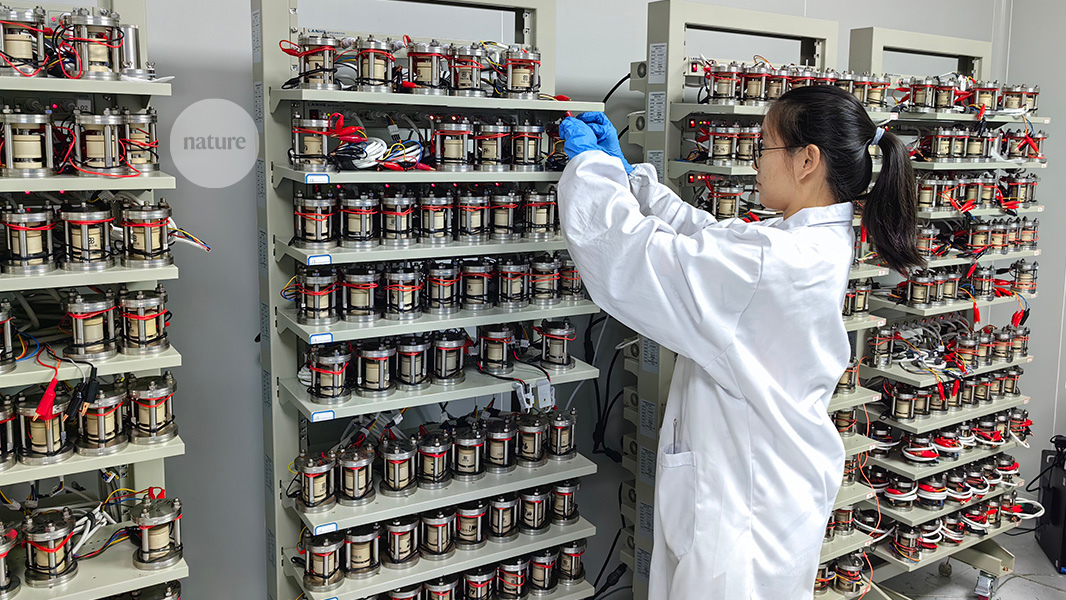
Xiaona Li’s team aims to boost the conductivity of solid electrolytes.
Solid-state batteries offer many advantages over lithium-ion batteries: they’re lighter, they can store more energy, and because they use a stable solid material instead of a flammable liquid electrolyte, they’re safer. But for the technology to become more widespread, “there are many issues we need to solve”, says Xiaona Li, an inorganic chemist at the Eastern Institute of Technology in Ningbo, China.
In a battery, electrons flow from an anode to a cathode through an external circuit to deliver power, while charged ions move through the electrolyte between two electrodes to maintain charge balance. In lithium-ion batteries, ions move relatively easily through a liquid electrolyte; in solid-state designs, the ions move through a solid electrolyte, which is typically slower and can constrain performance.
Nature Index 2026 Chemistry
The materials used in a solid electrolyte can make all the difference. One option that Li is investigating is halides — compounds made by combining a halogen element, such as fluorine or iodine, with another element, often a metal. “The conductivity of halides can be very high,” she says.
One type of halide, lithium indium chloride, is a promising candidate, but it’s difficult to produce. The process usually involves grinding lithium chloride and indium chloride — crystalline salts made of metal and chlorine atoms — into a fine powder before rapidly heating and then slowly cooling the material to alter its structure and properties. “It’s a method that’s hard to scale up,” says Li.
During her postdoctoral studies at the University of Western Ontario in London, Canada, Li and her colleagues pioneered an alternative water-based method1 to synthesize lithium indium chloride. They found that dissolving the precursor components in water resulted in an electrolyte with high ionic conductivity, meaning the ions could pass through it more efficiently. “The method is cheaper, requires less energy, and is highly suitable for large-scale batch production,” says Li.
Her team in China is now working to improve solid electrolyte conductivity. Scientists typically rely on doping — adding small amounts of other elements to the mixture — but it can be hard to find the right combination. Li’s team took a different approach, designing a halide-based set-up in which parts of the battery temporarily dissolve and release their ions. A 2025 study2 in Nature Energy by Li and her colleagues identifies 73 halide materials that could be used to achieve this state.
“The result is a glass-like solid that can still conduct electricity really well, because the ions are free to move inside it,” she says. “We found that this approach can be universally applied to many different materials.” — Sandy Ong
ANANTH GOVIND RAJAN: Reactive research

Ananth Govind Rajan is using nanomaterials to improve water filtration systems.
Ananth Govind Rajan is fascinated by how the smallest components of a system contribute to the whole. Growing up in Delhi, he loved taking apart the family radio to study its components before reassembling it from memory. “I’ve always been interested in tinkering with things and figuring out why they work,” he says.
A chemical engineer at the Indian Institute of Science in Bengaluru, Govind Rajan wants to find the most effective materials to use as catalysts. Nanomaterials are a promising option because their unusually high surface-area-to-volume ratio exposes more atoms at the surface, which increases active reaction sites and enables faster, more efficient chemistry.
During his postdoctoral research at Princeton University in New Jersey, Govind Rajan and his colleagues used nanomaterial catalysts to speed up electrolysis — a process that uses electricity to split water into hydrogen and oxygen. Using models to vary factors such as temperature, pressure and acidity, they identified the optimal conditions to speed up reactions on a nickel oxyhydroxide nanoparticle catalyst in an electrolysis system3.
Since returning to India and setting up his own lab in 2020, Govind Rajan has switched part of his focus to water filtration systems. Last year, he and his colleagues described4 how weaving graphene oxide — a nanomaterial made from a sheet of graphene with oxygen atoms attached — into a filtration membrane could make it more chemically reactive and easily dispersible in water. He says the modification improved both the membrane’s filtration rates and its resilience, which could help it work more effectively for longer.
Govind Rajan is also using artificial intelligence to design membranes5 that take advantage of nanopores — tiny holes or channels in a material that molecules or ions can flow through. There are “countless possible nanopore shapes and arrangements” to consider when designing a new material, he says, and using AI to speed up the screening and testing processes could be a game-changer. “We came up with a machine-learnable language that turns complex nanopore structures into strings of text that computers can easily understand.”

