


You have full access to this article via your institution.
Hello Nature readers, would you like to get this Briefing in your inbox free every day? Sign up here.

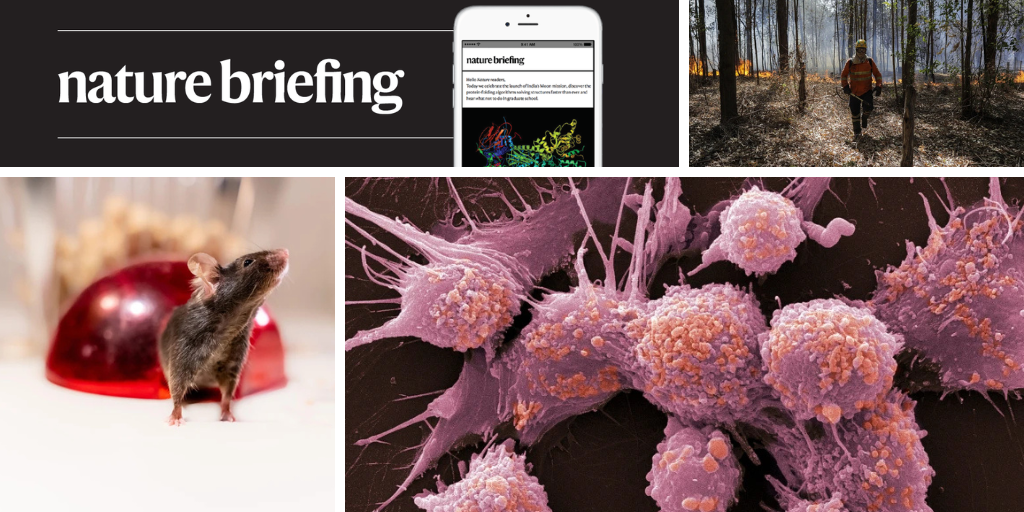
Wildfires ravaged forests in Brazil in 2024, in the wake of the last El Niño, when the country experienced a record drought.Credit: Sergio Lima/AFP via Getty
The strongest El Niño weather patterns in recent decades are forecasted later this year, which could bring floods, droughts and high temperatures. But it’s still uncertain whether winds and other weather factors will either ratchet up ocean heat or temper it — and therefore weaken the possibility of a strong El Niño. Forecasters should know more in the coming weeks, once they get past the notorious ‘spring predictability barrier’.
A genetic analysis has found inconsistencies between the reported names and the actual genetic make up of 47% of lab-mouse strains distributed globally. The mismatches have the potential to compromise the integrity of mouse studies and undermine their conclusions, say scientists. “This study is another wake-up call for biomedical research. If we don’t fully understand the genetics of the mice we’re using, we risk misinterpreting how diseases actually work,” says immunologist Daniel Rawle.
A review by Cochrane, an influential group renowned for its gold-standard medical reviews, suggests that testing for prostate-specific antigen (PSA) “likely reduces the risk of dying” from prostate cancer. The number of lives saved is small, the group found, but the latest finding still marks a reversal of Cochrane reviews published in 2006 and 2013. The most recent findings were driven in part by data from two new trials, encompassing 250,000 people, and extra years of data from four older trials.
Reference: Cochrane Database of Systematic Reviews paper
The US National Institutes of Health has a US$47-billion budget this year — but not the staff that they need to spend it. Many staff members called grants management specialists (GMSs), who handle the administrative aspects of issuing grants, either resigned or were laid off in 2025 by the administration of President Donald Trump as it sought to downsize the federal workforce. The GMS shortage has forced NIH employees to prioritize approving and distributing funds for already-existing grants, which they have a legal obligation to pay out over a certain timeframe, over reviewing new ones.
Question of the week
Should researchers post their raw data sets on open-access databases now that AI algorithms are known to scrape these resources as training fodder? Some want tighter controls to prevent misuse of data, while others argue openness still matters and restrictions won’t stop bad actors anyway. Please take our short survey to tell us what you think. Some responses might be considered for publication in a Nature news story.
Features & opinion
A truck-stop server finds their ticket out of town in The futile beauty of flightless birds and a woman struggles to discern which thoughts are really hers in Serebral.
Nature | 6 min read & Nature | 6 min read
To battle antibiotic resistance, researchers are leaving no stone unturned and harnessing AI to find new antibiotics. Nature filmmaker Nick Petrić Howe went to a remote graveyard in Northern Ireland in the pouring rain to learn how one researcher discovered a source of antibiotic-producing bacteria closer to home — at the grave of a faith healer.
This editorially independent video is part of Nature Outlook: Antimicrobial resistance, a supplement produced with financial support from Meiji Seika Pharma.
Today Leif Penguinson is investigating the Turtle Stone in Sete Cidades National Park in Piauí, Brazil. Can you find the penguin?
The answer will be in Monday’s e-mail, all thanks to Briefing photo editor and penguin wrangler Tom Houghton.
This newsletter is always evolving — tell us what you think! Please send your feedback to [email protected].
Thanks for reading,
Flora Graham, senior editor, Nature Briefing
With contributions by Jacob Smith
• Nature Briefing: Careers — insights, advice and award-winning journalism to help you optimize your working life
• Nature Briefing: Microbiology — the most abundant living entities on our planet — microorganisms — and the role they play in health, the environment and food systems
• Nature Briefing: Anthropocene — climate change, biodiversity, sustainability and geoengineering
• Nature Briefing: AI & Robotics — 100% written by humans, of course
• Nature Briefing: Cancer — a weekly newsletter written with cancer researchers in mind
• Nature Briefing: Translational Research — covers biotechnology, drug discovery and pharma


