



Panel highlights healthcare logistics, emergency response, and disaster resilience as key drone use cases
At the XPONENTIAL 2026 conference in Detroit this week, CVS Health publicly shared new details about “CVS Air Response,” an emerging drone-enabled healthcare logistics and emergency response network being developed with SkyfireAI and Thales Aerospace.
The discussion offered one of the first detailed public looks at a project that panelists said has been under development for several years. Initial deployment operations are expected to begin in Troy in Spring 2026.
The panel featured Josh Wright of CVS Health, Matt Sloane of SkyfireAI, and Sean Roy of Thales Aerospace.
Rather than focusing on retail package delivery, the discussion centered on healthcare logistics and emergency response. Panelists described a long-term vision for a scalable aerial operations network supporting medical transport, disaster response, and community emergency care.
According to Wright, CVS Air Response is focused on three primary mission areas:
- Middle-mile medical logistics between CVS and healthcare facilities
- Disaster response and infrastructure resiliency
- Community emergency response, including AED delivery
Wright explained that the initiative grew from operational challenges surrounding specialty pharmaceuticals and continuity of care during emergencies.
“We move heaven and earth to get those patients their meds when they need their meds,” Wright said.
Disaster Response as an Early Operational Driver
One of the most detailed examples discussed during the session involved Hurricane Helene response operations in Asheville, North Carolina.
Wright said CVS teams used drone-enabled situational awareness and logistics coordination to support Coram specialty pharmacy patients during the disaster.
“For our Coram patients in Asheville, North Carolina, having experienced a once-in-a-generation disaster — their next dose was just a Tuesday,” Wright said. “No change in their patient experience, no change in their medical adherence.”
The comments highlighted how drone systems may provide resilience tools for healthcare providers during infrastructure disruptions, road closures, and communications outages.
Panelists described the concept as more than individual drone flights. Instead, they framed the effort as a broader operational ecosystem combining logistics infrastructure, airspace management, emergency workflows, and scalable deployment systems.
Leveraging Existing Infrastructure
SkyfireAI’s Matt Sloane emphasized that CVS’s nationwide footprint could help reduce barriers for public safety agencies seeking to adopt drone operations.
“CVS has a reason to build this network, and then we can leverage that network to help first responders,” Sloane said. “It’s great for CVS — they’re already there. It’s great for public safety agencies because they don’t have to stand up their own network. And it’s great for citizens because they get access to emergency medical care.”
Sloane also stressed that the effort focuses on repeatable operational systems rather than isolated deployments.
“What’s exciting is the possibility that every fire department and public safety agency doesn’t have to reinvent the wheel every time,” he said.
During the discussion, panelists revealed several operational details that had not previously been discussed publicly. Those included:
- Active flight testing of AED drone payload systems
- Integration with 911 dispatch workflows
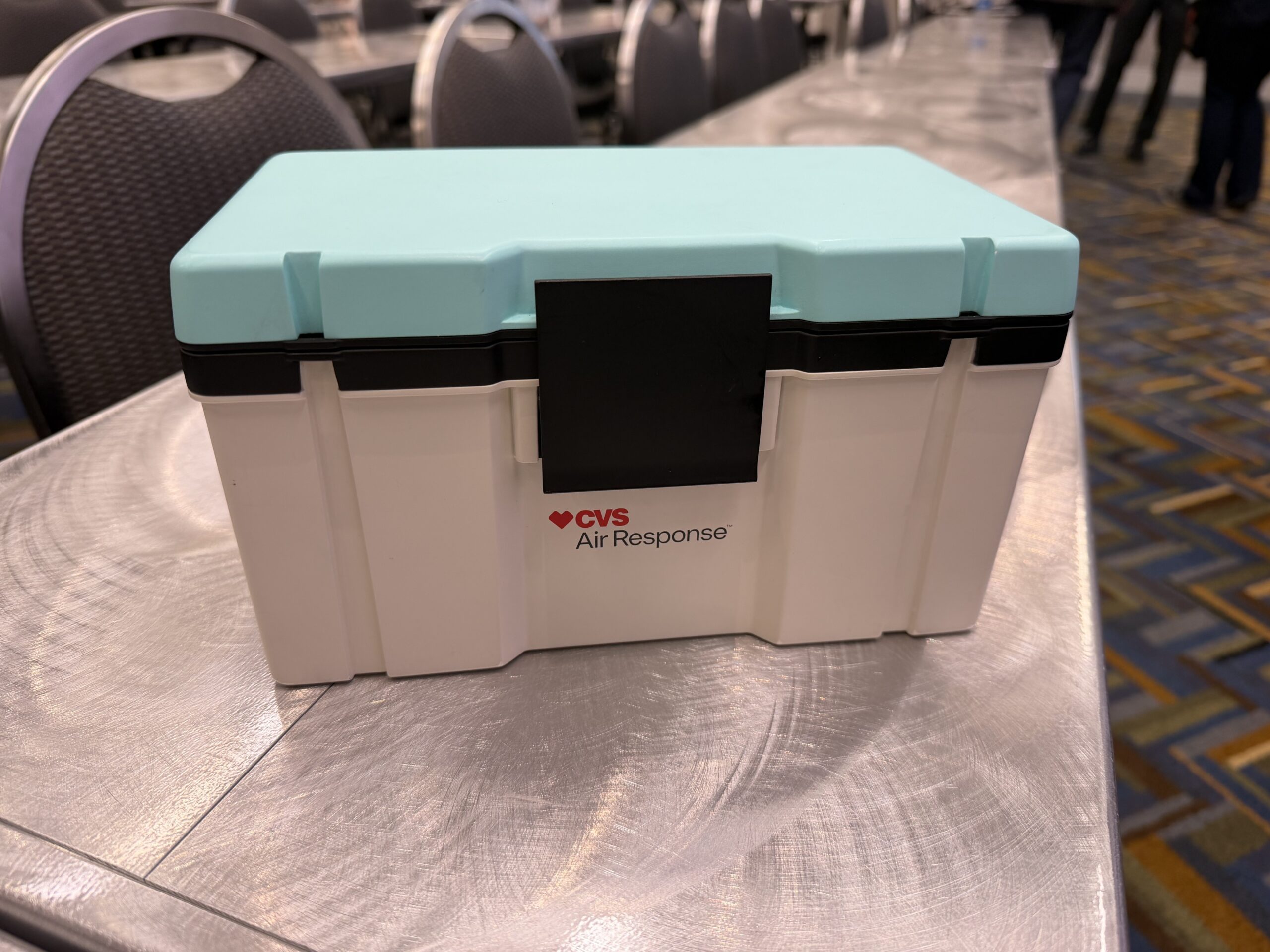
- Temperature-controlled pharmaceutical payload containers
- A patent-pending building integration system using existing pneumatic tube infrastructure at CVS locations
- Future potential for blood transport, organ logistics, and medical device delivery
Supporting BVLOS Operations
Sean Roy of Thales Aerospace discussed the company’s role in supporting airspace integration and operational awareness infrastructure for beyond visual line of sight, or BVLOS, drone operations.
“These operations can be done as safely as possible in different environments — whether it’s the middle of Detroit or a less controlled area,” Roy said. “Our values aligned really well with CVS and Skyfire, and we wanted to be part of helping support the mission.”
The comments reflect a broader trend within the drone industry toward operational scale and integration into existing critical infrastructure systems.
While much of the public discussion around drones has focused on retail delivery, healthcare logistics and emergency response continue to emerge as significant commercial and public safety applications for autonomous aviation systems.
The planned Troy deployment may serve as one of the first operational demonstrations of that model at scale.
Read more:

Miriam McNabb is the Editor-in-Chief of DRONELIFE and CEO of JobForDrones, a professional drone services marketplace, and a fascinated observer of the emerging drone industry and the regulatory environment for drones. Miriam has penned over 3,000 articles focused on the commercial drone space and is an international speaker and recognized figure in the industry. Miriam has a degree from the University of Chicago and over 20 years of experience in high tech sales and marketing for new technologies.
For drone industry consulting or writing, Email Miriam.
TWITTER:@spaldingbarker
Subscribe to DroneLife here.

