


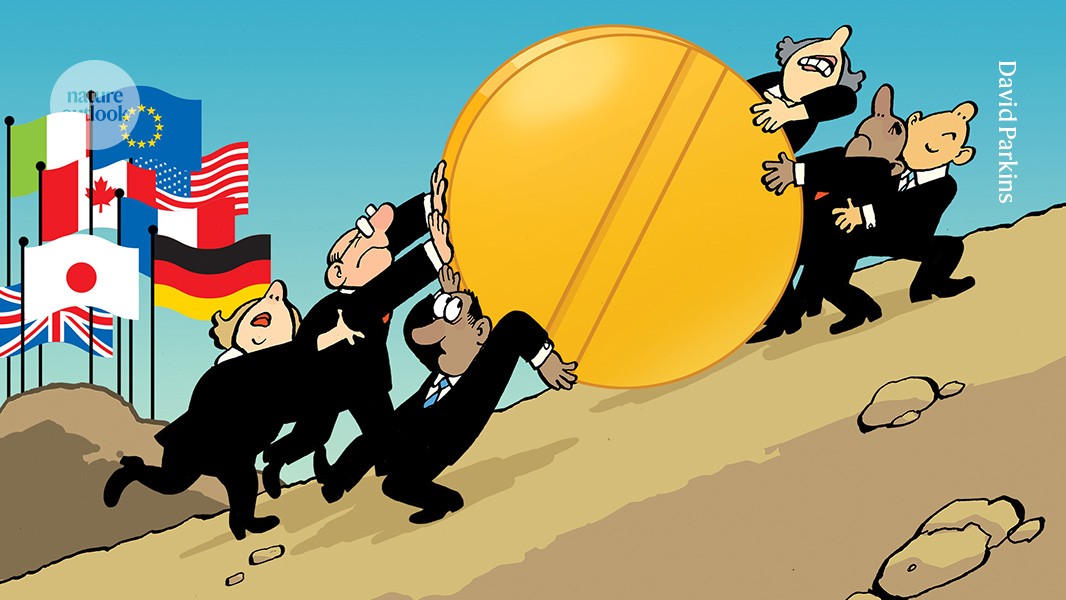

Credit: David Parkins
Antimicrobial resistance (AMR) is an inevitable evolutionary process — resistance will occur, and it will spread globally. We are in a race to maintain a portfolio of effective antibiotics, and we are falling behind.
Creating an antibiotic has become a daunting task. Development is long and expensive, yet antibiotics are used for short durations and sold at relatively low prices. Newly developed antibiotics are often also reserved for use as a last resort, to protect the drugs’ efficacy. This combination of factors makes it difficult for a company to recoup their investment, and has led to an exodus of organizations and scientific talent from antibiotic research and development. The pipeline of drugs has been reduced to a trickle, and deaths resulting from antibiotic resistance are increasing.
To keep pace with AMR, the flawed economic model of antibiotic development must be addressed. Some governments and biopharmaceutical companies have already begun to do so.
Push and pull
Governments can help to remove economic barriers in two ways. The first is by funding the development of antibiotics. Known as a push incentive, the aim is to reduce the cost of research and development for companies.
Nature Outlook: Antimicrobial resistance
One example is the Combating Antibiotic-Resistant Bacteria Biopharmaceutical Accelerator (CARB-X), funded by governments and non-governmental organizations. CARB-X provides funding to companies and institutions during the early, high-risk stages of antibiotic development, and has helped to progress several drug candidates into clinical trials.
The US Biomedical Advanced Research and Development Authority (BARDA) provides push incentives that support development all the way through to drug approval, and in some cases beyond. And the AMR Action Fund, mostly sponsored by the pharmaceutical industry, provides push funding to help companies run clinical trials for promising antibiotics.
The other, even more crucial way that governments can invigorate antibiotic innovation is by creating a predictable and attractive market for antimicrobial drugs. Numerous companies have failed in the early stages of commercializing an antibiotic, when costs are high and revenue is low — not least because their drug might be reserved for use in people with only the most resistant infections. These ‘pull incentives’ can sustain companies through this period.
The UK National Health Service has successfully piloted a pull-incentive programme in which they committed to paying a fixed annual fee for access to two innovative antibiotics, regardless of the volume consumed. This subscription programme, often referred to as a ‘Netflix’ model, is now open to other drug manufacturers.
Shared responsibility
Ideally, the UK model will inspire other governments to implement incentive programmes of their own. AMR is a global problem; the emergence of resistance in one place is felt everywhere. All nations should contribute, but in practice, the highest-income countries will need to take on most of the burden.
One way to estimate how much funding nations should aim to allocate to these incentives is to use gross domestic product (GDP). An analysis conducted last year estimated that, to create one antibiotic, the G7 group of the world’s leading economies and European Union nations should collectively contribute US$363 million annually over a ten-year period to fund pull incentives (M. Goh et al. eClinicalMedicine 88, 103485; 2025). The analysis suggests that the UK subscription model puts the country on track to meet a target proportional to its GDP. Italy, which has implemented another model of reimbursement, also meets the authors’ proposed target.
The return on investment from implementing these schemes would greatly exceed their cost. In 2022, the Office of Health Economics, a research institute in London, estimated that, if G7 and EU countries were to implement pull incentives, they would make back between 11 and 28 times the cost over a 30-year period, mostly in the form of health-care savings (see ‘A price worth paying’).
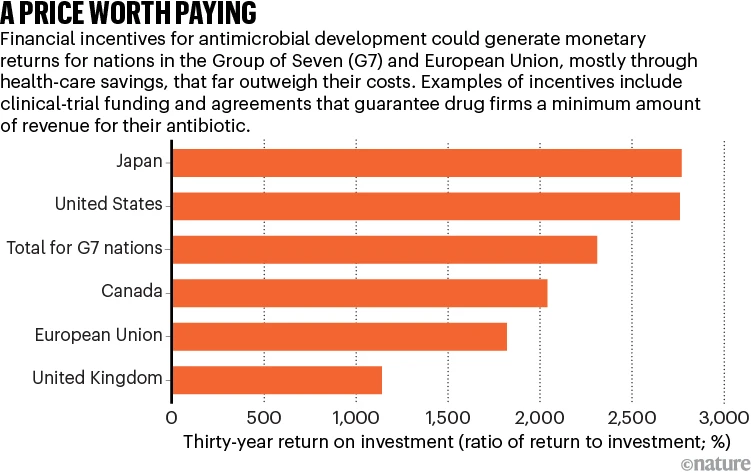
Source: go.nature.com/3pauqcu
The expected economic return for the United States sits at the higher end of that range. In February, the US House of Representatives reintroduced a bill called the Pioneering Antimicrobial Subscriptions to End Upsurging Resistance (PASTEUR) Act. It would establish a pull incentive that guarantees a minimum annual contract value to drug makers. If a company’s US sales revenue falls short of this minimum in a given year, the government would make up the difference. If it passes in its current form, the PASTEUR Act would provide contracts worth between $75 million and $300 million per year.
Policymakers elsewhere are also stepping up to varying extents. The European Parliament has proposed legislation to provide companies that develop antibiotics with ‘transferable data exclusivity’ vouchers that they could use to extend the period of market exclusivity for another drug of their choice. In Canada, the government is planning a pull incentive pilot programme similar to PASTEUR. Sweden and Japan have also developed modest incentive programmes, which ideally will evolve further.
Antibiotic innovation is crucial to keep ahead of unrelenting bacterial resistance. Governments must create an economic environment that motivates biopharmaceutical companies to research, develop and commercialize antibiotics with innovative mechanisms. Some governments have acted. Now, others must follow.
Competing Interests
G.M. is an employee of Shionogi Inc., a company that is engaged in antibiotic R&D and sells cefiderocol.

