


Chantle Edillor 00:08
I believe that the creativity, you know, the uniqueness of the perspectives that I had, you know, it allowed me to identify unique opportunities in subjects that no one was thinking about in that way.
David Payne 00:24
This is Creativity in Science, a series brought to you by Nature Careers…
Chantle Edillor 00:30
There’s a lot of permeability in what I do, you know, for my day job, but also how I like to spend my time on the back end as like a creative pursuit.
David Payne 00:42
…a podcast about how science and creativity go hand in hand, and about how one can nurture the other.
Chantle Edillor 00:52
So I feel like because of my understanding of the science and the microbiology, I was really drawn to the creative side of how to apply these approaches, microbes, techniques.
David Payne 01:08
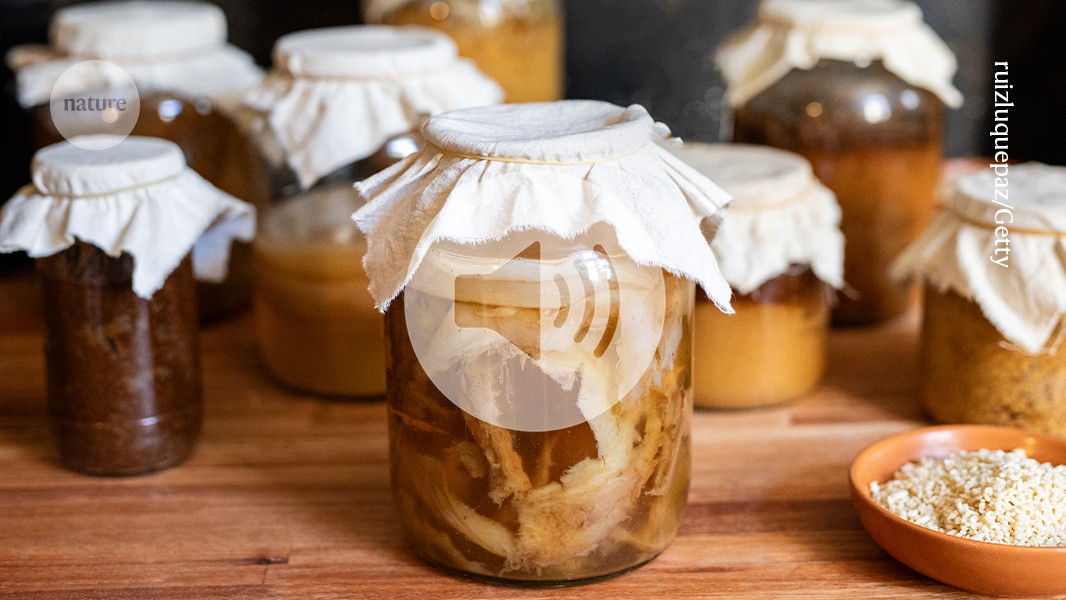
This time, a biologist who has taken sourdough starters and fermented foods to a whole new level of inventiveness.
Chantle Edillor 01:24
Hi. My name is Chantle Edillor. I am based in San Francisco, California, and I am an assay development scientist at Astera Institute, and a fermented food scientist at Microcosm Foods.
My background is in yeast genetics as well as in human and mouse cardiometabolic diseases,
I first became interested in food in general from a very young age. I grew up watching the Food Network on television, where they teach you how to cook and prepare and understand the basic mechanisms of food preparation.
And I have early memories of sitting and watching Food Network with a metal bowl in my lap full of egg whites and a whisk in my hand and attempting to make, you know, stiff peak meringue for the fun of it, but to also understand how proteins capture air in order to create volume and texture.
How to brine a Thanksgiving turkey, and how that influences the osmolarity, the amount of water in, you know, across a membrane.
So there’s always been this scientific tilt to food for me.
Chantle Edillor 02:51
During Covid, during lockdown, I was in the process of writing my PhD dissertation, and I needed to do some mouse experiments, but I couldn’t go into the lab.
I needed to do some cell culture experiments, but I couldn’t go into the lab.
And I’m sure a lot of you know scientists can relate, or people who work with their hands, that, you know, to sit home idly was very difficult.
And so, yeah, I like to say I took my experimental angst, and need to, you know, tinker and play and took it, took it back into the kitchen, right?
Like I feel like that version of me went back to the kid that was sitting on the couch whipping egg whites.
But in this case, it was me in the kitchen of my apartment, like staring at my sourdough starter.
So that really kind of opened up a huge rabbit hole from a scientific perspective.
Because I was looking to figure out what I was going to do next in terms of my research career and trajectory, and I hadn’t quite figured it out, but I knew that I wanted to do something different.
And, and, yeah, this, this exploration in sourdough during Covid really kind of presented an opportunity that I felt uniquely able to pursue.
Chantle Edillor 04:17
A lot of my fermentation projects actually were inspired by the Noma Guide to Fermentation, which I think is a lot of people’s foray into creative ferments.
And so, I feel like because of my understanding of the science and the microbiology, I was really drawn to the creative side of how to apply these approaches, microbes, techniques.
So for things like kombucha, right, which I understand is a community of acetic acid bacteria which gives it that vinegary flavor.
Like, well, what happens if I collect all of the leftover wine from a dinner party? And I add some kombucha to it, you know, I can make red wine vinegar, which, you know, really kind of intrigued me from a, like, decreasing the amount of personal waste and food waste perspective, which is something that I champion very strongly about fermentation, is that it allows food to be preserved.
So we’re wasting, we’re wasting less. And then also we can kind of recycle it or reuse certain components of it to kind of create more value from the food that we eat.
Chantle Edillor 05:43
There are a brand of tortilla chips called Takis. And so one flavour they came out with was called blue heat.
And it’s like this unnatural, bright blue, spicy, cheesy flavour on these, on these tortilla chips.
And so I saw this and decided I wanted to make miso from it.
So I took the bag of tortilla chips, ground it up, added some koji. Koji is typically grown on rice.
You can grow them from spores, but the easiest way is to add rice that has koji on it, kind of blend it all together, and then you leave it for, I think it was probably months, at room temperature.
You know, you cover, you cover it with a little bit of salt and a piece of cling film to try to keep the air out.
You seal it, and then you just leave it.
And the longer you leave it, the more those enzymes will break down starches and proteins, and it will create kind of more complex flavours.
One, it was still spicy. It wasn’t as spicy as when it started. But it was this vibrant, bright blue. It had a bit of that kind of sweet corn flavour.
But because the chips had been deep fried, and fat does not necessarily ferment super well, it had this like off flavour of kind of like oxidized fat. Yeah.
So that was not quite nice. Not going to be commercializing that anytime soon.
Chantle Edillor 07:37
I’ve also done a lot of kind of creative alcoholic fermentations. One of the communities that I love on Reddit is the r/prisonhooch subreddit, which is focused on creating alcohol from the most kind of creative or unexpected substrates.
For example, I saw someone today pitch yeast or so to throw, to kind of throw yeast into a vat of essentially diluted char siu barbecue sauce.
So this, you know, these jarred sweet soy based sauces that you can find in like an Asian aisle or in an Asian grocery store, diluted, added yeast to it, slapped an airlock on it, and you know, I think I’ll try to circle back in a couple weeks to find out what it tastes like.
But in general, these days, the fermentation projects that I feel drawn to are usually based in some kind of creative or sustainable fashion. With the exception of sourdough. I feel like that is the one ferment that I remain kind of a purist about.
Chantle Edillor 09:09
So my academic background as a biologist, I would say, makes me more skilled at producing fermented foods, but also does not necessarily translate.
Yes, in that a lot of the work that I do on the bench requires sterile technique, so being able to not contaminate my cultures brings a heightened awareness to my at-home fermentation projects, because, you know, I have an understanding of cleanliness or spoilage, or the right temperature and conditions in which to promote growth, or stop growth of something.
So I think that that really informs a lot of kind of the dynamics of the fermentation process.
But know, in the sense that studying you know sourdough does not make you a better baker, you know that. To be able to make a high hydration country-style boule, you know, takes practice. It’s an art that not just you know, having a scientific understanding will transfer into that kind of success.
Chantle Edillor 10:25
I don’t really have a separation between, kind of my passion and, you know, my hobbies and my day job.
I’m very aware and cognizant of that. And I would say that’s due to the perspective that I hold, that I am a emergent property of microbes of my gut,microbes. And microbes don’t have nine to fives.
Before I moved to San Francisco, I had a fermentation like a small fermentation lab in in my home. Like a whole separate fridge, a microscope, some incubators, shakers, all the things, which was just for fun for me, just because I was taking up too much space in the main kitchen.
We had back extra kitchen that then became my lab. And then when I moved to San Francisco to start working at Microcosm, we opened a food lab.
So within our we have the biolab.
And then we have a separate food lab and a lot of the same kind of building out of my own personal food lab at home.
I was a one to one of, okay, well, I need incubators, and I need, you know, blenders and, you know, induction, heat plates and, you know, so, yes, there, there’s a lot of permeability in, in what I do, you know, for my day job, but also how I like to spend my time on the back end, as like a creative pursuit
Chantle Edillor 12:02
So what I’m working on now is actually a nice combination of the things I did in my PhD, plus the things I did in my postdoctoral work, which is studying the anti-inflammatory properties of fermented foods.
So inflammation underlies atherosclerosis and heart disease, but also obesity, type two diabetes. Inflammation is kind of responsible for a lot of these dysfunctions in our body.
As well as, you know, the circulating population of of white blood cells.
And you know, we’re now starting to understand the effects of microbial metabolites on human health. So these are the molecules derived by microbes breaking down ingredients in foods.
So what we work on is essentially taking fermented foods, you know, things that you can find at the grocery store, and testing them directly on immune cells that are from humans and see, okay, well, does being exposed to this fermented food actually dampen the signal of inflammation?
Chantle Edillor 13:22
So advice I have for future scientists, from my own experience, is to never let go of that sense of curiosity and playfulness.
For me, those have really been the guiding characteristics in the latter half of my career.
You know, I think I went into my PhD programme really trying to understand something that was both personal to me and then something that I felt was going to make an impact on society.
I believe that the creativity, you know, the uniqueness of the perspectives that I had, that it allowed me to identify unique opportunities in subjects that no one was thinking about in that way.
Or some people had been thinking about, and I was able to go even further.
So I think for me, the best thing that I that I did was really find my niche, to find the people whose work excites my brain and that I want to be around.
But also that I feel most myself around.
You know, science is a community, and you know, I was in a biomedical community, but then I became, then I joined the yeast genetics community, and now I’m in the fermented foods community.
And I’ve learned so much along the way in terms of how each community operates, how things change, how open certain things are, and so in general, the advice that I have is have as many different kinds of conversations with as many different people and scientists as you can
Chantle Edillor 15:12
Yeah, I think there’s a benefit to, kind of being an interdisciplinary scientist, right? Like I’m a human geneticist masquerading as a yeast geneticist, masquerading as a microbiologist.
So I think not being attached to labels, finding your niche and finding your people.
Not being afraid to ask questions, ask for advice.
And I think that there are certain areas of science that are less competitive and more collaborative.
And those are the spaces I like to occupy.

