


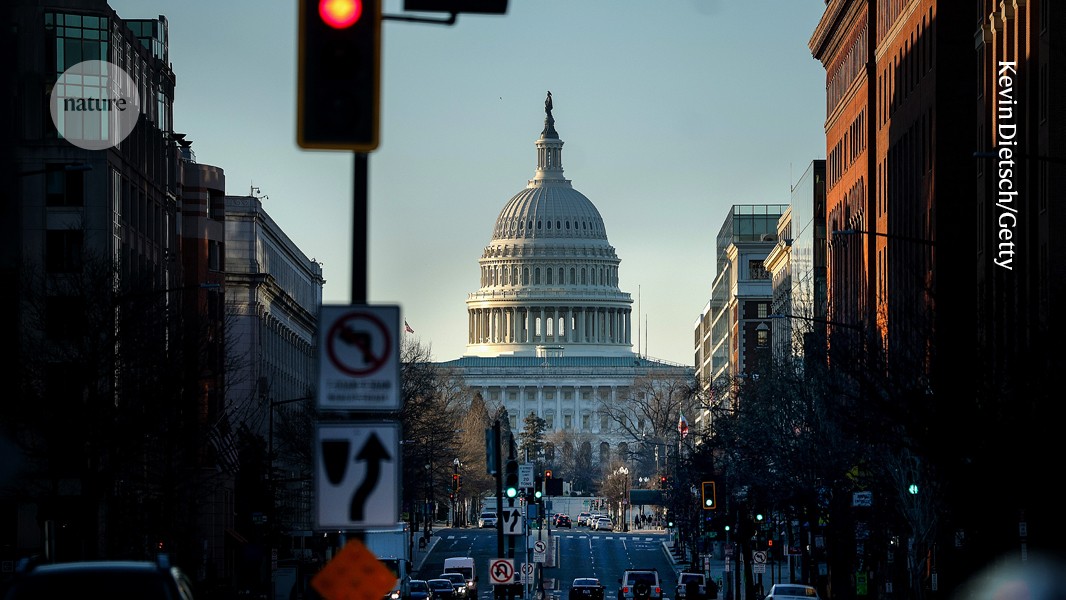

President Trump’s proposal for huge cuts to a number of key science agencies was rejected by a Congressional panel Thursday. Credit: Kevin Dietsch/Getty
Members of the US House of Representatives signaled that they would again reject a proposal by the administration of US President Donald Trump to slash science spending. But the bill advanced by a House subcommittee on Thursday still calls for substantial cuts to science education and spending by agencies such as the National Science Foundation (NSF). The Senate, which also has a say on federal budgets, has yet to schedule a hearing on its own spending bill.
Last year, the Trump administration proposed unprecedented cuts to science agencies in 2026, only for Congress to reject those cuts and instead keep science spending relatively flat. In April, the Trump administration tried again, calling for the NSF’s 2027 spending to fall by 55% from 2026 levels and for the US National Oceanic and Atmospheric Administration’s and NASA’s to fall by more than 27% and by 23%, respectively. According to the administration’s 2027 budget proposal, “every tool in the executive fiscal toolbox has been utilized to achieve real savings”.
On Thursday, members of the House Appropriations Commerce, Justice, Science, and Related Agencies Subcommittee voted to cut the NSF’s spending in 2027 by 20% and NOAA’s by 5% (see ‘Budget divisions’). Subcommittee members also voted to keep the total NASA budget — which covers things like spacecraft development as well as science missions — roughly at its current level. (A separate House subcommittee oversees funding for the National Institutes of Health.)
All eight Republicans voted for the bill, while the six Democrats voted against it, advancing it to the full appropriations committee on 13 May.
“I disagree with this bill’s approach,” said Grace Meng, a Democrat representing New York. “We should be doubling down on the investments in science.”
The bill “right-sizes government while refocusing agencies on their core missions,” said Tom Cole, a Republican from Oklahoma and chair of the full House appropriations committee.
The US Senate will draft its own version of spending legislation in the next few months, and then the House and Senate will hammer out any differences between their proposals. The final spending bill will then be sent to the White House for Trump to sign.
Last year the Senate proposed slightly smaller cuts to science agencies than the House. The final spending numbers were closer to the Senate’s than to the House’s.
A spokesperson for the White House did not respond to questions from Nature about the House bill.
Investing in the future
Although the House bill would maintain overall spending on NASA, it would reduce the agency’s science funding in 2027 to US$6 billion, below its current level of $7.2 billion – but well above the Trump administration’s request for $3.9 billion. Subcommittee members on both sides lauded the recent Artemis II mission to the Moon. “It’s why we continue to support innovation and NASA in this legislation to guarantee we keep making history,” Cole said.
Democrats raised concerns about cuts to science education at NASA and the NSF. “These cuts represent a failure, a failure to invest in the future to ensure that the next generation of world-class engineers, inventors, researchers and technicians are educated here in the United States,” said Rosa DeLauro, a Democrat from Connecticut and ranking member of the full appropriations committee.
Some scientists also objected to the cuts. “If this goes through, then whatever little science we still pay for, NASA won’t be able to tell us about,” Katie Mack, a theoretical astrophysicist and science communicator at the Perimeter Institute in Waterloo, Canada, posted on social media.
Entire NSF science advisory board fired by Trump administration

