


As anyone into luxury would want to do, Sir Henry Royce spent his winters in the French Riviera, eventually buying a villa named La Mimosa in 1911 after a particularly stressful time setting up Rolls-Royce’s factory on Nightingale Road, Derby. Nestled in the hills above Le Canadel, the villa was so spectacular that Royce built two more houses: a design studio called Le Bureau, and a house named La Rossignol (French for “The Nightingale”), where Rolls-Royce’s designers and engineers would also live in the winters. Now that’s a job perk.
La Rossignol lends its name to the first car from Rolls-Royce’s new Coachbuild Collection program, which will create series of exclusive models that are invite-only for the company’s most “discerning and design-literate” customers, who are “a growing community of passionate clients who seek Rolls-Royce design at its most ambitious and uncompromising.” Basically all of Rolls-Royce’s buyers do some sort of customization to their cars, with more customers than ever wanting bespoke creations that are like rolling works of art — thus why the brand’s Goodwood facility has doubled its footprint. In recent years Rolls-Royce’s has created some extremely rare coachbuilt models, like the $30-ish-million Boat Tail and Droptail, but these new Coachbuild Collection cars will be a bit more common — as in, there will be 100 of these instead of just three or four, and they will probably cost a mere seven figures.
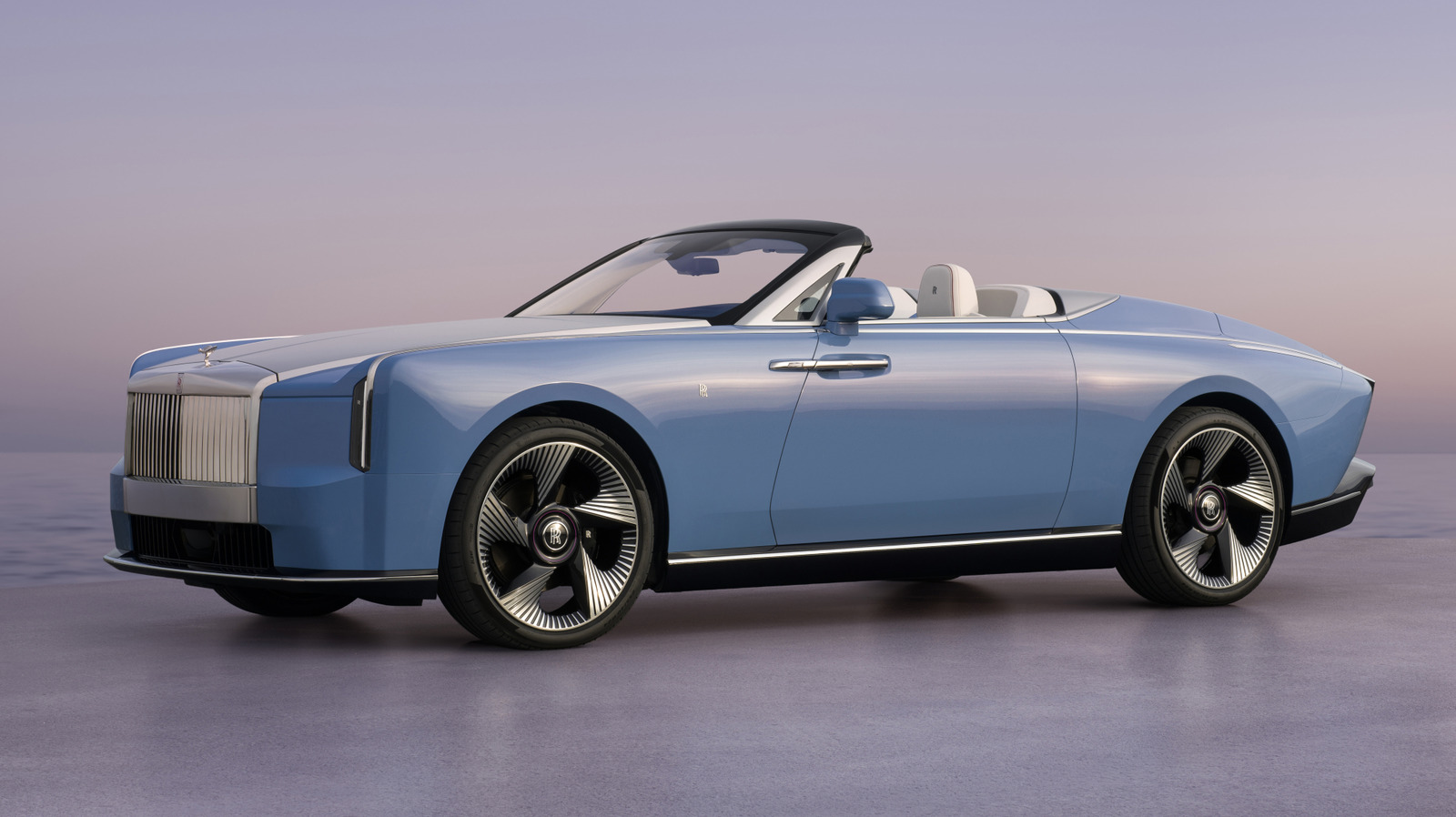
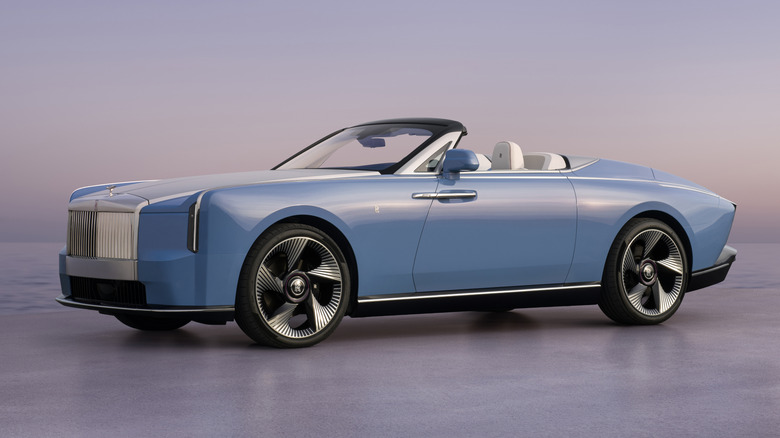
The new car is called Project Nightingale, and it’s pretty astounding. I think this is Rolls-Royce’s wackiest car design in years, and I mean that in the best way. It’s an electric two-door convertible the size of a Phantom with chrome freakin’ tail fins. How could you not love that?
Pulling from the past
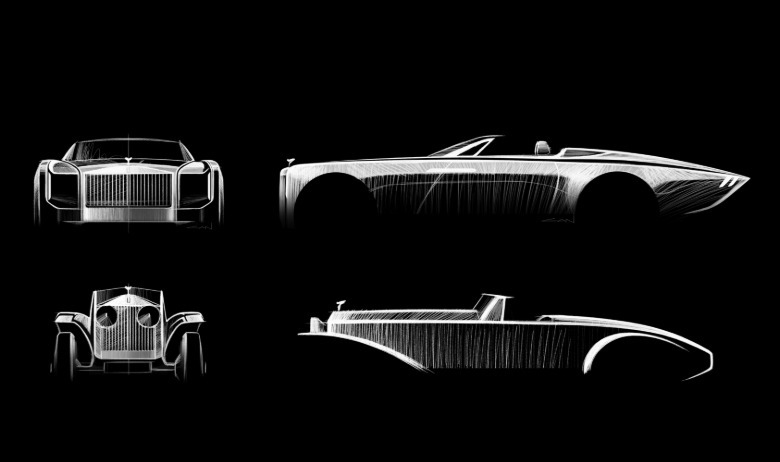
Rolls-Royce says that while the Nightingale you see here is a “production concept,” as the company will start global testing and validation this summer ahead of deliveries in 2028, the design is essentially locked, with only a few details that “demand entirely new manufacturing techniques that are currently under development.” Its overall design was inspired by the Art Deco era, and Rolls-Royce’s experimental models from the 1920s, specifically the 16EX and 17EX that, like the Nightingale, also wore red badges.
 Rolls-Royce
In 1928 those two cars’ torpedo-shaped bodies got them to speeds of more than 90 mph, and they birthed three principles for the Nightingale: the Pantheon grille’s commanding vertical gesture that flows into a graceful rear end, a central fuselage with an unbroken front-to-rear hull line, and flying wing surfacing that creates tension and draw your eye to the back of the car. Rolls-Royce says the Nightingale nails those three marks “in a way that is both familiar to those fluent in the Rolls-Royce story, yet unapologetically contemporary and unlike anything before it.”
Project Nightingale sits on the same Architecture of Luxury platform as every other new Rolls-Royce, and it really is massive. We don’t have full specs yet, but the company says it’s 18.9 feet long, or about 226.8 inches, which makes this two-door almost identical in length to a short-wheelbase Phantom, and a whole foot longer than a Spectre coupe. For a bit of perspective, the wheels are 24 inches, Rolls-Royce’s biggest ever. And unlike a Spectre, the Nightingale only seats two.
The grille is a meter wide
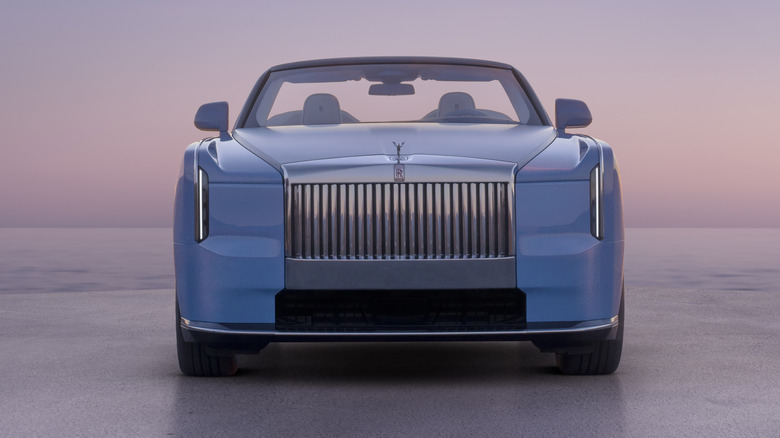
The company went with a fully electric powertrain instead of a V12 partially because that makes it as quiet and comfortable as possible, but also because of the design freedom it allows. (Rolls’ customers do love their EVs, and actually drive them, too.) With no need for big cooling intakes the designers “achieved unprecedented expanses of uninterrupted surfacing” between the outer edges of the grille and the corners of the front fenders, which is especially impressive given how the grille surround is almost a meter wide. There’s 24 veins in the grille, and the Spirit of Ecstasy hood ornament is mounted in a recessed section on top the grille surround, like on a Phantom.
Art Deco skyscrapers had decorative floors supported by geometric forms, which Rolls-Royce says informed the way the grille appears to float above structural section below that widens at a 45-degree angle, with a carbon-fiber lip jutting out below. But the most striking aspect of the front end are the ultra-slim vertical headlights that lie in the leading edge of the peaked fenders, with a contouring stainless-steel strip that runs all the way back to the taillights.
Jeez, that’s long
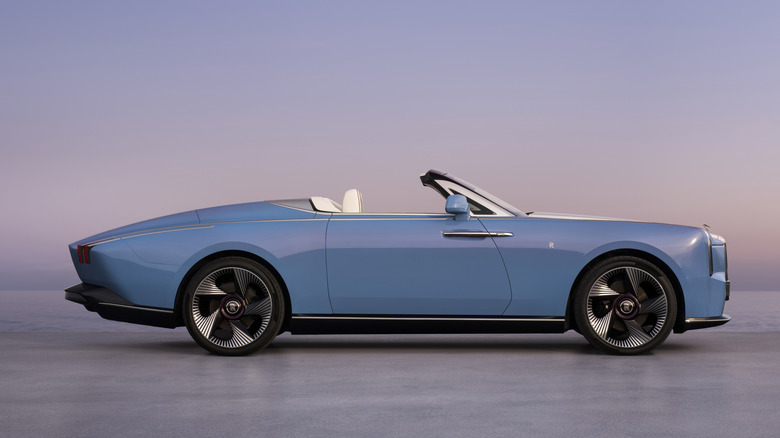
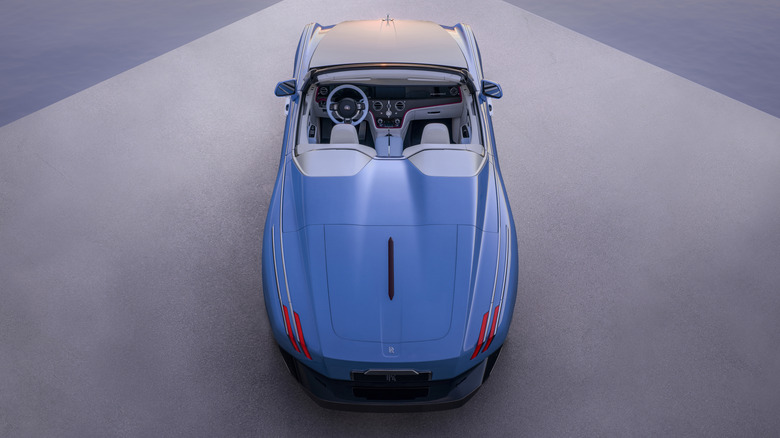
Its hood looks absurdly long, and I really hope there’s some sort of storage or other interesting thing under there, as the Spectre has no frunk at all. The windshield looks more steeply raked than any other recent Rolls-Royce, and its stainless-steel frame houses triangular quarter lights like on the old Phantom Drophead. The company didn’t take many risks when it came to the surfacing of the Nightingale; it has the same lower crease as a Spectre, soft wheel arches, carbon-fiber side skirts that obscure the battery pack, and an intentionally tall beltline. There’s a small double-r badge ahead of the doors, and the coach doors’ handles were redesigned with “a hidden lock mechanism and a discreetly integrated indicator lamp” to further declutter the exterior.
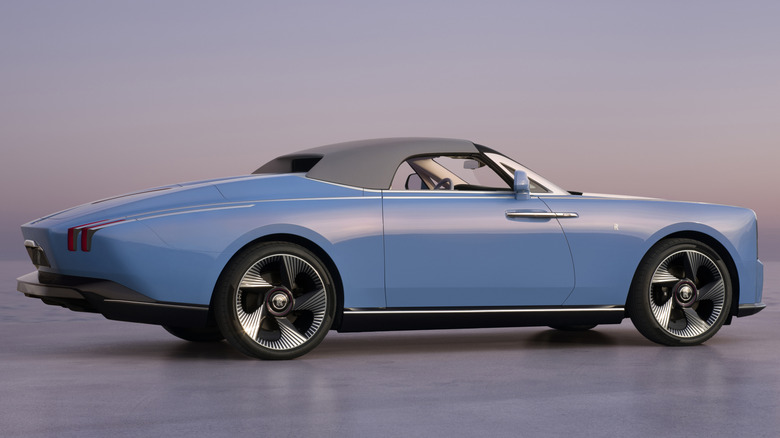
Later in the Dawn convertible’s run Rolls-Royce offered an aero cowling option that covered the rear seats, and the Nightingale is an evolution of that to a much bigger degree. Two fairly subtle fairings behind the seats flow into the long deck, coming to a tapering point at the rear, and the way they enclose the cabin is like the collar of a dress shirt. The trunk opens sideways on a cantilever, like the top of a grand piano. While the Boat Tail and Droptail had to rely on huge, fixed roofs, the Nightingale actually has a powered soft top:
With it raised, the character transforms entirely, creating a commanding, coupe-like presence. Within the roof itself, a unique sound-deadening material combines cashmere, fabric, and high-performance composites. Paired with Rolls-Royce’s fully electric drivetrain, which generates virtually no mechanical noise, the marque’s acoustic engineers aim to achieve an exceptionally serene experience whether the soft top roof is raised or lowered, while still preserving the sounds that enhance the romance of driving — such as raindrops on canvas.
The near-silent sensation of driving even early Project Nightingale prototypes with the roof lowered is described by Rolls-Royce designers and engineers as akin to traveling by sailing yacht. The fully electric drivetrain generates virtually no mechanical noise, and wind noise is all but eliminated: What remains is the world itself — the sound of ocean waves breaking on the shore, the movement of air through trees, the silence of open countryside at speed, the chorus of birdsong.
Fins!
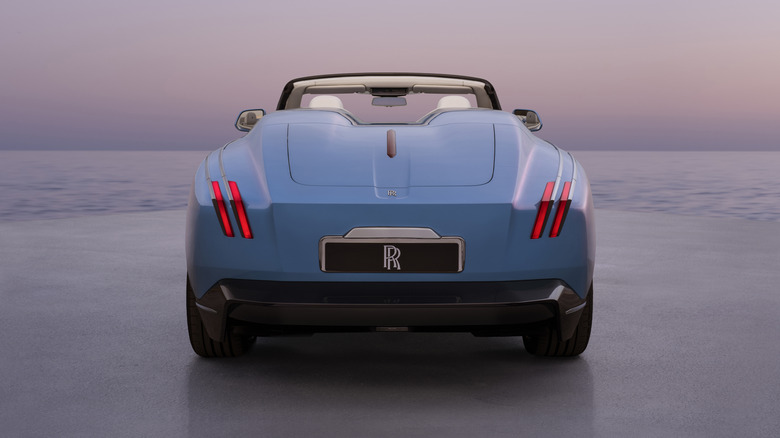
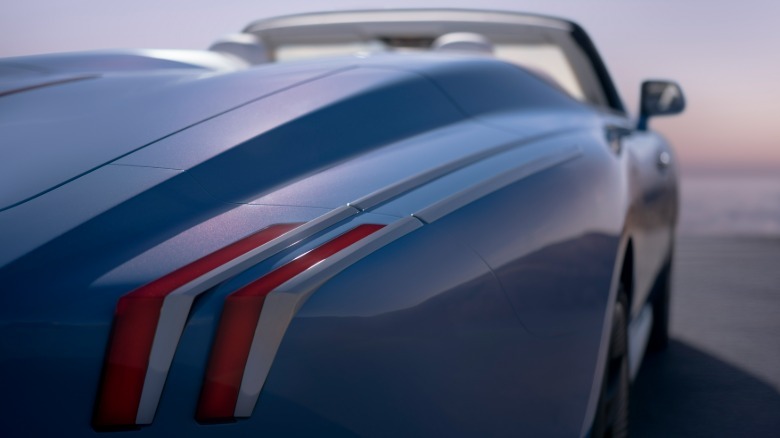
The rear end is the Nightingale’s real reason for existing. Those stainless-steel hull lines extending from the headlights end in what could only accurately be described as tail fins, coming to a raised point with an integrated taillight at the end. Just behind the center of the rear wheels, a second metal line grows back into a second taillight, and the CHMSL is a long line down the center of the deck. Rolls-Royce says this treatment is a nod to “the gentle white water of a sailing yacht’s wake.” Man, rich people really love boats, and things that remind them of boats. Case in point, the directional wheels are inspired by yacht propellors, with machined stripes like old wire wheels at speed and aluminum flakes on the black finish for some added sparkle while in motion.
 Rolls-Royce
The back edge of the rear end is shaped kind of like the Pantheon grille and its surrounding bodywork, and below that contour the tail dramatically drops back down at a steep angle, with the license plate surround set into the lower section like a watch bezel. Below that, and only existing because there’s no exhaust, is a carbon-fiber transom diffuser that Rolls-Royce calls the Aero Afterdeck, which increases high-speed stability without the need for a spoiler.
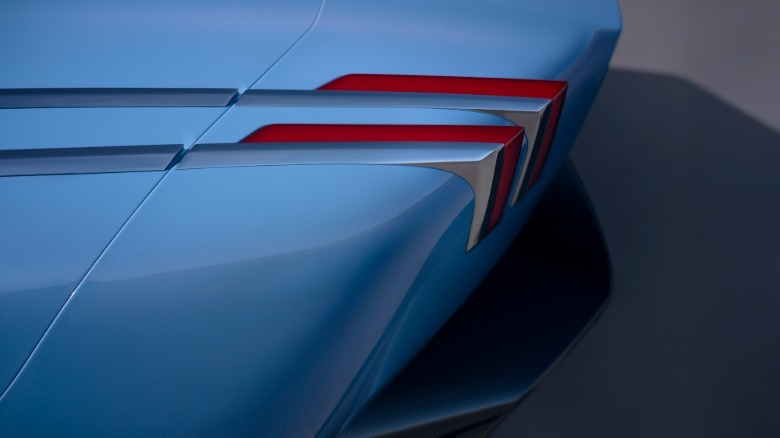 Rolls-Royce
This is another paragraph that exists just so you can look at another photo of the taillights. Rolls-Royce isn’t the first company to do a tail fin sort of thing on a modern car. Lexus did it with the UX, Cadillac’s latest EVs definitely have fin–esque taillights, and other automakers are doing some wacky angular lights. But I think this is the first new car where you can undoubtedly say, “damn, now that’s a tail fin!” As you’d hope from their names, the Boat Tail and Droptail had pretty impressive butts, but this is my favorite one yet, even though it lacks the wood-paneled deck of its more expensive siblings.
10,500 stars
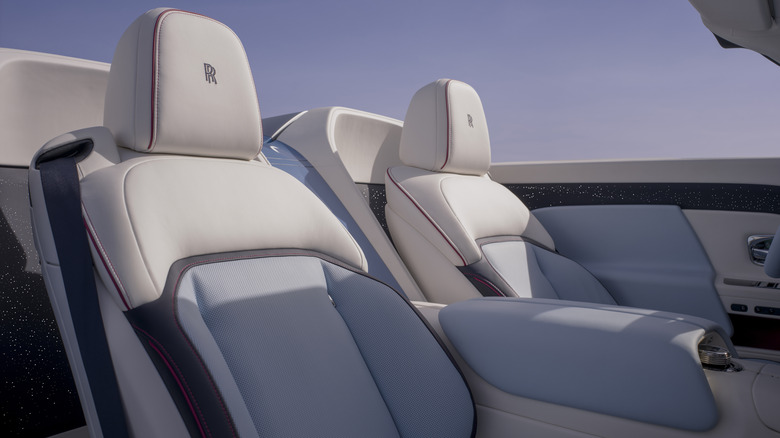
We already went over how quiet the car is with the top up, but that serenity (and the Nightingale theme) was the basis for the whole interior design, including how Rolls-Royce would handle its now-signature fiber-optic starlight trim feature:
During an early prototype drive, Rolls-Royce designers were able to hear birdsong with unusual clarity. Intrigued by this experience — and in tribute to the motor car’s name — they began studying recordings of nightingales and analyzing the distinctive sound-wave patterns created by their song. From these studies emerged an idea: to translate the rhythm of birdsong into a visual form that could envelop those within the motor car.
The result is the Starlight Breeze suite — a flowing constellation of ambient illumination comprising 10,500 individual ‘stars’ in three subtly varied sizes. Named after the gentle movement of air suggested by the nightingale’s song, the pattern of light draws directly from the sound-wave forms studied by the designers. Extending from the front of each door around the driver and companion’s seat, the illumination wraps those within in their own celestial field, transforming melody into light.
The Starlight Breeze looks phenomenal, and it’s even found on the sculptural “horseshoes” that envelop the seats and create the shape of the cowling. Too bad Rolls-Royce hasn’t seemed to figure out how to put stars in convertible tops yet. I’m sure some elves at the factory are working hard on developing that. While they’re at it, I want to see this sort of vibe but inspired by whales.
Inspired by saddles
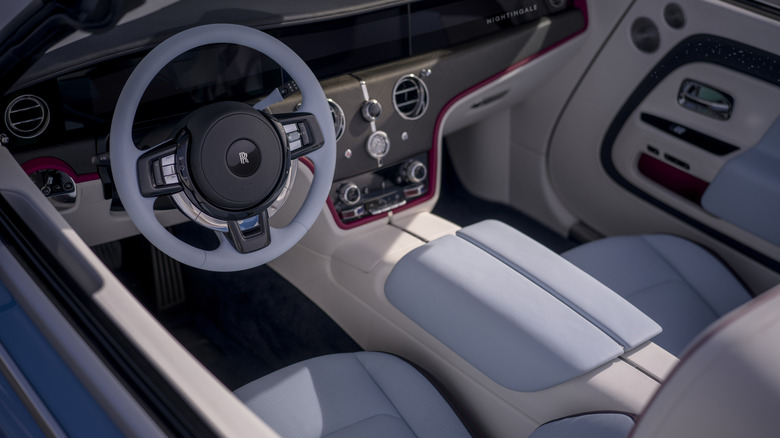
The armrests look like expensive horse saddles, and the split center console aligns with the coachline the runs from the center of the hood back to the third brake light. When the doors are opened the center armrest automatically slides back to expose the rotary controller for the infotainment system, which itself is a piece of jewelry:
It is operated with an exceptionally tactile aluminum collar formed with four grooves reminiscent of contemporary haute joaillerie. Within each groove, the metal is faceted and then glass-blasted, delicately subduing the controller’s high polish. This jeweled treatment extends throughout the interior to the gear selector and remaining rotary controls, which are sparingly curated to just five in total.
It can move even further back to reveal storage for your weed or precious gems, and there’s a hidden storage shelf for luggage behind the seats. You even get cupholders machined from billet aluminum. While it’s not mentioned in Rolls-Royce’s release, it sure looks like there’s a fancy watch integrated into the dashboard, which has been a feature of previous coachbuilt models. I’m guessing the customers will be able to pick exactly what sort of watch they want.
It will influence all future Rolls-Royces
Rolls-Royce says Project Nightingale’s color and material palette, as well as its “set of bespoke features,” have been designed for this car specifically and will not be available on any other Rolls. Each one will be designed with the chosen client to reflect their tastes, and god do I hope some of those people have really out-there tastes. Here’s what Rolls-Royce says about the buyers it’s going after with Project Nightingale:
Project Nightingale and the Coachbuild Collection program have been crafted for aesthetes — individuals for whom beauty is both observed and lived. These clients are connected by a shared conviction in the primacy of Rolls-Royce design, the value of the most considered motor cars in the world, and a deep appreciation for experiences that only Rolls-Royce can offer. Clients are already participating in a multi-year program of gatherings and moments curated by Rolls-Royce, immersing them in the creative and technical formation of their motor car, as well as private events in the world’s most desirable destinations.
People love to talk about how us auto journalists are on automakers’ payrolls, but I can tell you we’re definitely not doing that. Though Project Nightingale is limited to just 100 cars, its design language will inform future Rolls-Royces, with director of design Domagoj Dukec (who used to lead BMW design) saying the Nightingale “feels both inevitable and completely unexpected, and it will shape everything that follows.”
There will certainly be more Coachbuild Collection models in the future, and while I’d bet most of them will be EVs, we know Rolls-Royce is sticking with its V12 engine for a while longer. But likely the next Rolls-Royce we’ll see wearing similar design cues to the Nightingale will be an electric SUV, seen in the embedded post above, that has been spied a lot recently. It could be a next-generation Cullinan or a new model entirely, but through the camouflage we can already see features like peaked front fenders and radical (for Rolls) headlights. The Phantom is due for a full redesign soon, too. I can’t wait to see what Rolls-Royce’s designers cook up for that one.

