


New release combines mission execution and intelligent supervision in a single autonomy platform
Teledyne FLIR OEM has announced an upgrade to its Prism SKR software, expanding its role from automated targeting to a unified autonomy platform for defense applications. The update brings mission execution and intelligent supervision together in one system designed for guided weapon platforms.
The April 7 announcement positions Prism SKR as a closed-loop autonomy solution. It supports a range of systems, including loitering munitions, air-launched effects, counter-UAS platforms, interceptors, and FPV drones.
Expanding from Targeting to Full Mission Autonomy
The upgraded Prism SKR software manages the full mission lifecycle. It handles tasking, execution, and tracking through perception-based automatic target recognition (ATR). The system focuses on maintaining accuracy in contested environments.
A key feature is pixel-lock targeting. This capability supports the final phase of FPV drone missions, where signal loss often limits manual control. The system maintains target focus during this critical stage.
“The upgraded Prism SKR represents a significant leap forward by unifying execution and intelligent supervision to provide operators with greater mission confidence,” said Jared Faraudo, vice president of product management, Teledyne FLIR OEM. “By integrating advanced mission scripting with support for AI-accelerated development and execution compatible with large language model (LLM) tools like GitHub Copilot, we are enabling developers to plan and task systems at the speed of intent, while the QgroundControl plugin ensures these capabilities fit naturally into existing operator workflows.”
New Features Support Complex Mission Scenarios
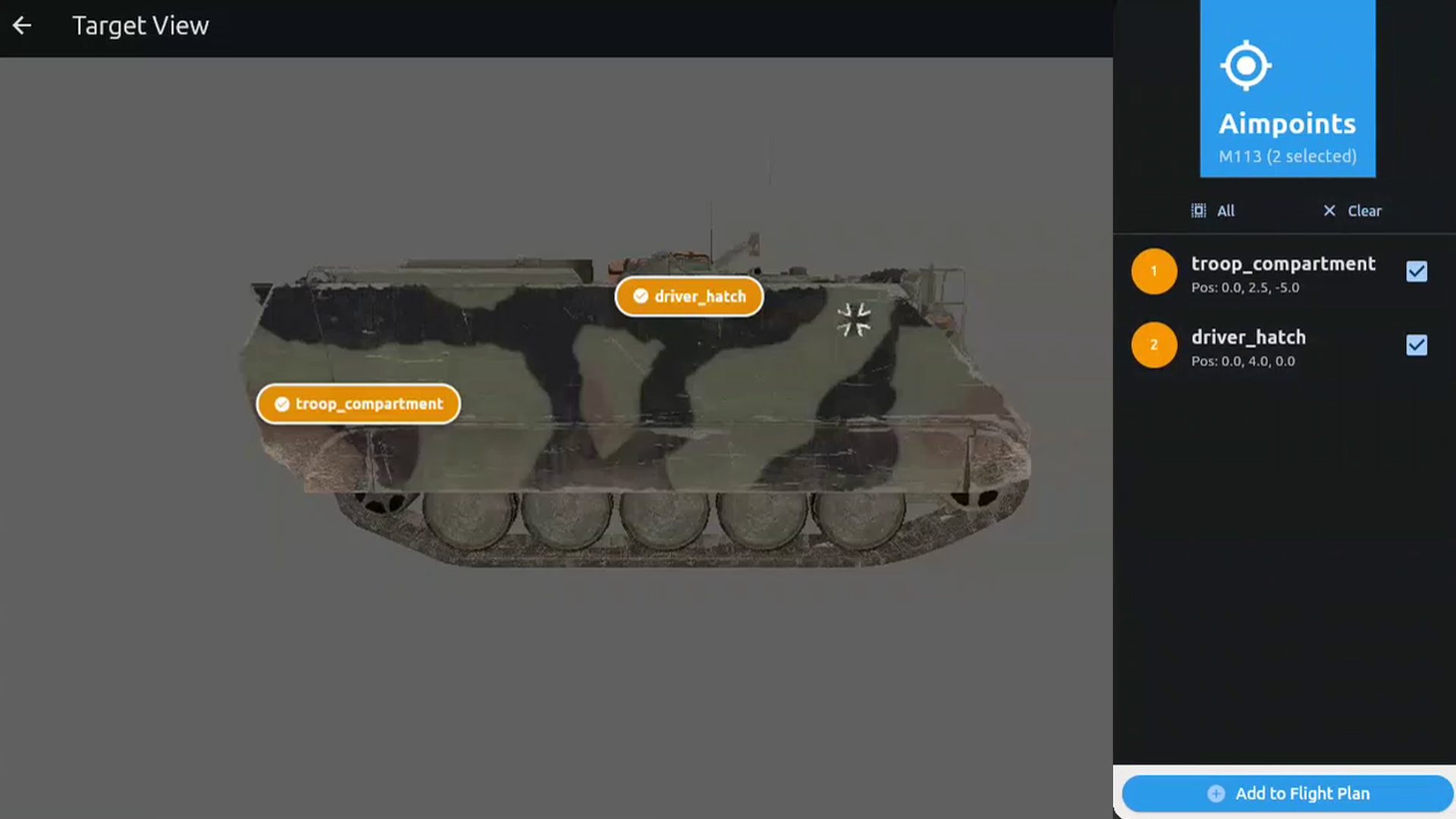
The update introduces several new tools designed to improve mission flexibility and reliability. These include 3D interactive aimpoint selection and terrain-aware operations.
The system also improves persistent re-identification tracking. This feature allows the software to maintain awareness of a target even when signals degrade or drop. It supports a range of operational scenarios, including air-to-ground, air-to-air, and ground-based engagements.
The platform scales from assisted AI control to full autonomy. This flexibility allows operators to transition between manual and autonomous modes as needed.
Built for Edge Deployment and Rapid Integration
Prism SKR runs on low-power embedded systems at the edge. It supports platforms such as NVIDIA Orin and Teledyne FLIR OEM’s AVP module based on Qualcomm technology.
The software aligns with Weapon Open Systems Architecture (WOSA) standards. It integrates with infrared cameras such as Boson and Neutrino, as well as visible sensors selected by integrators. This setup enables real-time tracking and system awareness.
A full API and software development kit support customization. These tools help reduce development risk and speed up deployment timelines for OEM partners.
Context: Growing Demand for Autonomous Targeting Systems
The update reflects broader trends in defense and uncrewed systems. Operators are seeking greater autonomy to maintain performance in contested environments. Signal disruption, electronic warfare, and complex terrain all increase the need for onboard decision-making.
Platforms that combine sensing, tracking, and execution in a single system may reduce operator workload. They can also improve reliability in missions where communication links are limited.
As defense programs continue to explore scalable and modular systems, software platforms like Prism SKR may play a larger role in enabling autonomy across different vehicle types.
For more information, visit the Teledyne FLIR OEM website.
Read more:

Miriam McNabb is the Editor-in-Chief of DRONELIFE and CEO of JobForDrones, a professional drone services marketplace, and a fascinated observer of the emerging drone industry and the regulatory environment for drones. Miriam has penned over 3,000 articles focused on the commercial drone space and is an international speaker and recognized figure in the industry. Miriam has a degree from the University of Chicago and over 20 years of experience in high tech sales and marketing for new technologies.
For drone industry consulting or writing, Email Miriam.
TWITTER:@spaldingbarker
Subscribe to DroneLife here.

