


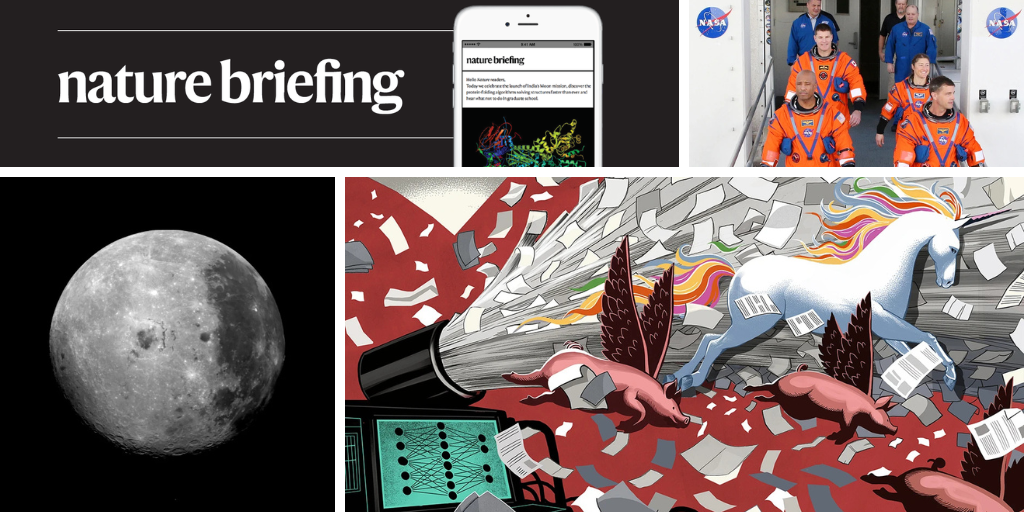

The four Artemis II astronauts did a dress rehearsal in December for what will happen on launch day. Clockwise from front left are pilot Victor Glover, mission specialist Jeremy Hansen, mission specialist Christina Koch and commander Reid Wiseman.Credit: Gregg Newton/AFP via Getty
If all goes to plan, later today NASA will launch four people on a journey around the Moon. Some of the key experiments that will be conducted during the mission will explore how deep-space travel affects human health. For example, researchers will place cells from each Artemis II astronaut onto an ‘organ on a chip’ to test their reaction to deep-space radiation during the flight. Other research will rely on the astronauts’ ability to spot geological features on parts of the Moon that have never been seen first-hand before. (Apollo astronauts travelled much closer to the surface, limiting their view.) “The amazing part of having crews is they have brains and eyes, and the capacity for thought and reaction,” says planetary scientist Barbara Cohen.
What do you want to know about the Artemis mission? Tell us using this form, and we’ll aim to answer top questions in our coverage.
“On the science side, this is one of the first steps in a very long-term plan to get a human base on the Moon,” says Catherine Heymans, the Astronomer Royal for Scotland. As such, some scientists aren’t that excited about what’s more of a test flight than a scientific mission. Others say they find it hard to rejoice, given the political context and the state of science funding in the United States. And some scientists are just not that interested in putting people in space. “Almost all of the science gets done, for a tiny fraction of the cost, by the [uncrewed] missions,” says quantum computing theorist Scott Aaronson.
Firsts and farthests
• The first crewed mission beyond low-Earth orbit since Apollo 17 in 1972.
• Victor Glover will be the first person of colour to travel farther than low-Earth orbit.
• Christina Koch will be the first woman to do so.
• Jeremy Hansen will be the first non-US citizen to do so.
• The crew might fly around 7,000 km beyond the Moon, the farthest that people have ever been from Earth.
• The first time some parts of the far side of the Moon will be seen with human eyes.
• The first launch of the Space Launch System, the most powerful rocket that NASA has ever built, with people on board.
Plus, at 50 years young, Reid Wiseman will be the oldest person ever to have travelled beyond low-Earth orbit.
Quote of the day
Canadian Space Agency astronaut Jeremy Hansen experienced a four-day vision quest with elders in Sagkeeng First Nation, in which he pondered how to feel happy when there is so much suffering. (The New York Times | 17 min read)

