



The past three years have been the warmest recorded on Earth.Credit: Raj K Raj/Hindustan Times via Getty
The rate of global warming has surged since 2015 and is now nearly double what it was in the 1970s, according to a study1 that tackles one of the hottest debates among climate scientists.
Because the past three years have shattered temperature records (see ‘Temperature boost’), researchers have been exploring whether global warming is accelerating, and if so, why. Many scientists agree that the rate at which it is increasing has picked up. This is mainly because of a reduction in air pollution following the introduction of fuel regulations for international shipping (which has resulted in fewer pollutant particles that reflect sunlight into space and seed insulating clouds). In the data, “you can practically see by eye that it has accelerated”, says Stefan Rahmstorf, a climate scientist at the Potsdam Institute for Climate Impact Research in Germany.
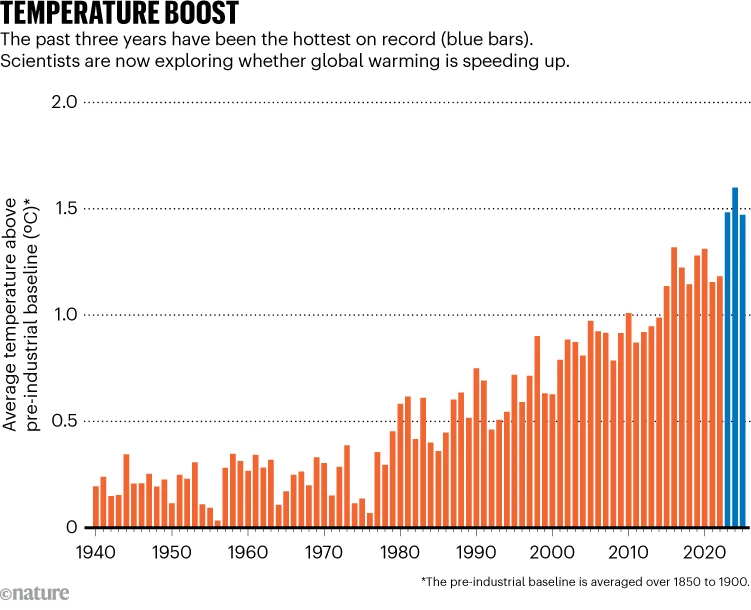
Source: Copernicus Climate Change Service/European Centre for Medium-Range Weather Forecasts.
Rahmstorf and Grant Foster, a statistician in Orono, Maine, say they have the strongest evidence yet that global warming has sped up, to a rate of around 0.35 ºC per decade. That’s faster than some other estimates2. But, the pair say their analysis captures a more accurate picture because of the way it accounts for and removes the effects of natural factors, such as weather events and volcanic eruptions, that cause climate fluctuations. The study was published today in Geophysical Research Letters1.
Accounting for nature
The analysis removes the impact of the powerful El Niño weather phenomenon that contributed to record-high global temperatures in 2023 and 2024. Even with that subtracted from the data, the acceleration of warming is clear, Rahmstorf says. Their research took five of the most widely used global temperature data sets into consideration, including one produced by NASA (see ‘Rate hike’).
Global temperatures have been soaring as people burn fossil fuels and release heat-trapping gases into the atmosphere. By 2030, the planet is on track to breach — and stay above — the threshold of the 2015 Paris agreement: 1.5 ºC above pre-industrial levels, Rahmstorf says.

Source: Ref. 1.
Other studies have also argued that global warming is accelerating3. One commonly cited estimate holds that the rate of change is now 0.27 ºC per decade, compared with around 0.20 ºC per decade in the 1970s2.
Not everyone agrees with the latest estimate of a rate of 0.35 ºC per decade. Climate scientist Zeke Hausfather at Berkeley Earth, a non-profit organization that tracks global temperatures, in Berkeley, California, says the authors’ methods for removing natural fluctuations are “imperfect and will leave some remaining effects”. Robert Rohde, chief scientist at Berkeley Earth, says he estimates that the current warming rate is more like 0.30 ºC per decade.
Still, Hausfather and Rohde note that most climate scientists agree that warming is indeed accelerating, emphasizing the urgency of addressing climate change. “We have to really prioritize emissions reductions — we have even less time now that the rate of warming has accelerated,” Rahmstorf says.

