


You have full access to this article via your institution.
Hello Nature readers, would you like to get this Briefing in your inbox free every day? Sign up here.

Credit: Darren Staples/AFP/Getty
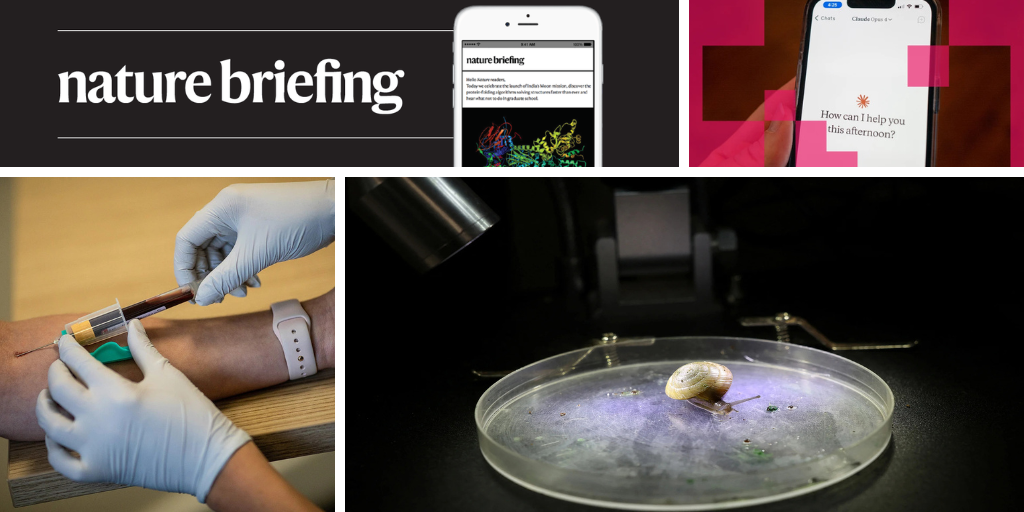
Under a microscope at Chester Zoo, UK, a greater Bermuda snail (Poecilozonites bermudensis) awaits its journey home. This button-sized species was once thought to have vanished from its native habitat in Bermuda, until a small surviving population was discovered in an alleyway in the capital, Hamilton, in 2014.
See more of the month’s sharpest science shots, selected by Nature’s photo team.
You might have heard of blood tests that promise to detect the early signs of many types of cancer, or to provide the reassurance of an all-clear — one was even advertised during American football’s Super Bowl last month. But few of the approximately 40 such tests that are either in development or already on sale have been through randomized controlled trials, and none has yet received approval from regulators. Critics point out that the tests fail to detect many early cancers, and that the downsides of false diagnoses for many people might outweigh the benefits for a few. “I don’t think we’re anywhere close to ready for widespread adoption, but it’s an exciting technology,” says public-health physician Tom Callender. “If we do it properly, [it] could be an important part of the mix in the future.”
All major large language models (LLMs) can be used to either commit academic fraud or facilitate junk science, a test of 13 models has found. Some were harder to coax into mischief than others: the most resistant to prompts about committing fraud was Anthropic’s Claude. xAI’s Grok, and early versions of OpenAI’s GPT, performed the worst. “The most important thing that developers can learn is that guard rails are easily circumvented,” says biomedical scientist Matt Spick, who has studied the surge in low-quality papers linked to LLMs “Especially when developers are creating LLMs that tend towards a simulation of being ‘agreeable’ to encourage user engagement.”
Features & opinion
Last month, the US Environmental Protection Agency rescinded the finding that the Clean Air Act obliges the agency to act to limit the harm caused by greenhouse-gas emissions. But rescinding the ‘endangerment finding’ does not change the very real danger, writes climate-policy leader David Widawsky. Lives and livelihoods are put at risk as climate impacts threaten homes, damage health and push up prices for people and businesses. Meanwhile, “moving away from science threatens US leadership on every issue for which credibility matters”. Widawsky calls on cities, states and businesses to keep pushing for progress despite the headwinds.
Almost every person that ever lived has shared a spectacular view of the stars — until now. Ed Krupp, the director of the Griffith Observatory in the megacity of Los Angeles, remembers that people were “unsettled” by seeing the night sky in all its glory during a blackout that followed the 1994 earthquake. “It just goes to show the bankruptcy of our astronomical experience,” he says. Research has shown that light pollution has increased the average sky brightness in North America and Europe by 9.6% per year between 2011 and 2021. “If you think about that, a child born today that can see, let’s say, 250 stars in the sky, when they turn 18, that number will be reduced to 100,” says astrophotographer Alex Cherney. “That’s a scary thought.”
ABC News | 18 min scroll, with some lovely photography
Reference: Science paper (from 2023)
In Off Limits, a podcast series exploring topics that are often perceived as taboo in the academic workplace, host Adam Levy speaks to researchers about what to do when a colleague dies, how to dismantle the stigma of alcohol dependence in academia and attitudes towards religion in scientific workplaces.
Nature Careers Working Scientist podcast | Multiple episodes
Subscribe to the Nature Careers Working Scientist podcast on Apple Podcasts, Spotify, YouTube or your favourite podcast app.
If you enjoy this newsletter, please consider recommending it to a friend or colleague. Click here to forward it by e-mail. Thank you!
Thanks for reading,
Flora Graham, senior editor, Nature Briefing
With contributions by Jacob Smith
• Nature Briefing: Careers — insights, advice and award-winning journalism to help you optimize your working life
• Nature Briefing: Microbiology — the most abundant living entities on our planet — microorganisms — and the role they play in health, the environment and food systems
• Nature Briefing: Anthropocene — climate change, biodiversity, sustainability and geoengineering
• Nature Briefing: AI & Robotics — 100% written by humans, of course
• Nature Briefing: Cancer — a weekly newsletter written with cancer researchers in mind
• Nature Briefing: Translational Research — covers biotechnology, drug discovery and pharma

