


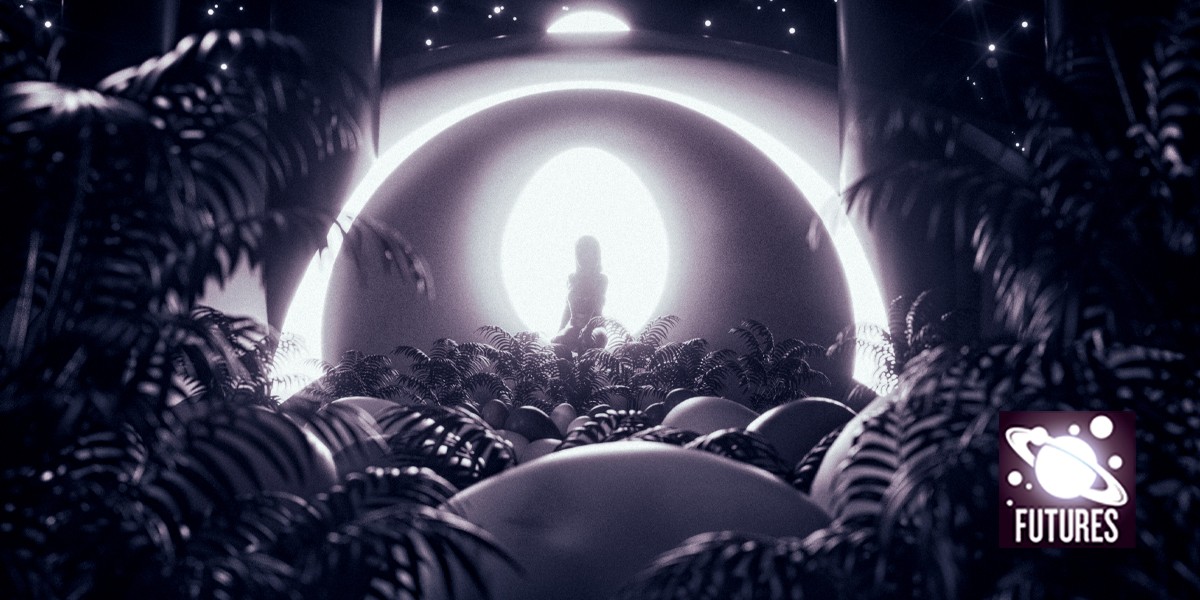
The scientific outpost on Arden B was being invaded by the forest. Vines cracked the outer walls. The domes were covered in moss. And large flightless birds stalked the campus, eating away at the landscaping. The outpost had once been well maintained, a bustle of activity, with more than 100 evolutionary scientists. They designed exciting new planetary ecosystems and distributed their publications throughout the galaxy. But after political squabbling and funding cuts, their top scientists left for other institutions. Lab equipment was repossessed. And entire buildings went dark.
Orr and Roslin were the last hold-outs. The colleagues walked across the scraggly quad, waiting for power to be restored in their labs. The sky overhead was milky green.
“I’ve been offered a position at Touchstone orbital,” Orr said. “It’s a step down, but I can’t stay. I have to go where my research takes me.”
Roslin kept silent.
“You should come along. Maybe I can find you a post?”
Silence.
“Roslin?” A bird crossed their path and Orr shooed it away. “Are you listening?”
She meditated on the fleeing bird. “Do you ever wonder where the moa go at night?”

Read more science fiction from Nature Futures
“Who?”
“The moa. The native birds. They’re too big to travel nimbly through the jungle. Clearings are few and far between. They don’t burrow. Nor roost in trees. Where do they go?”
“Why should you care? They’re spurious evolution. This entire forest is.”
“Follow me.” Roslin tugged his arm. “I want to show you something.” She stepped around a crumbling sculpture and passed through a crack in the outer wall.
“Roslin?”
“Come on!”
Orr reluctantly followed her into the forest, walking down a trail that had been hacked through the bush. The trees were knotty, with red peeling bark. Branches were thick with blooming epiphytes. Spider-webs reflected in the filtered light. He stepped in the mud and cursed.
“Come on!”
As they travelled deeper into the forest, Orr’s attention drifted. He forgot about his soggy shoes and the nibbling insects. His expertise was in botanical profiles and he couldn’t help being distracted. “What is this shrub, wild blackberry? Kānuka?” He plucked a leaf. “Nasty thorns.”
“Come on!”
The path grew choked, forcing them to duck beneath vines. Cackles emitted from the canopy. A purple lizard bathed in the sun. Soon, they reached a clearing with a sinkhole surrounded by dense ferns. A rope was tied around a nearby trunk, dangling down into the hole.
“You’re kidding,” said Orr.
“Nope.” She started down.
At the bottom of the sinkhole was a metal hatch, encased in mud. Roslin cracked the door and entered. Orr tentatively ducked inside. A light flickered on, revealing an ancient germination lab with gleaming equipment — a microscopic imager, a multi-armed sequencer, a rusty android and a control panel for a modular fission reactor.
“This is an old terraforming lab!” Orr marvelled. “Why didn’t you tell me?”
“I’m telling you now.”
“So this forest isn’t spurious.” He tapped on a workstation. “It was staged before we arrived, probably by Progress scientists, and left to run wild.”
The lab equipment booted, causing lights to buzz and the old Jaq-U android to complain about insufficient power. Roslin activated a 3D display. “I found the species chart,” she said. “Whoever designed this forest neglected higher-order species. There are no large predators and very few mammals. I’m guessing they never intended to evolve humans and Arden B was a test bed.”
Orr scrutinized the glowing chart. “It’s unusually diverse. And full of invasives. They must have been using accelerated evolution.” He turned and surveyed the cramped lab, wondering how anyone could tolerate working down here. And yet the metal surfaces were clean. The workstations seemed functional. And the equipment had been recently upgraded.
Wait a second.
“Roslin? Have you been working down here?”
Her cheeks reddened. “You caught me.”
“Why?”
“I already told you.” She manipulated the species chart, zooming in on a plump speckled bird with truncated wings. “I’m trying to learn where the moa go at night.”
Orr slumped on a stool, feeling a little tricked.
“You’re right about accelerated evolution,” she said. “The adults are a foot taller than the original schema. And yet thermal scans show entire colonies living in the shrubs.” She brought up a heat map showing red clusters at the base, along with bunches of little yellow dots, possibly eggs.
“OK, you have my attention. How do they squeeze in there?”

