


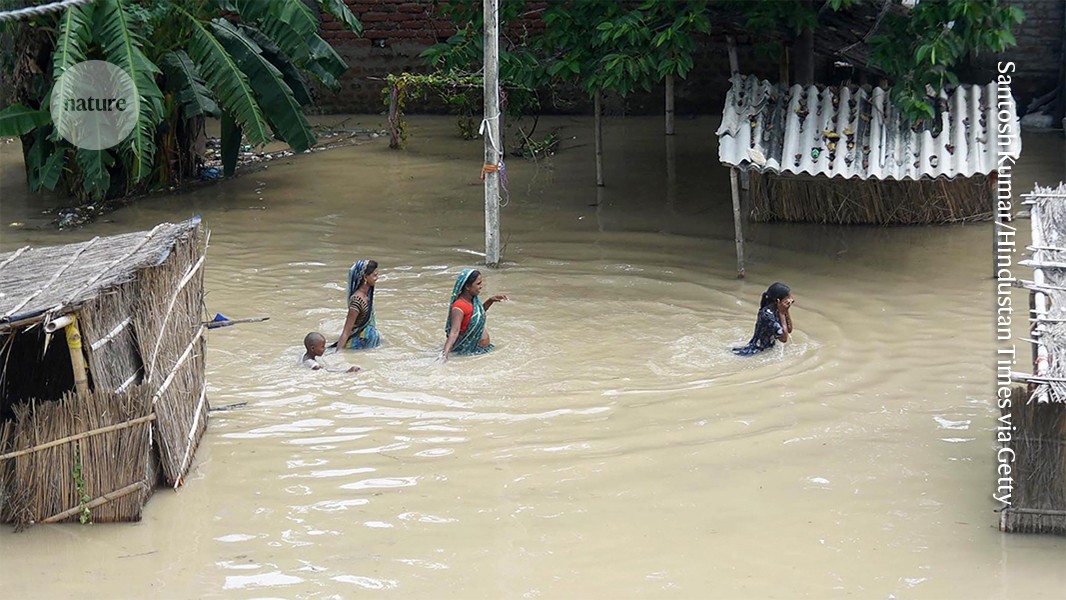

Flooding of the Ganges River in India (pictured) and Bangladesh affects millions of people.Credit: Santosh Kumar/Hindustan Times via Getty
The United Nations warned in January that the world faces imminent water ‘bankruptcy’. Overuse, pollution and climate change are threatening water systems; many will not return to their historical levels. Glaciers on the Tibetan Plateau are melting at a rapid rate, for instance. This affects the seasonal volumes of melt water entering the Indus, Ganges and Brahmaputra river systems as well as the dynamics of monsoons in South Asia.

How to achieve safe water access for all: work with local communities
Meanwhile, geopolitical tensions are jeopardizing regional water-sharing agreements. In April 2025, India suspended the 1960 Indus Waters Treaty — an accord with Pakistan. Similarly, friction is increasing over Afghanistan’s plans to construct a reservoir in the Kunar River that will reduce downstream water flows in Pakistan. And the 1996 Ganges Water-sharing Treaty, which sets out how India and Bangladesh share resources during dry seasons, expires in December, affecting 630 million people.
The international community must urgently strengthen, not just preserve, water treaties. The Ganges treaty’s renewal negotiations, which are currently strained, present an opportunity. Agreements should transition from a static process that aims to maintain historical river levels to a dynamic one that uses monitoring and modelling data on rainfall, snow and ice as well as river levels and flows. Real-time data would enable water managers to better control sediment and salinity levels. And such information can feed into ‘digital twin’ simulations that aim to mitigate climate volatility, as was used for the Yangtze River basin, for instance (see X. Wang et al. Nature 639, 303–305; 2025).
As a water- and climate-governance expert who has advised the Pakistan government, I urge the UN water agencies, multilateral development banks and institutions working in the region to draw from, and improve on, the experience of the Indus treaty. Until its suspension last year, it sustained millions of people through several wars and military operations, as well as a 13% loss of glacier mass between 2000 and 2021 (A. Khan et al. Remote Sens. Appl. 34, 101192; 2024).
The durability of the Indus treaty stems from three features: a neutral mediator (the World Bank), a commission comprising specialists from both India and Pakistan who could resolve technical issues without formal political renegotiations and a shared investment system (with an initial fund of £320 million (around US$900 million in 1960). A few practical steps could increase the resilience of water treaties.
Environmental treaties are paralysed — here’s how we can do better
First, turn the commissions that oversee water treaties into proactive data-driven basin-management authorities, rather than reactive adjudicating bodies. And treat a network of rivers as a whole ecosystem, rather than just as a volume of water to be shared. Such a process should be informed by real-time satellite monitoring and predictive modelling, to adjust water allocations without constant renegotiations. The Indus treaty already has the institutional structure and experience necessary for making such a transition.

