


You have full access to this article via your institution.
Hello Nature readers, would you like to get this Briefing in your inbox free every day? Sign up here.

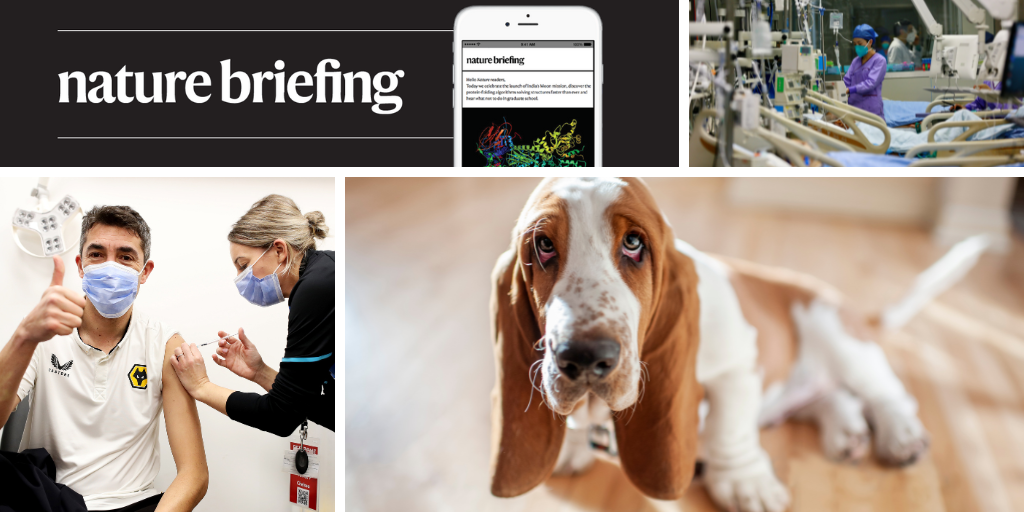
Evolution and breeding have wrought a wide variety of ear lengths in our canine companions.Credit: Getty
DNA variants near a gene called MSRB3 — which is important for hearing in humans — could determine whether a dog’s ears are pendulous like a basset hound’s or stubby like a rottweiler’s. Researchers analysed the genomes of thousands of canines and found that small, single-letter changes to DNA in a region of the genome near MSRB3 could boost the gene’s activity. The boost can increase the rate at which ear cells proliferate, resulting in longer ears.
Reference: Scientific Reports paper
Around two-thirds of people in the United Kingdom who were initially vaccine-hesitant during the COVID-19 pandemic did go on to get at least one dose. Using data from almost 38,000 people that reported some form of vaccine hesitancy — 65% of whom went on to receive one or more vaccinations — researchers found that reasons for hesitancy could be grouped into eight broad clusters, including concerns about the vaccine’s efficacy and their personal health. The team hope that the results will help with the roll-out of future vaccines, by focusing efforts on people whose hesitancy is rooted in concrete concerns that can be allayed with the right information.
Reference: The Lancet paper
The first comprehensive oceanographic research mission to study some of the Arctic’s most resilient ice has found it to be more fragile than expected. The narrow fjords of Canada’s Queen Elizabeth Islands (QEI) harbour the thickest and oldest sea ice. It could be the last Arctic ice left in a warming world, making it a refuge for wildlife. But its thickness has also made it impenetrable to icebreakers and so difficult to study. Now a research ship, the Amundsen, has given scientists a first-hand look at the state of play. Viewed in combination with satellite data, the news is not good. “Multiyear ice used to have a haven in QEI,” says remote sensing specialist Mallik Mahmud. “Now, it will come here to die.”
Reference: ArcticNet conference session
Features & opinion
In some people, rare genetic mutations cause ‘inborn errors of immunity’ (IEIs). These errors disrupt the function of their immune cells, which leaves them susceptible to a wide range of infectious diseases and immune-linked ailments that many people can simply shrug off. Since the 1980s, researchers have amassed a broad library of mutations in hundreds of genes that cause IEIs. Now, doctors can genetically screen people for relevant mutations or supplement missing immune factors, which can help them prevent or treat infections that used to seem like random cases of bad luck.
The first-ever medical evacuation from the International Space Station shows that NASA needs to ramp up research into health care for long journeys planned to the Moon and Mars, writes former NASA astronaut Clayton Anderson. “We cannot, during critical medical situations, simply rely on a steely-eyed astronaut having the right stuff,” he writes. “They need the tools to pull it off.”
The Washington Post | 7 min read
Researchers are increasingly finding themselves being targeted by harassment and intimidation campaigns. “It’s been an intense year,” notes Beck Haberstroh, digital-safety training manager at PEN America, a non-profit organization that defends free expression. Haberstroh and other experts outline their advice — primarily focusing on the US landscape — for assessing your risk, keeping your personal data personal, encrypting your communications and cleaning up your digital footprint.
Today I’m enjoying the fact that ecologists hunted each other in the Canadian woods to learn about predator-prey dynamics. “The rules are pretty simple,” said ecologist David Bolduc. “You either die or survive.” But not really: resources were hidden envelopes, ‘reproduction’ was work-appropriate and no ecologists were harmed in the making of the paper that resulted.
Help this newsletter to survive and thrive by sending your feedback to [email protected].
Thanks for reading,
Flora Graham, senior editor, Nature Briefing
With contributions by Jacob Smith
• Nature Briefing: Careers — insights, advice and award-winning journalism to help you optimize your working life
• Nature Briefing: Microbiology — the most abundant living entities on our planet — microorganisms — and the role they play in health, the environment and food systems
• Nature Briefing: Anthropocene — climate change, biodiversity, sustainability and geoengineering
• Nature Briefing: AI & Robotics — 100% written by humans, of course
• Nature Briefing: Cancer — a weekly newsletter written with cancer researchers in mind
• Nature Briefing: Translational Research — covers biotechnology, drug discovery and pharma

