


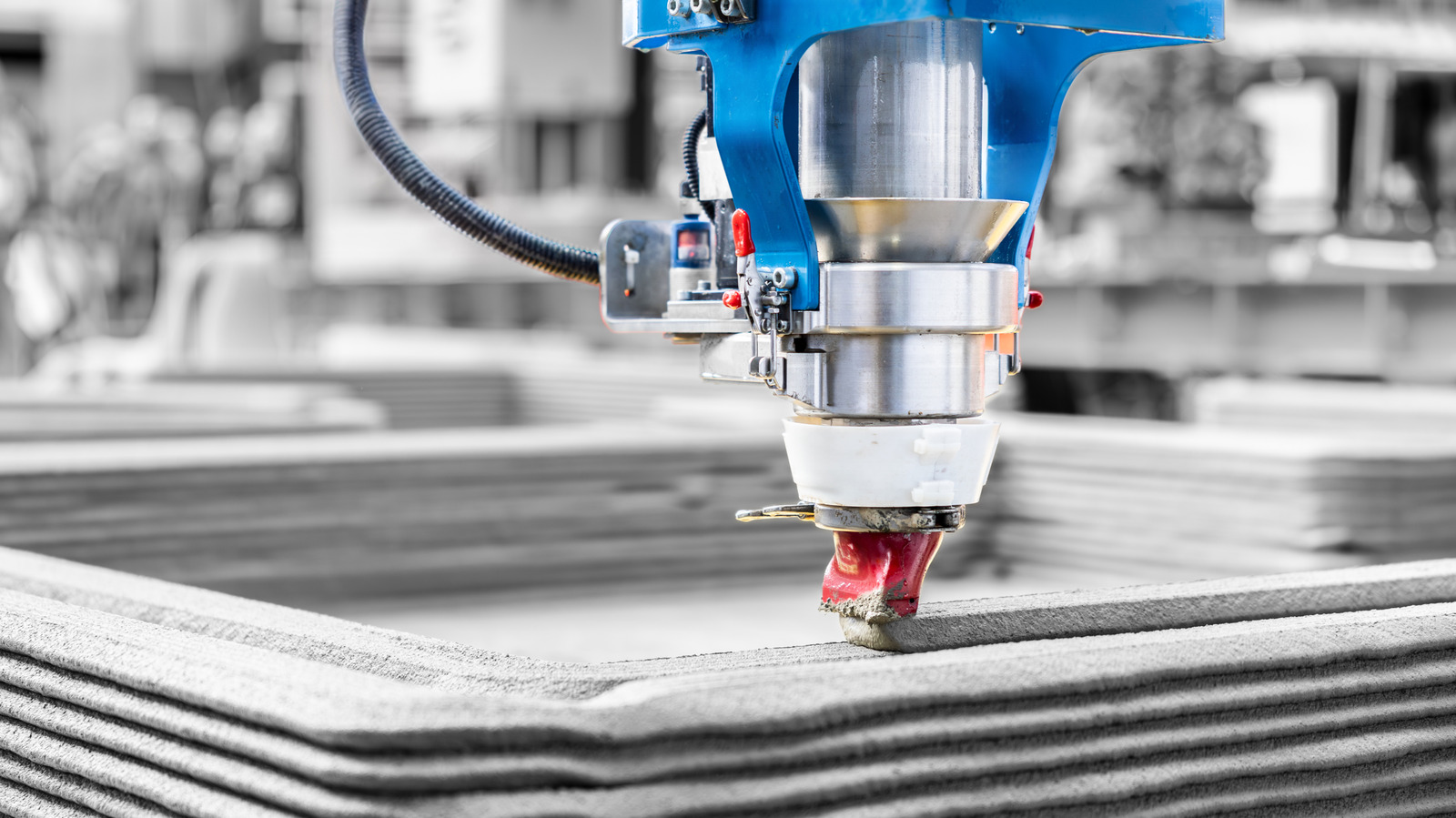
A team at the Massachusetts Institute of Technology has developed a new way to 3D print concrete structures, a technique that could simultaneously cut down on material use, costs, and climate-damaging CO2 emissions. While 3D-printed concrete structures are already out in the world, current systems are very unoptimized. Previous attempts at optimization, however, have suffered from being too perfect. That is, algorithmically generated blueprints were meant for ideal conditions that real-world, slightly clunky printers could never actually make. What the MIT team has done is developed a new algorithm, based on more sophisticated math, that can account for the clunkiness while figuring out the realistically ideal design. Their first result is a model bridge that is 16% lighter than its traditionally made equivalent, with the same load capacity.
That matters, because humanity sure uses a lot of concrete. As in, we use concrete more than any other substance on Earth, save for water itself. But in order to make all that concrete, a huge amount of CO2 is shoved into the atmosphere: 8% of all CO2 emissions, in fact, come from this process alone. So any reduction the CO2 output from concrete production would be a big step in the fight against climate change. Prior research indicated that 3D printing concrete saved 86% of emissions compared to the traditional process. And that’s to say nothing of the material savings! Fewer resources, less cost, less weight, less carbon. Sure sounds good to me. A major blocker to widespread adoption has been the gap between the ideal designs and the actual printers. If this new method can close the gap, some very exciting possibilities open up.
The new method involves the math underlying the programs creating the blueprints. As explained in the team’s whitepaper and reported by MIT News, older models simply couldn’t capture printer imperfections, which is what resulted in the too-perfect designs. Printers have limitations like the size of the concrete beads it lays down, the turning radius of the nozzle, and the curvature (or lack thereof) of the lines of beads. Sharp angles, in particular, are not something printers are great at. To capture all of that in numbers, there’s a mathematical technique called mixed-integer programming that could work, but it’s so computationally intensive that it wasn’t feasible. What changed, and what the MIT team brought to the concrete table, were some recent innovations in how to calculate for this technique. There’s quite a bit of very smart wizardry here, but the end result is that it’s now possible to deduce optimal designs bounded by what a printer can actually make.
Custom concrete designs to order
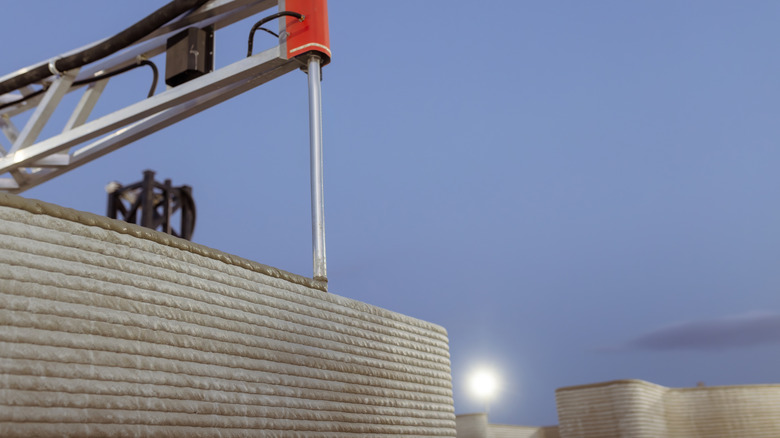
There’s a lot to like here, but it gets better. Traditionally, once the concrete is made, it then has to be poured into a mold. Making the mold is itself a non-trivial process, and locks the finished product to a very particular shape. What if you want to make a quick change to the shape? Or what if you want to create a complex shape only once, which would be uneconomical to build a whole mold for? 3D printing doesn’t require any of this, since it’s just laying down beads of concrete from a nozzle. Make any crazy shape you want, make changes on the fly, do whatever you like. Again, while saving on resources, cost, and emissions.
But we haven’t quite reached a golden (or, well, drab grey) new era yet. More testing needs to be done, and this method needs to be scaled up. The test bridge was less than 8 feet long and only weighed 900 pounds. Actual infrastructure will be a wee bit more than that. Plus, pure concrete has limitations in terms of the direction of the force it’s taking; from one direction, it is a mighty bridge, but from another, it’s a fragile little snowflake that cracks easily. (The test bridge, in fact, cracked when someone tried to lift it.) This is why real-world concrete is reinforced with rebar. And no fancy math has figured out how to 3D print rebar, or even manually add rebar into the 3D printing process. Still, this is real and exciting progress.

