


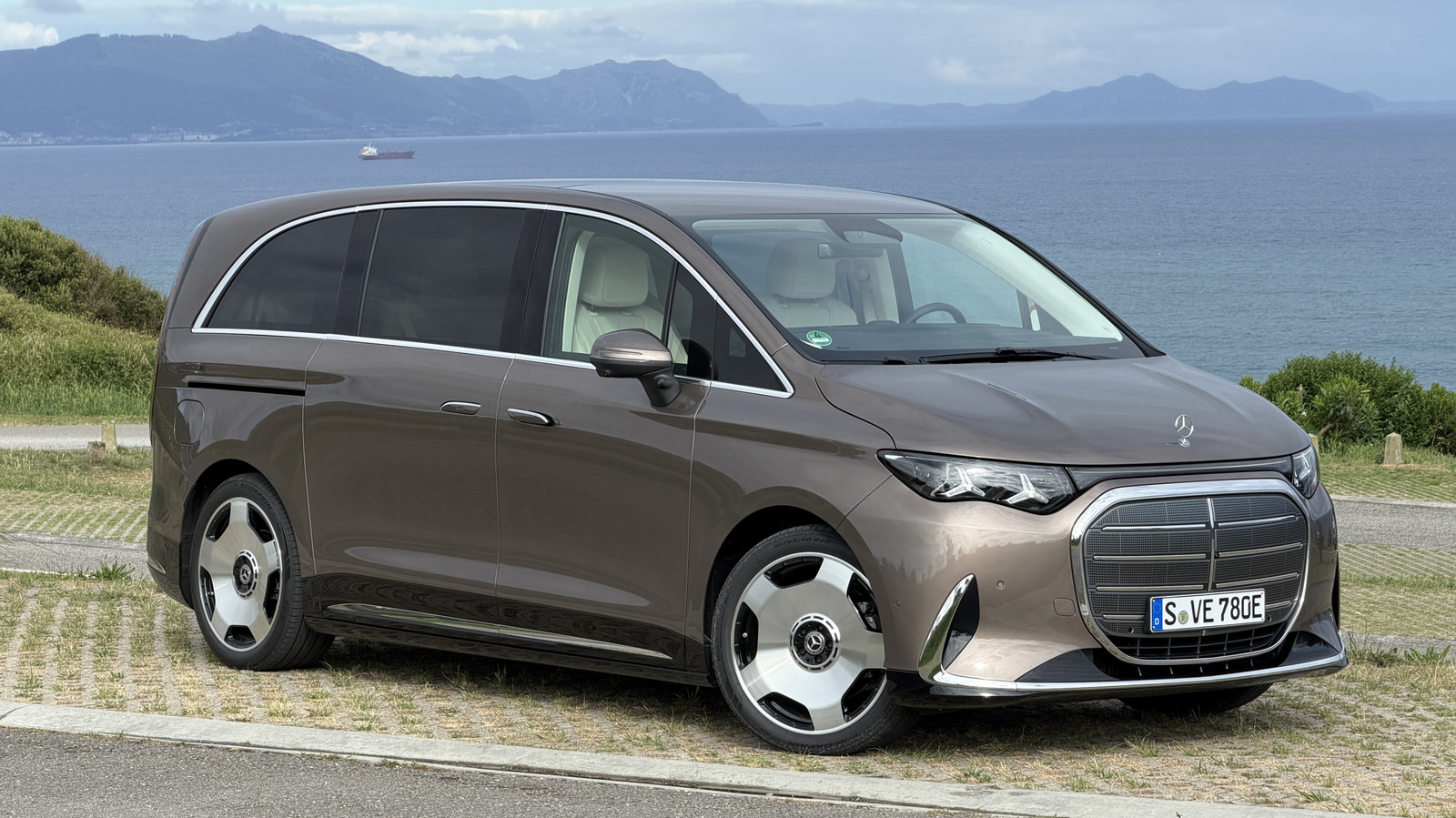
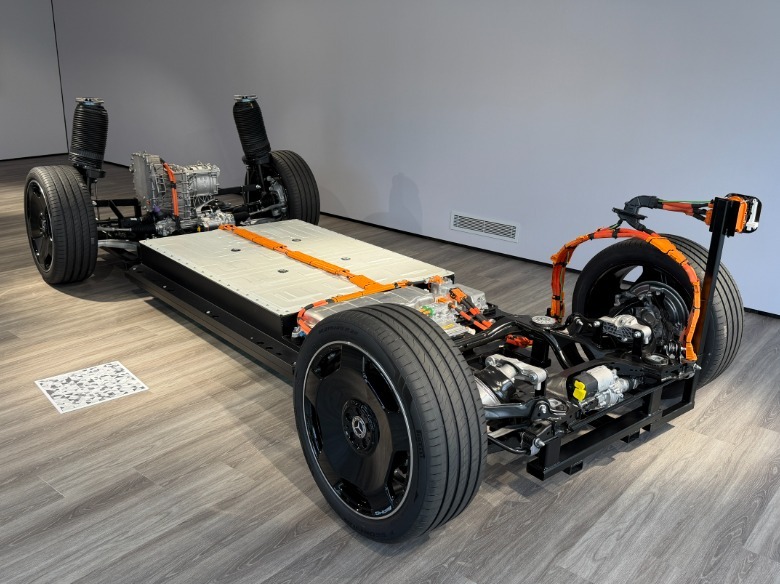
Speed and handling don’t matter for this car, though. It’s all about the smoothness and luxuriousness, which the VLE delivers in spades. Airmatic air suspension with individual adaptive dampers for all four wheels is standard, with the rear shocks being mounted inboard. In addition to automatically lowering above 68 mph for better efficiency or when Sport mode is on, the suspension can be raised 1.5 inches for unpaved roads or lowered 1.5 inches for ease of entry and exit. Even on 22-inch wheels that have fairly low-profile 265/40 Pirelli Scorpion all-season tires, the VLE has an extremely nice ride that rivals (or perhaps even surpasses) the S-Class in comfort, completely soaking up cobblestones and rough pavement. There’s some floatiness if you hit a bump at higher speeds, but it doesn’t ruin the experience. It feels just as quiet inside as an S-Class too, with only the slightest whispers of wind and tire noise coming in at freeway speeds.
 Daniel Golson/Jalopnik
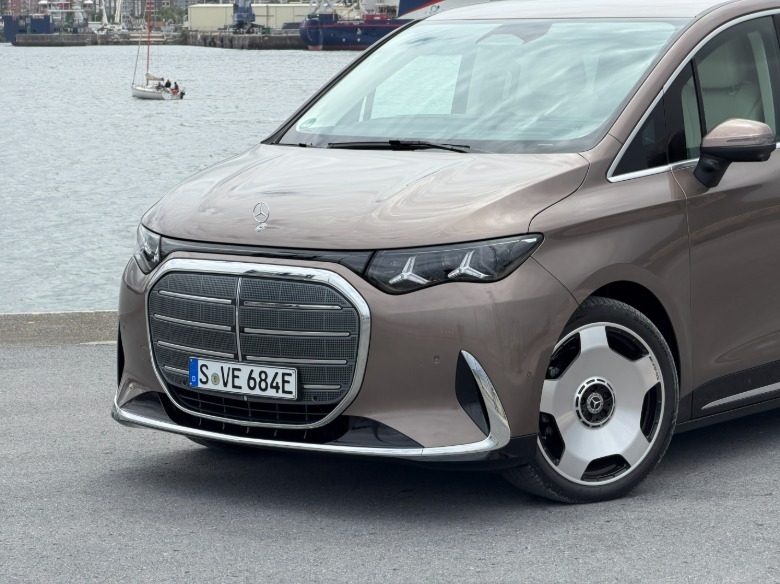
The difference in passenger experience between an old V-Class and the new VLE is night and day, and those old vans were already pretty nice vehicles to be shuttled around in. It’s not just because the VLE is electric and that makes a car inherently nicer, either — it’s also noticeably better than the old electric V-Class, the EQV. Building the VLE as its own distinct model on the new modular Van.EA platform was definitely the right move versus basing it on the upcoming next-gen commercial vans that we have yet to see. If you were blindfolded and tossed into the back of a VLE, you’d never guess that you were in a van, but you’d know you were in something expensive and luxurious.
Despite the VLE’s flat, low floor the front seats have me sitting up pretty high. Luckily the driving position is barely van-like, with nicely adjustable front seats, the ideal armrest positioning on the door cards, and not too long of a dashboard to peer over. The steering wheel is angled like on a car, too. The driver’s side A-pillar is really thick and steeply raked, creating a gnarly blind spot that’s most annoying on twisty roads, but visibility is much better on the passenger side, and the short hood and front overhang make the VLE easy to place. The side windows and back window are all huge, and an available digital mirror is a boon when the van has one of the fancier rear seat setups.
 Daniel Golson/Jalopnik
Helping maneuverability even more is the rear-wheel steering system, which comes standard. It turns the rear wheels up to 7 degrees, giving the short-wheelbase VLE a turning circle of just 37.5 feet, about the same as a CLA. Our LWB model will still have a really tight 39.7-feet turning circle. To give you a tangible visual, a VLE could turn around within a tennis court. It really makes the VLE so easy and effortless to drive on the narrow and hectic city streets in and around Bilbao.
Mercedes’ automated parking systems have also gotten a major upgrade. The sensors and cameras can now spot parking spots from far away and create a map, so you no longer have to drive past a spot before it can engage. It can now park in diagonal spots and both enter and exit a spot for you, and there’s a new reverse maneuvering function that can reverse up to 490 feet to recreate the drive forward you just did, useful if you get to a dead end or pulled off a particularly tricky parking job. Another really great new feature is a transparent rim protection view and warning system that helps stop you from curbing a wheel, adding red highlights above a wheel if it gets too close to the edge. The 12 ultrasonic sensors, 5 radar cameras and 10 external cameras are also used for the suite of driver-assist systems, which will include the hands-free MB.Drive Assist Pro system that will be able to handle point-to-point city driving.

