


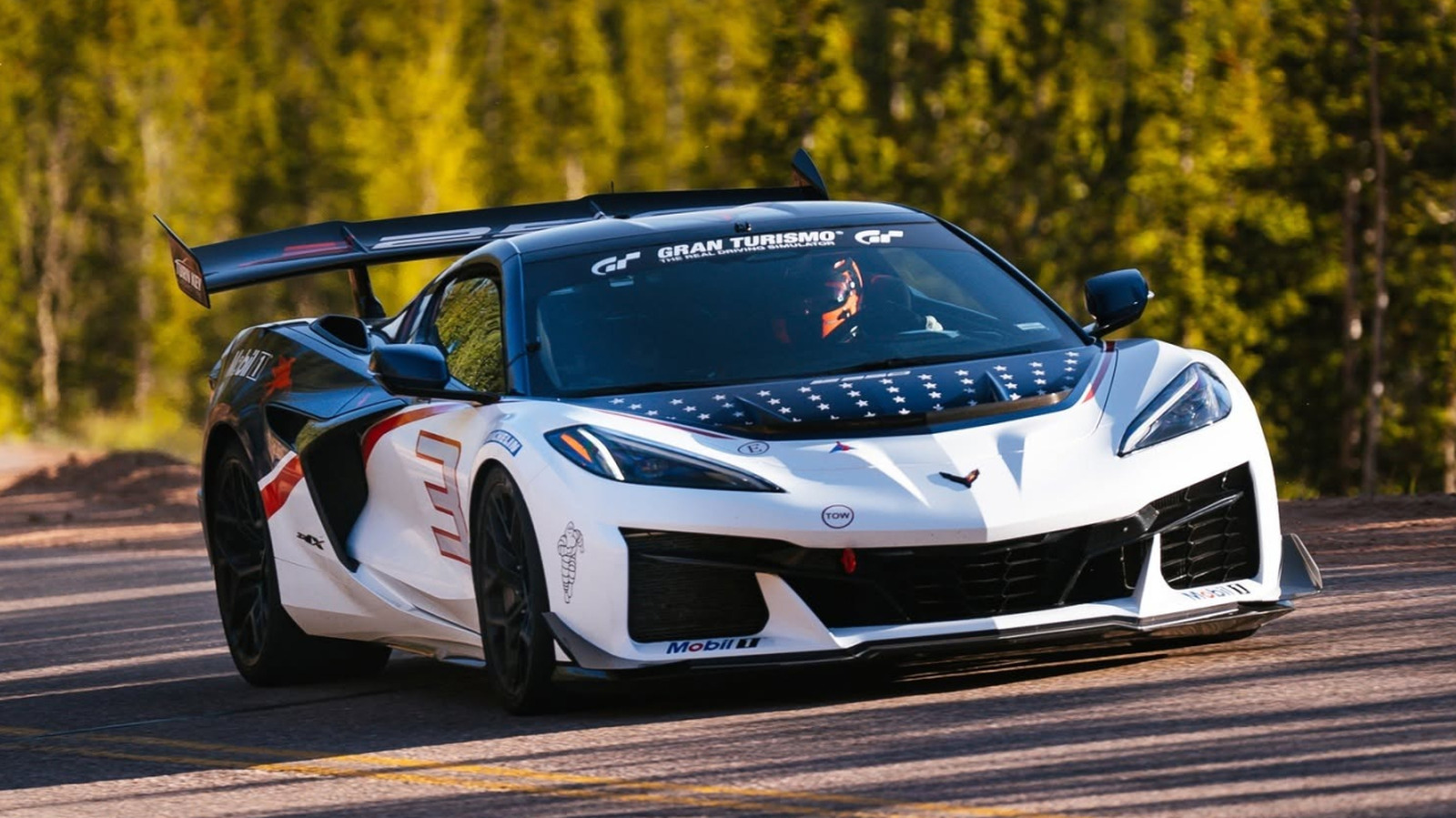
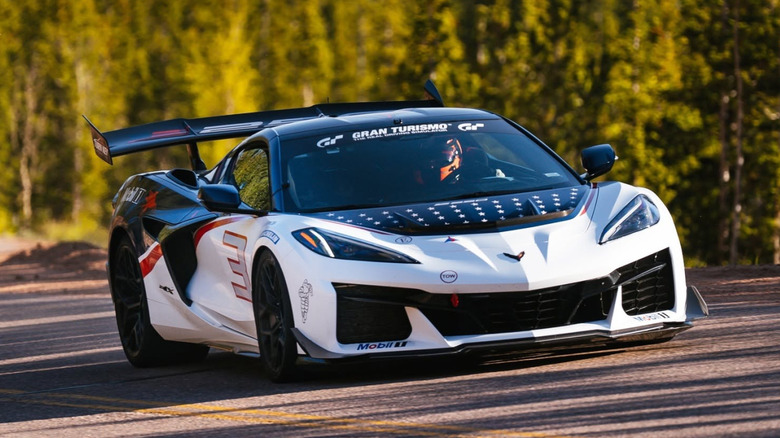
We already knew the Chevrolet Corvette ZR1X was quick. The 1,250-horsepower, all-wheel-drive Corvette runs the quarter-mile in the eights and lapped the Nurburgring in 6:49.275. That’s a seriously fast time, but it wasn’t enough to take the production car record back from AMG. So last weekend, as we drew closer to the first run of the 2026 Pikes Peak International Hill Climb, the question was, would driver JR Hildebrand come up short, or would he break the hill climb’s production car record in the ZR1X? Turns out, that was a silly question, because he didn’t just break that record — he destroyed it.
Hildebrand competed in the hybrid production class, but even before the race, he had his eyes on more than a class record. Speaking with a member of GM’s communications team, Hildebrand said, “Our goal is very simple, which is to be the fastest production car ever at Pikes Peak of any kind. 9:53 is the outright fastest production record of any kind — that’s definitely the number that we are unquestionably here to top. My goal is to lay down a heater that will be hard for anybody else to come after anytime soon.”
And boy, did Hildebrand lay down a heater. Watching his climb live, you could tell he was fast. Really fast. So fast that the production record didn’t stand a chance. He was going to set a new record, but just how much faster would he be? How about “bury the record and just keep piling on” fast? With an official time of 9:30:104, Hildebrand’s ZR1X beat the previous production car record by 23 seconds. Incredible. If Pikes Peak is America’s Mountain, then it’s only fitting an American car should hold the record.
USA! USA! USA!
In some ways, Pikes Peak is the closest thing the U.S. has to the Nürburgring. The course is 12.42 miles long, famously contains 156 turns, and every single one of them could bite you if you aren’t careful. Like the Nürburgring, weather systems change over the course — it can be wet in one area, dry in another, or clear in one area, and extremely foggy in another. Unlike the Nürburgring, however, the starting line sits at 9,400 feet above sea level. By the time they cross the finish line, drivers are at 14,105 feet, more than 4,700 feet above the start line. To put that altitude change into perspective, a mile is 5,280 feet, which means drivers climb 0.89 miles during a race that starts 1.78 miles above sea level.
Alternatively, for all four Europeans reading this, the starting line begins 2.87 kilometers up a 4.30 km mountain, while drivers race for almost exactly 20.00 km and climb 1.43 km to the finish. The Nürburgring may go in a circle and include a few hundred meters of elevation change, but it’s still no hill climb up a 14er. And when you’re racing that high up, the air that your engine needs to make power is much less plentiful than it is at sea level. Oh, and if you go off at Pikes Peak, there’s a good chance you’ll roll your car down a mountain.
As dangerous as Pikes Peak can be, the best news of the day is that no one died this year. With that in mind, though, it’s probably the second-best news that the record for the fastest production car to ever race up America’s Mountain now belongs to the most powerful version of America’s Sports Car. So many other things may be awful these days, but if watching a 1,250-hp Corvette race to the top of a 14er faster than any production car ever doesn’t do it for you, I don’t know what will. That’s objectively awesome, and JR deserves to be proud of himself.

