


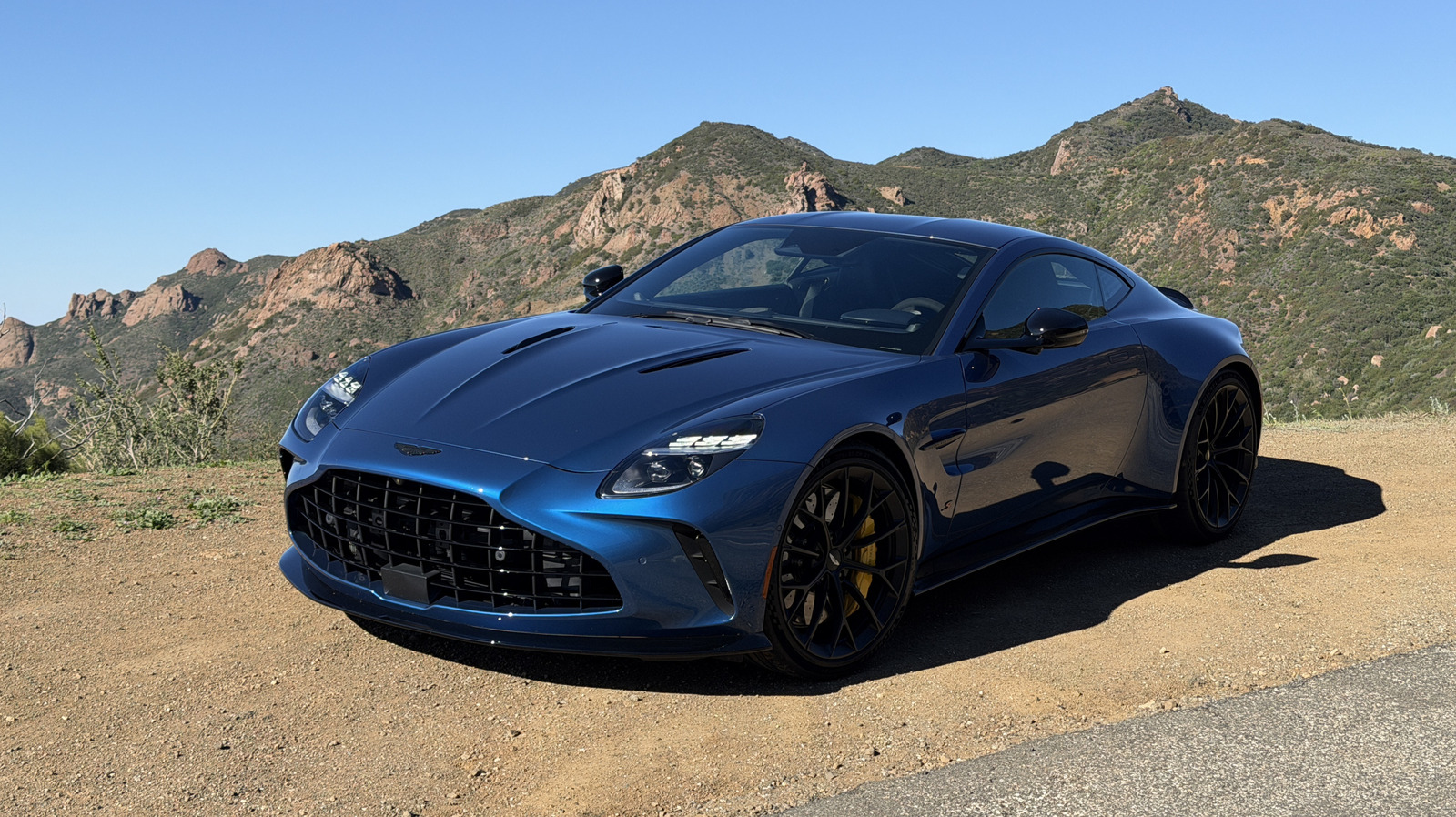
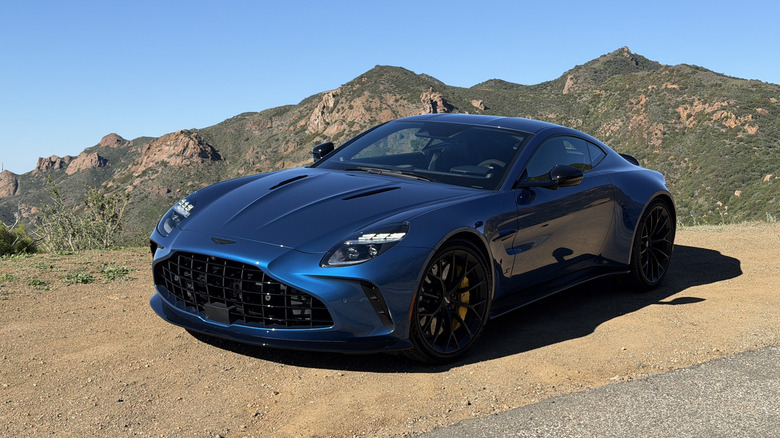
Upon getting into the new Aston Martin Vantage S, it’s immediately apparent that this car wants you to have a good time. Not because of the loud exhaust on startup, the cocooning layout of the cabin, or the fantastic styling you see before even opening the door. No, what separates the Vantage S from other sports cars and supercars like the Porsche 911 and Lamborghini Temerario is that there’s no Normal or Comfort or GT drive mode. You press the chunky start button in the center console, the V8 roars to life and you’re in Sport mode. This is not a car for those who want to have a subtle time.
The regular Vantage has GT, Sport and Sport+ modes (plus a Wet mode), and it’s a very exciting car to drive, but the Vantage S dials things up more than I was expecting. Aston Martin didn’t make any major changes here; there’s a bit more power, a slightly stiffer chassis, a more precise front end. But its drive modes go Sport, Sport+, and Track (plus Wet and Individual), and that tells you basically all you need to know about the Vantage S. Its upgrades add up to a hell of a good time, a car that will make you feel alive whether going to the grocery store or hitting the canyons.
Full disclosure: Aston Martin invited me to drive out to Westlake Village to spend an afternoon with the Vantage S in the hills around Malibu.
It’s quite fast
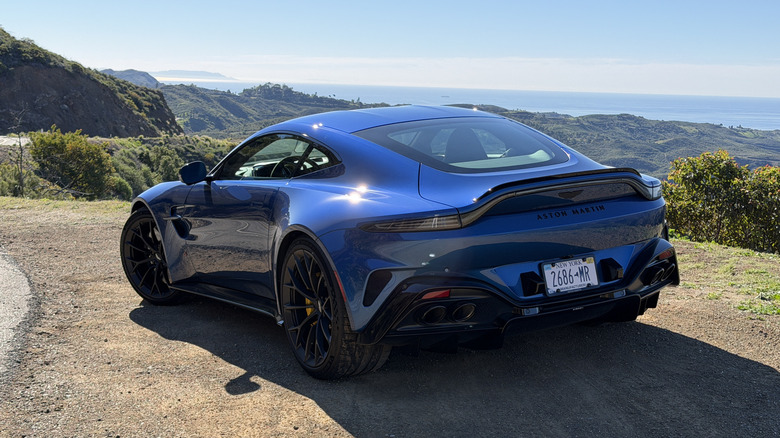
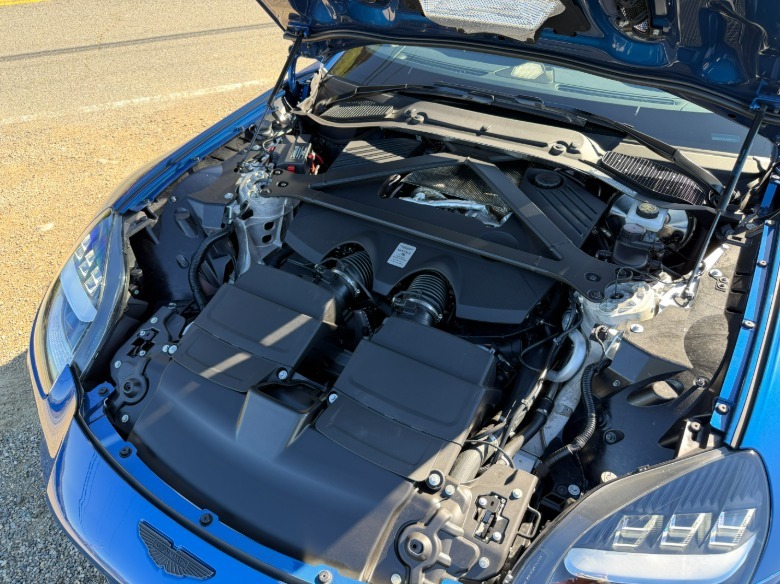
Powering the Vantage S is the same AMG-derived twin-turbo 4.0-liter V8 that has been used by this generation of Vantage since it came out, but the car’s facelift in 2024 brought the motor’s performance way up, surpassing even the AMG GT that uses the same engine. The Vantage S gets a slight bump from 656 horsepower to 671, and torque remains the same at 590 pound-feet. Normally that change wouldn’t really be noticeable, and it’s just a tenth quicker to both 60 mph and 124 mph, taking 3.3 and 10.1 seconds, respectively. But Aston also recalibrated the throttle to be more responsive, tuning the mapping more specifically for each drive mode, and the car definitely feels more eager to accelerate all the time.
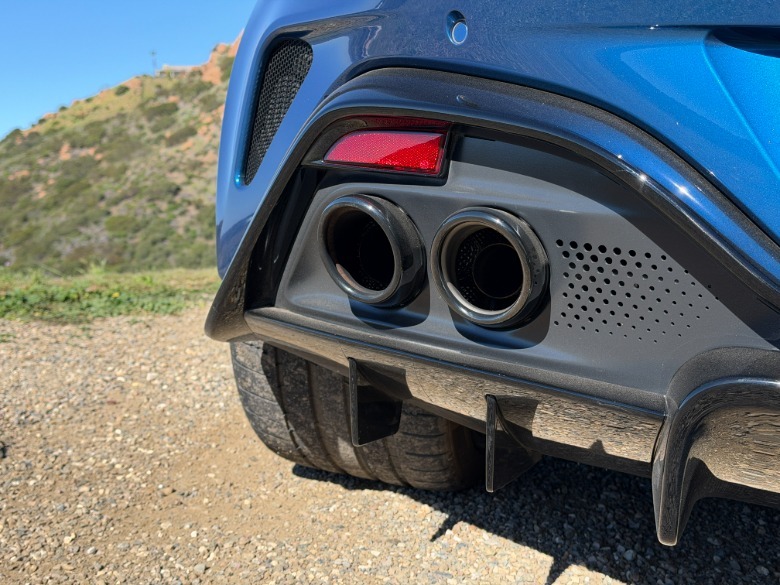
As you would hope, it sounds awesome when that gas pedal is even slightly squeezed. There’s no exhaust hardware changes specific to the S, but Vantage didn’t need any help in that department. This car is loud, and pretty much always loud especially given how Sport is the baseline. It’s got a totally different character from the Mercedes-AMG GT63 Pro, which is down a whole 68 hp from the Aston. (The AMG has a lame-o Comfort mode, too.) Because of how rev-happy and reactive the engine is, it’s tough not to drive around like an enthusiastic puppy pulling on its leash, wanting to run free at the park.
 Daniel Golson/Jalopnik
Once I’ve gotten out of the suburbs and into the canyons where I can really start to exploit all that power, the car practically begs me to step on it. I can’t think of another gas-powered car this side of a McLaren 750S that accelerates with such vigor no matter the situation. It’s quick as hell off the line — there’s no mistaking that it’s rear-wheel drive, either — but more impressive is how it accelerates in the mid and upper ranges of the tach. Aston didn’t tweak the 8-speed transmission for the S, but it didn’t really need to. The large paddles are nice to click, and even left to its own devices it’ll shift just when you’d want, with a serious kick in the more intense drive modes.
And speaking of drive modes, the changes made to this have also been pretty successful. In a lot of cars, even sports cars, there isn’t a big difference between Sport and Sport+ and Track (or whatever other names are used for analogous modes), but twisting the knurled dial changes up the car’s character more than in the standard model; Sport+ is so intense that even trying Track on the street feels unnecessary. Even though there’s no GT mode, the Sport mode can be calm enough to be driven in town or on a road trip without being annoying.
It feels just right
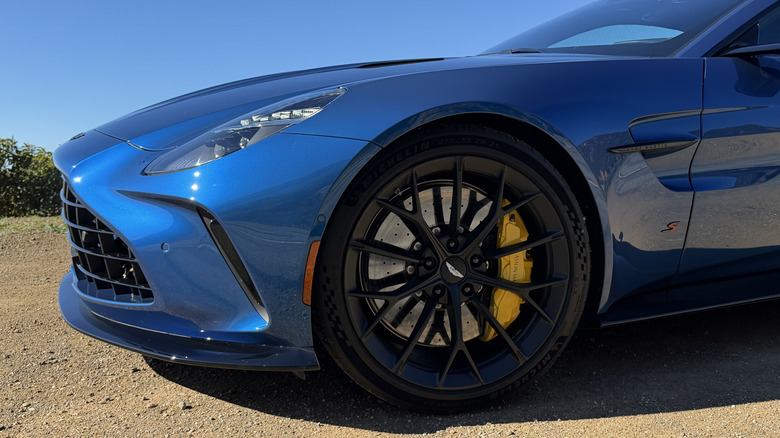
Can I tell that the S-specific ducktail spoiler adds 97 pounds of downforce at the car’s 202-mph top speed? Uh, that would be a negative, but Aston does say the spoiler makes the balance of downforce more biased towards the front for better turn-in and grip. The engineers also mounted the rear subframe right onto the body instead of using rubber bushings, made hardware and software changes to the Bilstein adaptive dampers, and adjusted the camber, caster and toe.
Aston describes the Vantage S as having “a thrilling appetite for corners,” and that is certainly true. It’s sharper and more direct than the base Vantage, with better steering weighting and accuracy. This is a freaking wide car that doesn’t have the greatest outward visibility, but even without the aid of things like rear-wheel steering it feels quite nimble and light on its feet. Aston’s drive route has me going on some of the tightest, narrowest canyon roads around Malibu, and I can attack them a lot more fervently than I’d expect. The Aston-specific Michelin Pilot Sport S 5 rubber helps with the car’s grip and cornering prowess.
 Daniel Golson/Jalopnik
Despite its rip-roaring attitude, the regular Vantage is already a much nicer car to daily drive than the pre-facelift model was, and the S doesn’t mess things up in that department. To compensate for the added sharpness, the transmission mount stiffness was reduced by 10%, and the rear spring aid stiffness was also reduced for better ride quality at low speeds. Any car with 21-inch wheels sized 275/35 up front and 325/30 in the back will have a kinda choppy ride, and the Vantage certainly tramlines, but it’s really not much worse than a Porsche 911 GTS, and the cabin is nice and quiet. Both as a grand tourer and an outright sports car, the Vantage S feels more well-balanced than the standard car.
What’s the price of joy?
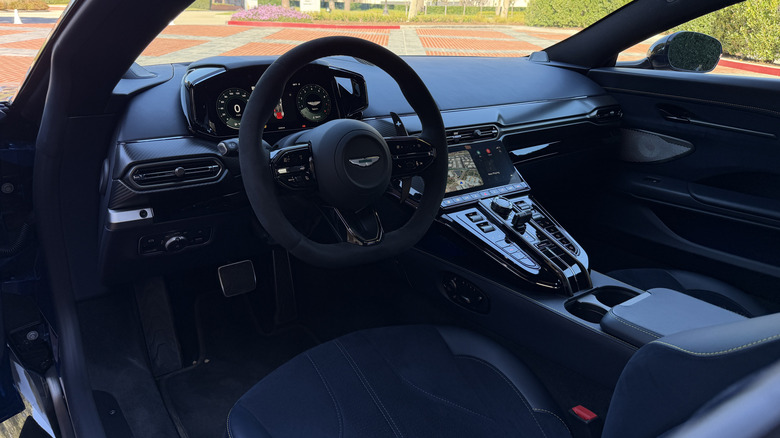
I could talk about how great it looks, how much better the facelift Vantage’s interior is, or how Aston’s build quality is definitely starting to get better. (I could also talk about how much I don’t care for Apple CarPlay Ultra, even if Aston’s own infotainment system isn’t great.) But none of that really matters. What’s important with the Vantage S is how it will make you feel. This isn’t the most precise sports car, the most refined or the most dynamic. No, it’s something much better: a sports car that will instantly put a smile on your face and have you hooting and hollering like a “Top Gun” pilot, as if you’re up in the sky pulling 7 G’s.
 Daniel Golson/Jalopnik
Do you have cats? I’ve got two, and I always enjoy watching one of them get the kind of zoomies where their eyes grow huge, they hunker down and start wiggling, and then blast off into the other room as if hunting a ghost. That’s what driving the Vantage S is like. Whether merging onto the freeway, exiting a corner or going when the light turns green, when I hit the gas the Vantage S lunges forward, squirming around as those giant rear tires hook up and the quad pipes bellow, and I’m rocketed toward the next exit, corner or light.
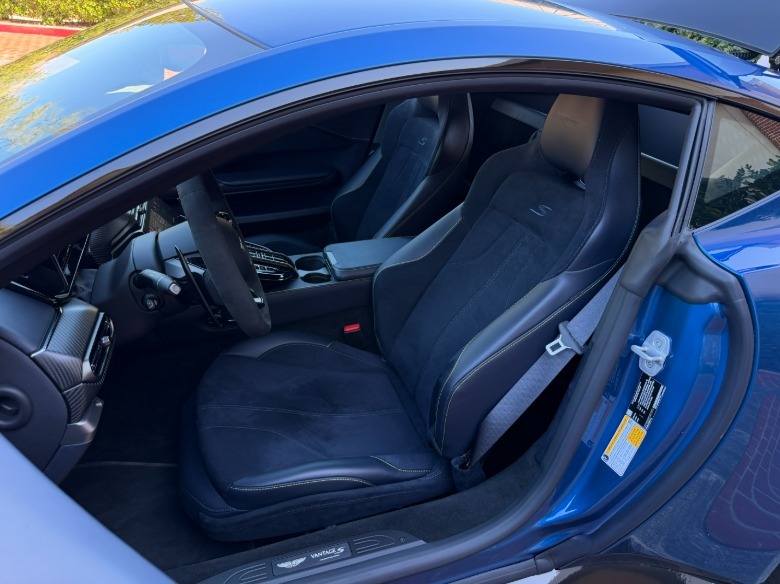
That’s why you want the Aston Martin Vantage S instead of any other sports car — every moment behind the wheel is electrifying. And Aston Martin is charging just $5,000 more than a normal Vantage for the pleasure of having those enamel S badges. The Vantage S starts at $199,500 including destination (but not including the $7,400 “import costs” tariff fee that’s on the window sticker). That’s only around sixteen grand more than both the 911 GTS and AMG GT63, and the Aston is actually a few thousand cheaper than a GT63 Pro. Granted, you’ll probably want some options. My Plasma Blue test car had a dozen options like a $10,000 Bowers & Wilkins sound system, $10,800 carbon-ceramic brakes, $2,900 contrast stitching and $1,900 ventilated seats, all coming to a total of $248,400. A small price to pay to really feel alive.

