


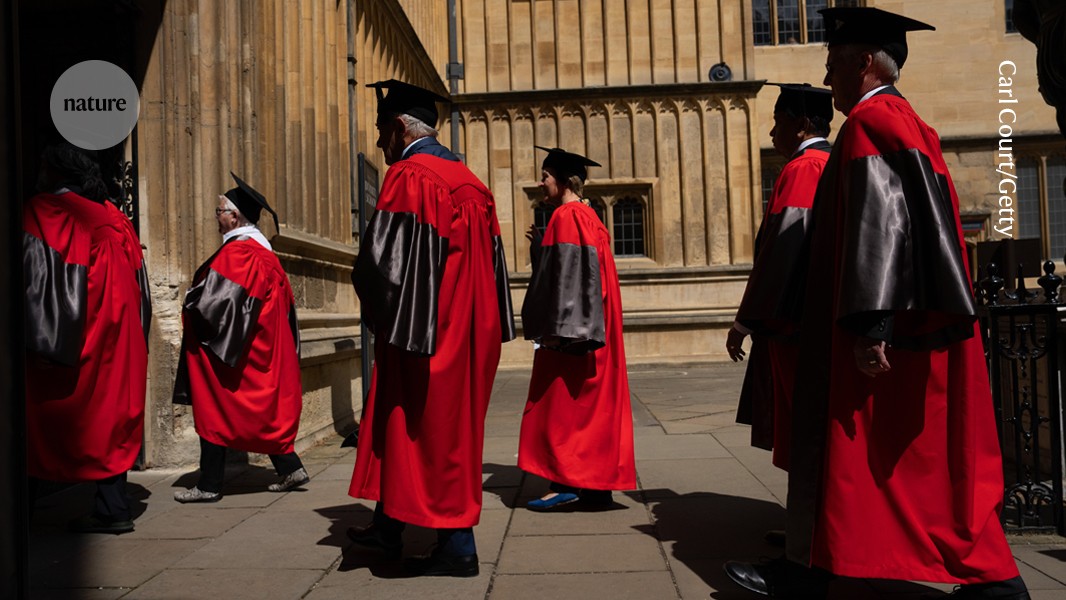

Some universities have revised their retirement policies to open more positions for younger academics.Credit: Carl Court/Getty
Gaining a foothold in academia is becoming increasingly difficult. Early- and mid-career researchers are facing fierce competition for stable academic jobs and funding, often because of a mismatch between the number of doctorates awarded to students each year and the number of tenure-track faculty positions available to them.
Contingent job positions at universities in the United States have risen — from 47% in 1987 to 68% in 2021 — giving many young researchers a sense of job precarity. And more than two-thirds of faculty members in US-based higher-education institutions had part-time employment or full-time posts that were not eligible for tenure in 2023, according to data published last year by the American Association of University Professors.
In attempts to improve job prospects for young researchers, some have taken aim at academic retirement rules. “We must redefine our perception of academic retirement,” wrote Thomas Roulet, a social scientist at the University of Cambridge, UK, on LinkedIn last year. “It does not mean ceasing all research and teaching. It simply means vacating an established post — a post that will then become a life-changing opportunity for those looking to kickstart their own academic careers.”
Some universities have revised their retirement policies to create opportunities for new generations of academics. For example, the University of Oxford and the University of Cambridge brought in mandatory retirement ages to open more positions for young researchers. In Spain, professors and academic staff have a mandatory retirement age of 70. In France, professors can request to remain in their posts up to the age of 69.

Is academic research becoming too competitive? Nature examines the data
Meanwhile, in Germany, academics are divided over a debate about whether to extend their retirement age. David Spergel, an astrophysicist and president of the Simons Foundation — which supports research in mathematics and basic science — in New York City, says that the retirement of professors can create opportunities for young academics — but retirement must not be forced. “People at different ages should make that choice, but with that flexibility comes responsibility that people need to think [what’s for] the good of the research enterprise,” says Spergel.
Does mandated retirement create academic jobs?
According to some researchers who have studied the impacts of mandatory retirement among academic staff, the evidence does not suggest that it sufficiently creates more job opportunities.
The University of Oxford and the University of Cambridge implemented a mandatory retirement age of 67 for their academic staff in 2011 and 2012, respectively, and later increased the age to 69. The aim of the policy — known as Employer Justified Retirement Age (EJRA) — is to create jobs for younger academics and routes for career progression.
In 2023, the University of Cambridge set up a committee to review the EJRA policy. According to the committee’s report, abolishing the EJRA would result in nearly 28 fewer permanent academic posts on average each year between 2023 and 2032.
In an analysis of the same data presented in the review report, Oliver Linton, an economist at the University of Cambridge, and his colleagues estimated that the EJRA should increase the rate of creating vacancies by 11% at the University of Cambridge. But when they examined the hiring data at the university, they found that forced retirement of professors contributed to only a 2.75% increase in job vacancies when excluding voluntary retirement and job openings for reasons other than retirements1.
Choose your own adventure: navigating retirement after an academic career
“It didn’t deliver anything noticeable in terms of the vacancies at the university,” says Linton. “There’s been a big increase in the number of non-academic staff,” he adds.
Michelle Silver, a gerontologist at the University of Toronto in Canada, agrees that retirement does not always create job opportunities. “There are many, many examples where people have retired and their lines stopped with them,” she says.
Ageist policies
Forced-retirement policies proved deeply unpopular with many academics. “There are a couple of lawsuits at the moment against Cambridge university to challenge [the policy] in particular cases,” says Linton.
Senior academic staff felt “personally wounded” and “not valued” by the EJRA policy, says Linton, in part because it affected people’s grant funding for years before retirement age. When researchers apply for grants, they “have to have an employment contract that stretches out”, explains Linton. “When you get to 64, you can’t get a five-year grant because you’re [your job] is going to be terminated at the end, and there’s no possibility of a renewal.”

