


You have full access to this article via your institution.
Hello Nature readers, would you like to get this Briefing in your inbox free every day? Sign up here.

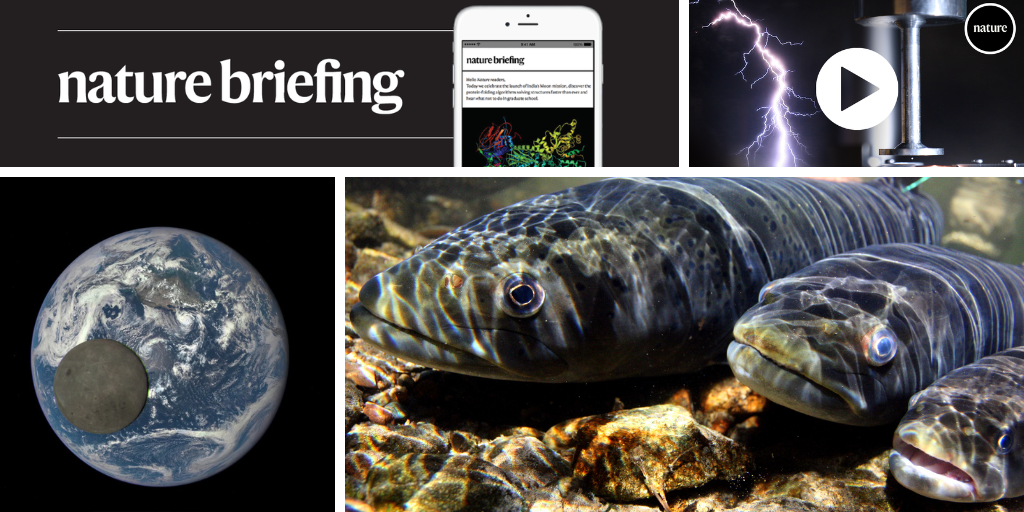
Siberian/Mongolian taimen (Hucho taimen), the world’s largest salmonid, can grow to over two metres long and are among the migratory species threatened by overfishing and habitat destruction. (Zeb Hogan)
Some of the planet’s greatest migrations happen in rivers, where fish such as salmon and sturgeon move nutrients, underpin food webs and support fisheries and livelihoods. But populations of migratory freshwater fishes have dropped by more than 80% since 1970. For the largest species, the story is even worse: numbers have dropped by 94%. Dams, overfishing and habitat destruction are to blame, says a new United Nations-led report. It calls for 325 border-crossing species to be added to the 24 already listed for international protection.
Reference: Convention on the Conservation of Migratory Species of Wild Animals report
Eye drops that contain drug-carrying molecules derived from pig semen can stop the growth of a retinal cancer in mice without affecting the animals’ vision. The drops contain tiny particles called exosomes that can penetrate the barrier around the retina so drugs can kill tumour cells without causing damage to the surrounding tissue. Researchers hope that the drops could be developed into a kinder treatment for children with retinoblastoma, which is currently treated with injections into the eye, chemotherapy or laser therapy.
Reference: Science Advances paper
Becoming a parent is much more detrimental to women’s academic careers than it is to men’s, lowering their chances of getting university jobs and tenure, and reducing their publication output. The reason, according to a large analysis of academics in Denmark, is that women have almost five times the amount of childcare responsibilities that men have. This is despite Denmark having paid parental leave, subsidized childcare and a widespread belief in equally shared household work. “Behaviours change much more slowly than attitudes,” notes economist Sofie Cairo.

Source: Ref 1.
Features & opinion

A NASA satellite’s camera captured the far side of the Moon as it passed in front of Earth.Credit: NASA/NOAA
NASA’s Artemis II mission, which is on track to launch as early as this Wednesday, will be the first time humans will leave Earth orbit in over 50 years. Putting people in space is incredibly hard — but convincing the public to keep going will be just as difficult, argues planetary scientist Bethany Ehlmann. Many people are sceptical of the value of crewed missions compared to other space-programme priorities, such as monitoring Earth’s climate. “Broadening who does space work — taking it out of solely NASA control rooms and also putting it into educational institutions and community centres — would strengthen engagement,” Ehlmann writes.
In The Paradox of the Organism, leading evolutionary theorists and philosophers explore the conflict between the idea that genes are ‘selfish’ — driven to increase their own chances of being transmitted to the next generation — and their requirement to work in harmony so as not to harm the organism as a whole. The book “doesn’t aim to resolve the conundrum once and for all, and raises as many questions as it answers”, writes evolutionary biologist C. Brandon Ogbunugafor in his review. But it “succeeds at making a challenging subject digestible”.
From Van de Graaff generators to flying kites in thunderstorms, scientists have spent centuries playing with the strange effects of static electricity — yet the details of the phenomenon remain mysterious. Now experiments show that carbon molecules could play a key role in how oxides gain static charge. Is this the long-hidden mechanism behind static electricity or just another piece of a complex puzzle?
On Friday, Leif Penguinson was exploring Terjit, an oasis in the Sahara Desert region of Mauritania. Did you find the penguin? When you’re ready, here’s the answer.
Speaking of Briefing staff lurking in unexpected places, if you’d like to see me leap out from behind a shrubbery (or Associate Editor Jacob Smith spin round in a chair like Dr Evil) then Nature’s new TikTok channel is the place to go.
Thanks for reading,
Flora Graham, senior editor, Nature Briefing
With contributions by Jacob Smith
• Nature Briefing: Careers — insights, advice and award-winning journalism to help you optimize your working life
• Nature Briefing: Microbiology — the most abundant living entities on our planet — microorganisms — and the role they play in health, the environment and food systems
• Nature Briefing: Anthropocene — climate change, biodiversity, sustainability and geoengineering
• Nature Briefing: AI & Robotics — 100% written by humans, of course
• Nature Briefing: Cancer — a weekly newsletter written with cancer researchers in mind
• Nature Briefing: Translational Research — covers biotechnology, drug discovery and pharma


