


You have full access to this article via your institution.
Hello Nature readers, would you like to get this Briefing in your inbox free every day? Sign up here.

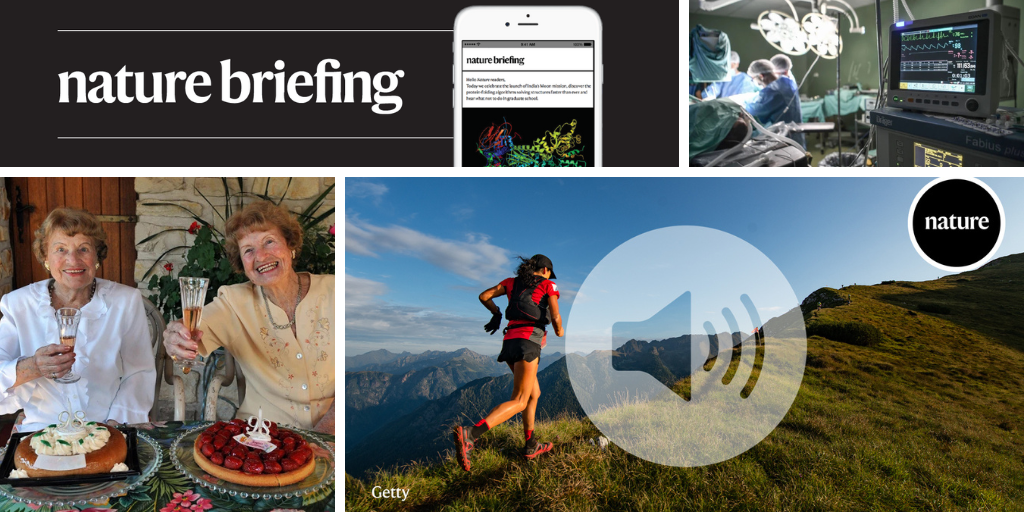
Researchers compared the similarity of lifespans of fraternal twins with that of identical twins like Raymonde Saumade and Lucienne Grare — shown here aged 98 — who both lived to over 105 years old. (Pierre Andrieu/AFP via Getty)
According to a new analysis, about 55% of the observed variation in longevity across a population is attributable to genetics — challenging previous estimates of 10–25%. Researchers say that earlier numbers were much too low because they did not effectively separate deaths caused by extrinsic factors, such as accidents, from intrinsic ones such as the gradual decline of organ function. Not all intrinsic causes of death are equally heritable, the researchers found — and the results don’t indicate a genetically encoded ‘destiny’ for lifespan, because so much is determined by environment and lifestyle choices.
Reference: Science paper
Scientists have identified a distinctive brain-wave pattern that marks the slide into unconsciousness during general anaesthesia with the drug propofol. Data taken from people about to have surgery show that, as anaesthesia takes hold, a specific type of activity in brain areas such as the parietal cortex and deeper structures slips out of synchronicity. If verified in studies that gather deep-brain data, and use other anaesthetics, this shift could serve as a biomarker of loss of consciousness that doctors could use to avoid sedating patients too deeply — or not deeply enough.
Reference: Cell Reports Medicine paper
“The synthesis of small molecules is the slow step in drug discovery and a number of other important areas,” says chemist Timothy Newhouse, co-author of a new paper about an AI system called MOSAIC. Instead of researchers having to trawl through millions of known chemical reactions and then test whether it is possible to synthesize them, MOSAIC recommends conditions to make potentially useful substances. In tests, researchers could successfully produce 35 of the 52 that the system suggested.
Features & opinion
Debates over what to eat — more protein, say, or less ultra-processed food — often neglect any mention of how our food systems affect the biosphere that keeps us alive. But nutrition doesn’t exist in a vacuum, notes Earth-systems scientist Johan Rockström. He co-chaired the latest update to the Planetary Health Diet, which aims to optimize human health globally and reduce environmental and social harms. It notes that “global greenhouse-gas emissions could be cut by 20% by 2050 by eating healthily, reducing food waste and adopting sustainable production practices”, writes Rockström. “If diets remain unchanged, however, emissions will increase by 33%.”
Reference: The EAT-Lancet Commission on healthy, sustainable, and just food systems report
A junior mapgrapher is forced to put style over substance in The unfortunate embossing of Subsector XZ-74.
“From ants to humans, individuals prefer rewards that have been harder to achieve,” note the authors of a new study that follows up on evidence that the key is the release of the neurotransmitter dopamine in the brain. “It’s another brain chemical called acetylcholine that actually does the magic,” co-author Neir Eshel tells the Nature Podcast. It “teaches dopamine how much effort the animal has put in and then augments or boosts the amount of dopamine that’s released when the reward is delivered”.
Nature Podcast | 24 min listen
Subscribe to the Nature Podcast on Apple Podcasts, Spotify or YouTube Music, or use the RSS feed.
Today Leif Penguinson is exploring Honey Island swamp in Louisiana. Can you find the penguin?
The answer will be in Monday’s e-mail, all thanks to Briefing photo editor and penguin wrangler Tom Houghton.
This newsletter is always evolving — tell us what you think! Please send your feedback to [email protected].
Thanks for reading,
Flora Graham, senior editor, Nature Briefing
With contributions by Jacob Smith
• Nature Briefing: Careers — insights, advice and award-winning journalism to help you optimize your working life
• Nature Briefing: Microbiology — the most abundant living entities on our planet — microorganisms — and the role they play in health, the environment and food systems
• Nature Briefing: Anthropocene — climate change, biodiversity, sustainability and geoengineering
• Nature Briefing: AI & Robotics — 100% written by humans, of course
• Nature Briefing: Cancer — a weekly newsletter written with cancer researchers in mind
• Nature Briefing: Translational Research — covers biotechnology, drug discovery and pharma


