


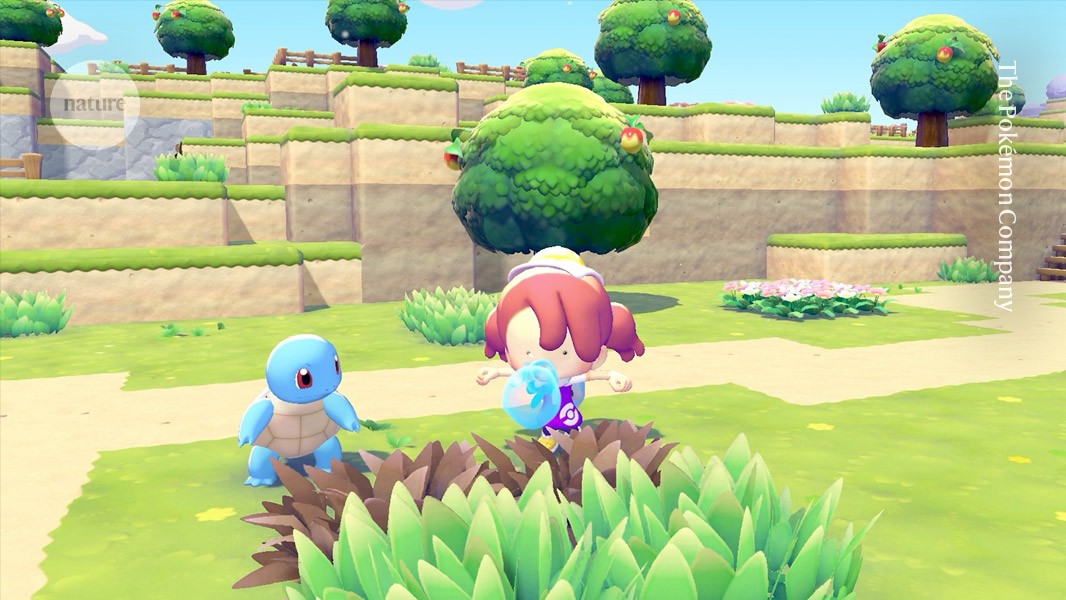

In Pokémon Pokopia, the player (right) learns how to water plants from Squirtle.Credit: The Pokémon Company
In Pokémon’s latest simulation game, named Pokémon Pokopia, players no longer catch creatures. Now, their role has evolved into one of restoring the deserted, post-apocalyptic Kanto region by using the skills of the Pokémon they befriend. Squirtle’s water gun — formerly a dependable weapon against opponents — now hydrates dry soil, preparing the ground for Bulbasaur’s leafage move to sprout fresh grass. A well-crafted habitat attracts wild Pokémon, each with distinct environmental needs. A grass-type such as Bulbasaur needs more humidity and vegetation than does a fire-type such as Charmander, for instance.
Get the balance right and a new species settles in. But if you don’t improve their homes, the residents become unhappy, halting game progression. The adaptive, interactive setting is a marked departure from earlier titles in the series, in which the environments served mainly as corridors between battles, or boxing rings during them, rather than as living worlds.
Evolving game design
The Pokémon Company in Tokyo is now recruiting scientists to push that immersion even further. A recent job listing on Japanese recruitment platform HRMOS asks for applications from PhD holders with research experience in animal and plant ecology, who will be assigned to various business divisions. The role requires no game-development skills, only a doctorate in science, engineering or agriculture, as well as fluency in Japanese and English. A PhD-specific bonus of one million yen (roughly US$6,300) is paid annually on top of the salary. (The Pokémon Company could not be reached for comment.)
The move seems unorthodox for a video-game company, but it fits a growing trend: entertainment studios are turning to academically trained professionals, whether as consultants, research partners or full-time staff members, to create immersion in a game through their knowledge of real-world dynamics.
The Pokémon Company has explored this route before. When Yoshinari Yonehara was hired in 2019, his experience included a doctorate from the University of Tokyo’s Graduate School of Agricultural and Life Sciences, with a specialization in animal behaviour and ecology. Yonehara’s work is credited in Pokémon Legends: Arceus, Pokémon Scarlet and Pokémon Violet. Together with freelance illustrator and ecology researcher Chihiro Kinoshita, a fellow University of Tokyo PhD holder, he wrote Pokécology (2025), a bestseller in Japan that applies real behavioural ecology to the franchise’s creatures. An English edition will be published on 23 April.

In Pokémon Scarlet and Pokémon Violet (pictured), players (centre) run and ride through an open world inhabited by Pokémon.Credit: The Pokémon Company
“I think it’s highly significant that Pokémon is hiring ecologists,” says Alenda Chang, an environmental media scholar at the University of California, Santa Barbara. Her 2019 book, Playing Nature, examines how games represent the natural world and intersect with ecological crises. “It demonstrates a real investment in ecological richness, which I think games sorely need, especially games like theirs that are all about wild species and habitats,” she says.
Research suggests that these design choices have real impact. A study in Frontiers in Education found that game-based learning significantly improved knowledge about and attitudes towards the environment in primary-school students1. This might indicate that interactive gameplay fosters deeper engagement with ecological issues than do conventional instruction methods.
Other video-game developers have pursued variations on this world-building approach. Ubisoft Montreal in Canada has long relied on historians and cultural specialists for advice on its Assassin’s Creed series, which launched in 2007 and has since reconstructed settings from the Crusades-era Holy Land during the twelfth century to feudal Japan during the sixteenth century. For Assassin’s Creed Origins (2017), which is set in ancient Egypt (first century bc), the studio embedded historians and Egyptologists directly into the production team, securing deals with universities and enlisting linguists to reconstruct approximations of ancient Egyptian speech.
The game also introduced Discovery Tour, a combat-free mode that turns some of the ancient worlds included in the Assassin’s Creed series into living museums, with guided tours curated by academics. Guerrilla Games in Amsterdam took a parallel route for Horizon Zero Dawn, an open-world game set on a far-future Earth overrun by robotic creatures. The studio consulted robotics researchers at Delft University of Technology in the Netherlands to develop the aesthetics of the artificial ecosystem.

