


You have full access to this article via your institution.
Hello Nature readers, would you like to get this Briefing in your inbox free every day? Sign up here.

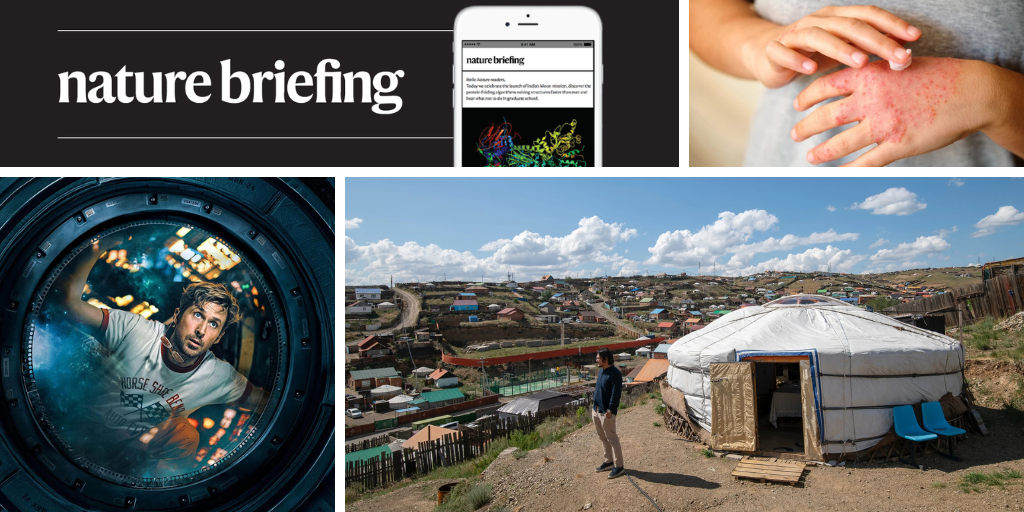
Ryan Gosling stars as a scientist who wakes up alone in deep space in Project Hail Mary.Credit: Amazon MGM Studios/Landmark Media/Alamy
The film Project Hail Mary grounds its plot — a quick-witted loner saves the day — in a sunny worldview and plenty of science, writes Nature’s Alexandra Witze. “Seeing characters who think scientifically as living, breathing, funny people is very refreshing,” says Andy Howell, an astronomer who advised on the book that inspired the movie.
Researchers have identified a network of neurons that could explain why stress fuels the symptoms of eczema. In mice with atopic dermatitis, a type of chronic eczema, researchers found that these neurons produce inflammatory proteins in response to stress signals from the central nervous system. These molecules lure immune cells called eosinophils to the skin, which drive further inflammation. The findings could lead to targeted treatments that block the activity of these nerves, or the molecules they produce, if the same mechanism is at play in people.
Mitochondria — the powerhouses of the cell — wrapped in a clever disguise can slip into cells whose own energy-factories are defective to bolster them. Researchers found that a mitochondrion cloaked in the membrane of a red blood cell could enter a cell without triggering any of the protective mechanisms that would typically destroy them. Administration of these incognito organelles to mice with a deadly disease caused by faulty mitochondria prolonged the animals’ lives.
An archeological site that overturned the history of humans in South America might just do it again. Radiocarbon dating pegged artefacts from Monte Verde, in southern Chile, at 14,500 years old — suggesting that people arrived along the continent’s coast, before the ‘Clovis people’ travelled through an ice-free corridor in North America. Not so, says a new study: those artefacts were mis-dated and originated no more than 8,200 years ago. “This is going to cause a furor in the field,” says retired archaeologist Stuart Fiedel, a critic of pre-Clovis sites, including Monte Verde. “There’s going to be a fight.”
Features & opinion

Credit: Dave Tacon for Nature
“I specialized in proton therapy for cancer treatment, but after working in labs for almost seven years, I wanted to do something good for my home city,” says Erdenemunkh. (Dave Tacon)
Ulaanbaatar, Mongolia’s capital, is among the world’s most toxic cities — with coal burnt in the furnaces of traditional ger (also known as yurt) housing responsible for most of the smog. Unurbat Erdenemunkh, a former experimental physicist, pivoted from a career abroad to focus on developing climate solutions for his home region. His flagship project is Coal-to-Solar, a pilot programme that works with ger-dwelling families to swap their furnaces for solar panels, assisted by heat-storage bricks, batteries and insulation.
A person and a robot debate what will become of humanity in the latest short story for Nature’s Futures series.
In Gilded Rage, journalist Jacob Silverman describes how some of the United States’ wealthiest men, who have enriched themselves during the technology boom of the past 20 years, are branding themselves as ideological ‘rage pundits’. “Silverman shows how some of the world’s most powerful figures have recast themselves as the most aggrieved,” writes reviewer Ramesh Srinivasan, the founder and director of the Digital Cultures Lab at the University of California, Los Angeles. “Amid this spectacle, Silverman identifies a broader bait and switch” in which hostility to ‘big government’ and the undermining of democracy relies on public contracts, subsidies, regulatory advantages and taxpayer support.
Extracted from the bark of trees of the Cinchona genus, quinine was the first effective treatment for malaria and is the deliciously bitter soul of tonic water. And that’s just the best known of the cinchona alkaloid family of compounds, which also includes other drugs and important chemical catalysts. But how plants make these architecturally complex molecules has remained an open question. Now, researchers have revealed the steps in the chemical pathway that the plants use — which could lead to even more useful molecules.
Nature Podcast | 15 min listen
Subscribe to the Nature Podcast on Apple Podcasts, Spotify or YouTube Music, or use the RSS feed.
Today, Leif Penguinson is investigating lines of glacial crevasses on Mount Tronador in Argentina. Can you find the penguin?
The answer will be in Monday’s e-mail, all thanks to Briefing photo editor and penguin wrangler Tom Houghton.
This newsletter is always evolving — tell us what you think! Please send your feedback to [email protected].
Thanks for reading,
Flora Graham, senior editor, Nature Briefing
With contributions by Jacob Smith
• Nature Briefing: Careers — insights, advice and award-winning journalism to help you optimize your working life
• Nature Briefing: Microbiology — the most abundant living entities on our planet — microorganisms — and the role they play in health, the environment and food systems
• Nature Briefing: Anthropocene — climate change, biodiversity, sustainability and geoengineering
• Nature Briefing: AI & Robotics — 100% written by humans, of course
• Nature Briefing: Cancer — a weekly newsletter written with cancer researchers in mind
• Nature Briefing: Translational Research — covers biotechnology, drug discovery and pharma


