


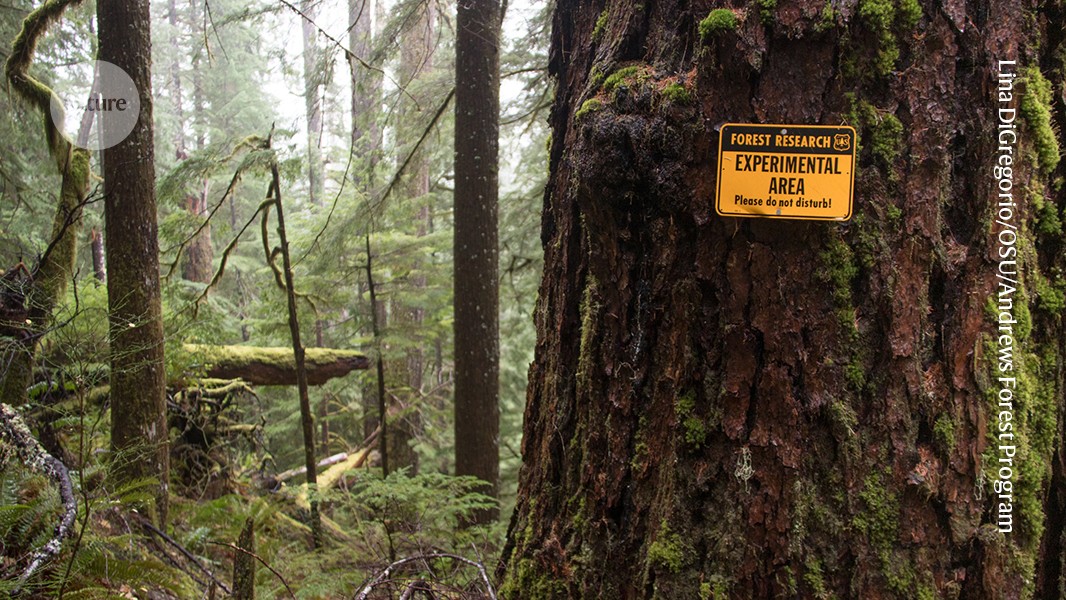

Long-term research in forests, such as the H. J. Andrews Experimental Forest in Oregon, is vulnerable when funding is episodic.Credit: Lina DiGregorio/OSU/Andrews Forest Program
This year, the US Department of Agriculture will close its office of forest-service research in Portland, Oregon — and similar ones nationwide. For a century, this office and its research station have managed wildfire prevention, scientific research and conservation across the Pacific Northwest.
Ecologists: don’t lose touch with the joy of fieldwork
What is at risk is not particular grants, but the idea of long-term, place-based research itself. As a socio-ecologist working in this region, my immediate concern is what the loss means for research: the quiet disappearance of decades of institutional memory, field sites, data and the human relationships that make sustained enquiry possible.
My own research projects — linked to the ecology of western US forests, and wolf and moose populations near Lake Superior in the Upper Midwest — have always depended on continuity more than novelty: on long time series, careful measurement and slow, cumulative reflection and understanding. Such diligent work is particularly vulnerable when funding becomes episodic and politically fragile. You cannot easily pause a 60-year data set or mothball a forest and expect to pick up where you left off.
Now I face the hard truth that not everything can be saved, and I’ve had to think about what that means. This moment is not just about tightening belts or looking for new sources of funding. It is about recognizing that the conditions under which the US research culture was formed are changing, perhaps for a long time, perhaps permanently. We are living through a period in which the scaffolding underpinning entire bodies of knowledge is no longer secure. US environmental scientists need to recognize this and adjust how we work and what we value most.
‘I rarely get outside’: scientists ditch fieldwork in the age of AI
Naming our reality matters, because it frees us to think differently about what research can be. When resources contract, the most responsible response is not to strengthen commitment to expansionary habits, but to ask what we are actually trying to protect. Is it every individual project, or is it the capacity of our research communities to keep asking meaningful questions, train thinkers and preserve what we already know? Those are not the same thing.
Many scientists are still in a phase of trying to preserve their entire pre-crisis research footprint by stretching existing projects and finding pockets of money to keep laboratories running. That is a natural first response, but not a sustainable one. If we don’t find fresh ways of keeping science moving forwards, those bearing the cost will be the most vulnerable members of our community: graduate students, postdocs and early-career scholars, cast aside from languishing projects.
The shift in research culture has pushed me to remember something that researchers in the arts and humanities have long known. Philosophers, historians, literary scholars and artists have spent decades building rigorous, generative bodies of work with minimal external funding. Their tools include close reading, archival work, collaboration, theory and — crucially — imagination. They know how to make research thrive when money is scarce, because it usually is.

The Wolf–Moose Project has studied the predator–prey system on Isle Royale in Lake Superior, Michigan, for more than 65 years.Credit: Sarah Hoy/Michigan Technological University
Many of us working in more-generous scientific research environments must now learn that lesson. Intellectual life does not end when familiar structures collapse. Instead, it requires imagination to continue.

