


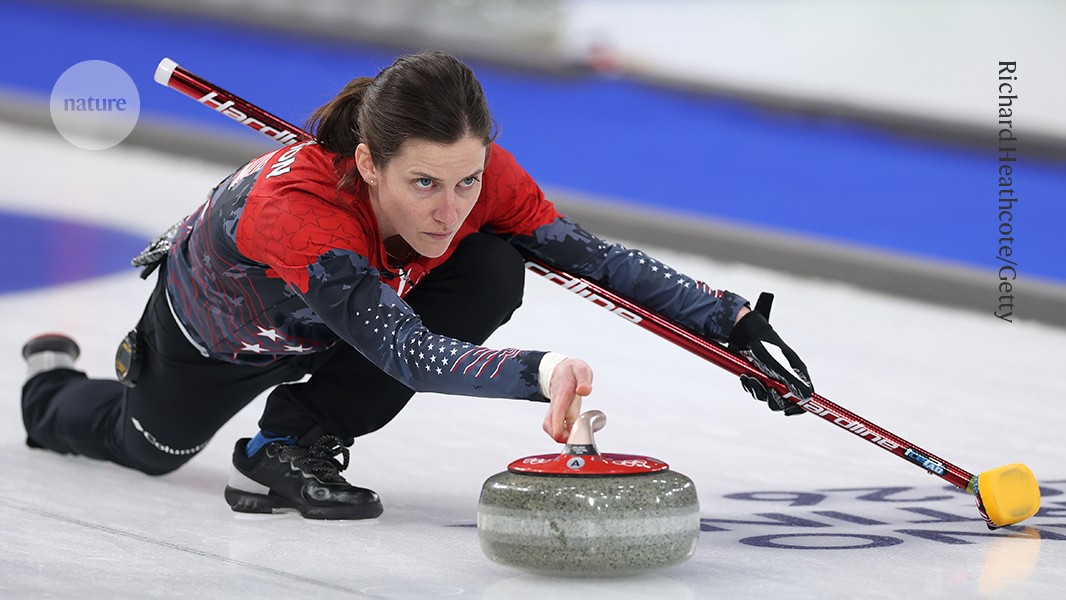

Tara Peterson of the US women’s curling team ‘throws’ a curling stone during the semifinal match against Team Switzerland at the Winter Olympics in Italy.Credit: Richard Heathcote/Getty
Athletes seem to be testing the laws of nature every day in the 2026 Olympic Winter Games in Italy, with figure skaters spinning four full times in a single jump and bobsledders withstanding forces five times stronger than gravity. But one sport in particular is fascinating scientists. After more than a century of research, physicists still don’t entirely understand curling. Specifically, why the heavy granite curling stones move in the opposite way to what is expected as they travel across the ice.
The mathematician who helps Olympic swimmers go faster
The sport of curling, which made an appearance at the inaugural 1924 Winter Olympics, involves two teams of four taking turns to slide granite stones weighing about 19 kilograms across a sheet of ice towards a target. Each team member gives two of the roughened stones a push across the ice — which is scattered, or ‘pebbled’, with frozen water droplets — while applying some spin. This ‘throwing’ action arcs, or curls, the stones towards the target. If the athlete spins a stone clockwise, it will eventually curl to the right, and vice versa. Meanwhile, other team members engage in ‘sweeping’, which involves brushing the ice to help the stone travel. Eventually, however, the stone slows to a halt owing to friction against the pebbled surface.
Although the ultimate goal of the game is simple — to be the team with a stone (or stones) closest to the target — curling’s inner physics is perplexing. If you spin a round object such as a bowl clockwise on the floor while pushing it forwards, you’ll find, time and time again, that it curls to the left — the opposite of what you see in the Olympics livestream.
Curling camps
Physicists have been trying to determine why curling stones behave differently since around the time the sport first appeared in the Olympics. But no one clear answer has emerged, and some scientists have split into camps supporting different hypotheses.
One idea is that, when a stone spins clockwise, its running band — the rough circle on its underside that is in contact with the ice — creates scratches in the pebbled surface1. As the back end of the rotating stone runs into scratches left by the front end, it veers right, says Sean Maw, who studies winter sports engineering at the University of Saskatchewan in Saskatoon, Canada.
In 2016, physicists also published a paper2 describing a ‘pivot–slide’ model, which suggests that the stone’s overall arc across the ice is composed of many smaller movements. With a clockwise-rotating stone, for instance, a point on its right side will catch on the ice, causing it to pivot slightly, until it unlatches and glides forwards. This continues, and, the hypothesis goes, many small pivots in a row create a curling effect. This “happens more easily further down the ice because the speed of the rock is reduced”, says Mark Shegelski, a physicist at the University of Northern British Columbia in Canada who is a co-author on the 2016 paper.

