


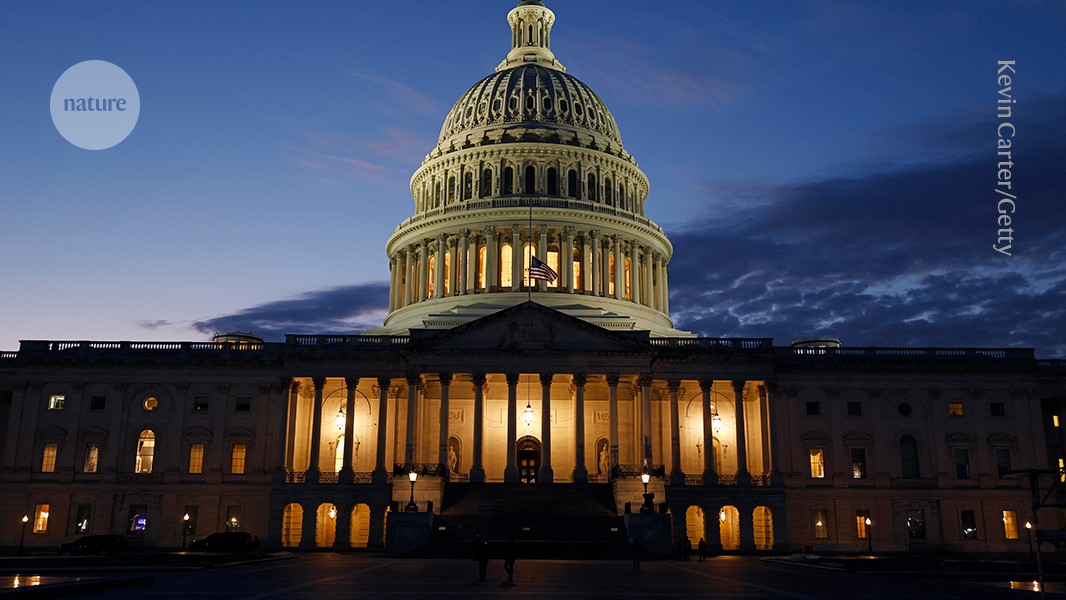
Some members of Congress (who work on Capitol Hill, pictured here) are calling on the US budget office to authorize research funds that they signed into law for 2026.Credit: Kevin Carter/Getty
Weeks after the US Congress rejected unprecedented cuts to science budgets that the administration of US President Donald Trump had sought for 2026, funding to several agencies that award research grants is still not freely flowing.
US Congress set to reject Trump’s sweeping science budget cuts
One reason is that the White House Office of Management and Budget (OMB) has been slow to authorize its release. The US National Institutes of Health (NIH) has so far not received approval to spend any of the research funding allocated in a budget bill signed into law on 3 February. The US National Science Foundation (NSF) was authorized to spend its funding just last week. And NASA has had its full funding authorized for release, but with an unusual restriction that limits spending on ten specific programmes — many of which the Trump team had tried to cancel last year.
The OMB did not respond to Nature’s queries about these moves or when the outstanding funding might be approved. OMB director Russell Vought has said in the past that the office’s role in doling out government funding can be an “indispensable statutory tool” to ensure that agencies are not wasting public funds and are adhering to White House priorities. Vought has also said that the OMB can provide less funding than what Congress has appropriated.
“This is a drastic departure from historical practice,” Rosa DeLauro, the ranking member of a US House of Representatives committee that drafts government spending bills, told Nature. DeLauro, a Democrat from Connecticut, and Patty Murray, a Democrat from Washington who is the ranking member of a similar committee in the US Senate, demanded that the OMB release funds, as is required by law. (The Republican chairs of the two committees, Representative Tom Cole, of Oklahoma, and Senator Susan Collins, of Maine, did not respond to Nature’s queries about the delays.)
Going slow
Usually, after a full-year budget bill is signed into law, US agencies automatically receive permission to spend a 30-day portion of their annual funding right away. This permission is awarded automatically every 30 days until the OMB approves the agencies’ spending plans, which unlocks more funds.
But the OMB tweaked the rules for fiscal year 2026. Last August, it revised a little-known document nicknamed the Budget Bible, officially the Circular A-11, to restrict these 30-day portions to cover only essential expenses such as employee salaries.

Source: NIH Reporter; adapted from Jeremy Berg
“It’s a way for the White House to assert more control over how agencies spend their money,” says Samuel Bagenstos, who was the top lawyer for the OMB under former US president Joe Biden, a Democrat.
Until its newly appropriated budget is released, the NIH, the world’s largest public funder of biomedical research, can issue new research awards only using leftover money from funds approved by Congress last November. These were meant to be a stopgap until the NIH’s budget bill passed this year. The agency has received about one-third of its US$47-billion budget from this measure, and new grant awards have slowed to a trickle (see ‘Grant slowdown’).
At the NSF, which funds about 25% of federally supported basic research at US colleges and universities, spending had been mostly restricted to paying for staff salaries and running facilities, such as the Antarctic field stations it operates, until last week. That’s when the OMB authorized the agency’s research funding for 2026, about three weeks after Trump signed the NSF’s budget bill into law.
These delays, paired with a record-breaking 43-day shutdown of the government in October to November that paused grant-application reviews and agency work, have caused the NIH to award only about 30% as many new research grants during this fiscal year as it had by this time in each of the past six years. That figure for the NSF is about 20%. (The fiscal year began on 1 October.)
An NSF spokesperson told Nature: “With full-year funding now in place, NSF expects award activity to proceed while continuing to support critical research.”
The NIH and the White House referred Nature’s queries to the OMB, which did not respond.
Rare restriction
Meanwhile, at NASA, in a footnote to a 21 February budgetary notice about science funding, the OMB told the agency it could not spend new money on ten specific science programmes until it provides more details on how the funds will be used. Normally, NASA has the discretion to begin working on missions once Congress has approved the budget. The projects in question include missions to Venus and to an Earth-threatening asteroid, as well as Earth-science satellites.

US science after a year of Trump: what has been lost and what remains

