


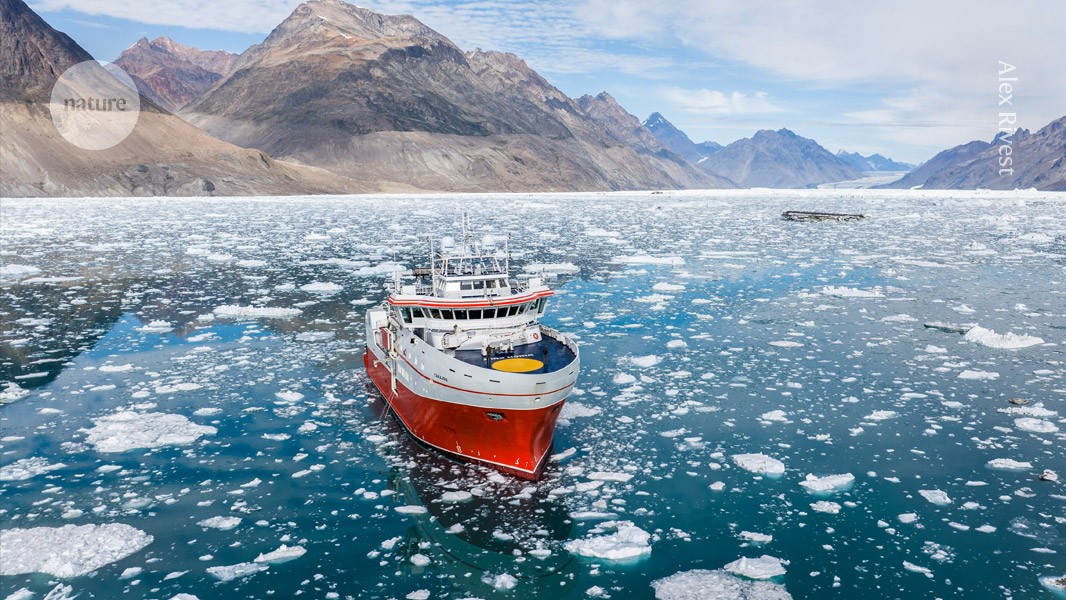
The research vessel Tarojoq is the biggest research investment by Greenland’s government to date.Credit: Alex Rivest
The streets of Nuuk, Greenland, were bustling in November — not from protests or military exercises, but from scientists who converged on the Arctic island to discuss the cutting-edge research taking place there. The conference, known as Greenland Science Week, had a theme of ‘All Eyes on Greenland’ — a particularly resonant title following US president Donald Trump’s threats to take over the island, which gripped the world over the past week.
Science in Greenland, also known as Kalaallit Nunaat and currently an autonomous territory of Denmark, is globally important and it is booming. Over the past five years, its government has taken steps to prioritize science, strengthen research infrastructure and bolster collaborations between scientists working there and the international scientific community.
On 21 January, global tensions eased somewhat when Trump ruled out using military force to take the island. But he also reiterated his desire for the United States to get ‘total’ access to Greenland after speaking to reporters on his way back from the World Economic Forum in Davos, Switzerland. Further talks between Trump and European leaders are expected, and much uncertainty remains. What, if anything, these tensions mean for research in Greenland is unclear.
Unique for research
The history of research in Greenland includes science stemming from Inuit traditional knowledge, European polar explorations and US military expeditions. By the 1990s, the island had become a global centre for climate-change research, after European- and US-led teams drilled ice cores deep into Greenland’s ice sheet to reveal past changes in climate1,2.
Today, climate scientists from around the world measure, analyse and predict changes in Greenland’s ice sheet. If it were to melt entirely, the ice sheet would raise the global sea level by 7.4 metres; last year, it lost an estimated 129 billion tonnes of ice, and it is responsible for around 20% of current sea-level rise, or about 0.8 millimeters a year.
But “Greenland is about more than just ice and climate indicators”, says a 2022 document from Greenland’s government that laid out its first-ever research strategy. Greenland is also a hub of geological and minerals research, given its unique geology and its promise of holding many critical raw materials such as lithium3. And Greenland is a unique place for genetic and biomedical research, given that its mostly Inuit population has been living around the edges of an icy island for millennia; that physical isolation led to genomic and other changes unlike anywhere else in the world4.
The 2022 plan, which lays out the island’s research priorities up to 2030, emphasized that research needs to be anchored in Greenland and to respond to social needs while being open to international collaboration and with findings being made available to everyone.

Researchers have been studying Greenland’s glacial ice sheet to monitor the evolution of surface lakes and the motion of the surrounding ice sheet.Credit: Joe Raedle/Getty
A burgeoning research community
The strategy has helped to bolster the island’s tiny research community. One big initiative is the research vessel Tarojoq, which is the largest research investment by Greenland’s government so far. It came into operation in 2022, costing 235 million Danish kroner (US$37 million) from the government and private foundations.
Last August, in one of its many expeditions, the Tarojoq and its crew brought a team led by Fiamma Straneo, a polar scientist at Harvard University in Cambridge, Massachusetts, to study how glacial meltwater interacts with the rich ecosystem in a fjord in eastern Greenland. The ship’s agility allowed the team to sail close to the water’s edge, deploying scientific instruments to continue long-term observations of changes in this crucial part of the Arctic5. “This ship is incredibly useful to our research,” Straneo says.
Other new infrastructure includes Greenland’s first artificial-intelligence-enabled computing resources, which were installed last year at the Greenland Institute of Natural Resources in Nuuk. Researchers are using this server for studies such as identifying and classifying marine species in video and acoustic data gathered underwater, says Diana Krawczyk, a polar scientist at the institute. Such tasks used to take weeks or months, but scientists can now rapidly perform studies such as modelling and forecasting the location of fish and other marine resources in the waters around Greenland.

