


Which animals came first? For more than a century, most evidence suggested that sponges, immobile filter-feeders that lack muscles, neurons and other specialized tissues, were the first animal lineages to emerge. Then, in 2008, a genomic study pointed to a head-scratching rival1: dazzling, translucent predators called comb jellies, or ctenophores, with nerves, muscles and other sophisticated features.

Ancient sea jelly makes tree of life wobble
That single study ignited a debate that has raged for nearly 20 years, sparking fierce arguments about how complexity evolved in animals. But after dozens of studies — some of which analysed and reanalysed the same data and reached different conclusions — the debate has become entrenched, some researchers say.
“Where it might have been healthy for people to engage with curiosity and an interest in finding the truth together, it became a battle,” says Nicole King, an evolutionary biologist at the University of California, Berkeley, who co-authored a paper last November that landed cautiously on ‘team sponge’2.
She has since asked to retract the paper because of flaws identified after its publication, and is reconsidering whether she wants to be part of the debate in the future. Scientists, including King, argue that a different approach is needed: one in which researchers from both sides work together to answer the question.
Fresh ideas — and attitudes — would catalyse progress, they say. “We must think out of the box,” says Leonid Moroz, a neuroscientist at the University of Florida in Gainesville, whose work has supported comb jellies as the lineage at the root of the animal family tree3.
The first animals emerge
Around 600 million to 800 million years ago, radically different organisms emerged. Instead of consisting of lone cells, like all previous life did, these creatures were formed of multiple, interacting cells. Multicellularity was so successful that it sparked an explosion in innovative body forms and new ways to sense and respond to environments.
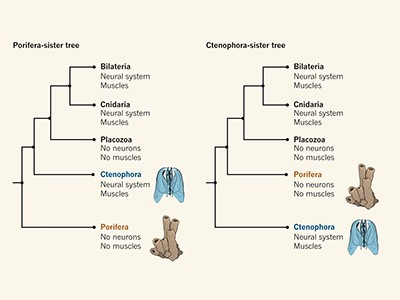
In an evolutionary blink of an eye — perhaps within tens of millions of years — five major groups of animals appeared. As well as the ancestors of modern-day sponges and comb jellies, there were placozoa (now represented by blob-like marine invertebrates); cnidarians (modern members of which include jellyfish and sea anemones); and bilaterians that show mirror-image body symmetry in early development that would give rise to invertebrates, including starfish, snails and spiders, and vertebrates, including humans (see ‘Tree of life — now with two options’).

Source: Ref. 2 and M. Telford et al. Nature 529, 286–287 (2016)
Fossil evidence of the earliest animals is sparse and hard to decipher — a porous cavity here or a branching tube there. Identifying the first animal lineage, along with knowledge of its modern-day descendants, is another way to gain insight into these early creatures. “Knowing this will tell us something, not everything, about what those first animals might have looked like,” says Max Telford, an evolutionary biologist at University College London. Evolutionary biologists sometimes call this first animal the ‘sister’ to other animal groups, because it shares a common parent with all of them.
For more than a century, most scientists placed the sponge lineage at the base of the animal tree, mainly because modern-day sponges lack many of the features that define other animals, including specialized tissues such as muscle, nerve and gut, which were thought to have evolved later. “If the sponge tree were right, everything would just rather fall into place,” says Telford. But when scientists turned to rapid genome sequencing to confirm this seemingly settled picture, it fell apart.
Evolutionary biology’s epic battle
Casey Dunn, an evolutionary biologist now at Yale University in New Haven, Connecticut, never planned to kick off a decades-long debate. But the arrival of faster and cheaper DNA-sequencing technologies in the early 2000s inspired Dunn and his colleagues to build the animal tree of life using genome data — one of the first such efforts.
They analysed thousands of gene sequences from 77 organisms — from sponges to sea spiders, and chickens to corals. The study was the first to include comb-jelly genome data, says Dunn, but “going into this we had no idea we would get a result other than sponges are a sister to the rest of animals”. Their 2008 conclusion that comb jellies, not sponges, were the first animal group1 landed like a bombshell.

The idea that comb jellies were the first animal lineage landed like a bombshell.Credit: Alex Mustard/Nature Picture Library
The finding drew two kinds of response, says Dunn. One was open-minded curiosity. “Maybe the common wisdom that is in the first few chapters of zoology textbooks isn’t correct,” he says. “There was another response where a variety of folks were like, ‘Hey, sponges have always been the sister and they always will be.’”
Dozens more papers followed, some using new data sets, different methods of analysis or both. Some gave further support for comb jellies as the lineage at the root of the animal family tree, others re-established sponges as the sister to all other animals (see ‘Papers ping-pong’). Journals published essays, perspectives and other expert analyses, while institutional press releases and media coverage sometimes painted each advance as the final word. “It fell into this sort of back and forth of trying to disprove each other, and then with each subsequent pronouncement saying this is the answer,” says King.

Source: Ref. 2
Unlike the sponge-sister hypothesis, which fits neatly with the apparent simplicity of modern-day sponges, putting comb jellies at the root of the animal tree raises new questions. One is how complex tissues such as nerve, muscle and gut could be present in the first animals but absent in members of some later lineages. One possibility is that these tissues evolved not just once, but independently in multiple lineages. Another option is that those features were present in the first animals, but were lost in later lineages, including sponges. Some biologists think that a similar loss occurred in the placozoa lineage, the modern members of which also lack nervous systems and muscles.
A sisterly dispute
The two camps tend to segregate by discipline, observes Antonis Rokas, an evolutionary geneticist at Vanderbilt University in Nashville, Tennessee. Sponge-sister proponents mostly have backgrounds in zoology and evolutionary-developmental biology. For these scientists, the gradual accrual and elaboration of complex traits was compelling.
Those arguing for a comb-jelly sister, meanwhile, are often trained in genomics, and are more open to the idea that complexity could evolve independently and was routinely gained and lost. Rokas counts himself in this group. “I’m not going to say this is the answer because I’ve been around long enough,” he says.
The struggle to look back
The challenge of piecing together the origin of animals that existed hundreds of millions of years ago using modern-day genome sequences is similar to that faced by astrophysicists discerning the early history of the Universe from the night sky, says Rokas. “The signal is low, it has travelled a long distance and there are multiple things that can erode that signal.”
To determine which of the two lineages — comb jelly or sponge — are at the root of the animal family tree, scientists are hunting for signs of the small number of genetic variations that appeared in a very specific time window: after the first animal lineage diverged and before the next one branched off. These are all that distinguish that first lineage from successive branches before each one starts to follow its own evolutionary path.

Modern sponges, such as Aplysina fistularis, are seemingly simple creatures.Credit: Alex Mustard/Nature Picture Library
But it’s tricky to find this genetic signal. The window might have lasted fewer than five million years, say researchers, less than the time since humans and chimpanzees (Pan troglodytes) shared a common ancestor, meaning that there wasn’t long for many changes to accumulate. And the signal’s trace faded quickly: after the animal lineages started evolving independently, some 600 million years ago, these early gene variations would have quickly become lost or obscured among newer changes along specific lineages.
When looking for such a weak signal, seemingly minor decisions can exert a major influence on the conclusion. In a 2021 analysis4, for example, Rokas and his colleagues found that whether a study comes to a sponge-sister or comb-jelly-sister conclusion can depend on which non-animals — called outgroups — are included in the analysis, as well as various assumptions about how different gene sequences evolve.
“These are good people earnestly trying to get a good answer, but the puzzle is really hard,” says evolutionary biologist Sean Carroll at the University of Maryland, College Park.

