


You have full access to this article via your institution.
Hello Nature readers, would you like to get this Briefing in your inbox free every day? Sign up here.
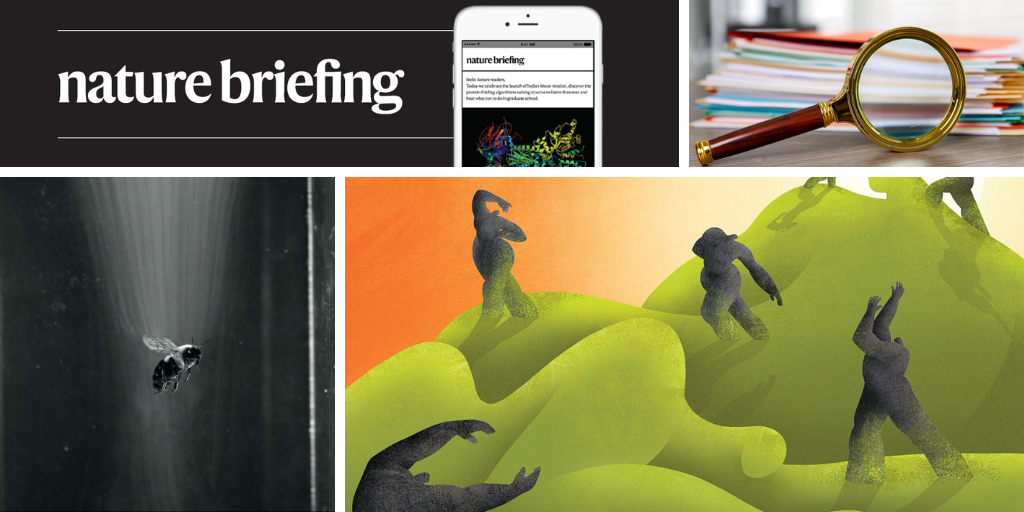
Researchers studying how bees regulate their body temperatures while they hover hope to understand how the insects might withstand a changing climate. (J.R. Glass et al./Proc. R. Soc. B (CC BY 4.0))
The breeze that bumble bees (Bombus impatiens) generate by flapping their wings stops them from overheating as they hover in place. To hover, bees’ large wing muscles must work overtime, which generates heat. Researchers found that the insects counteract this warmth by creating a downbreeze that can lower their body temperature by around 5 °C, which could explain how they can stay aloft for long periods even on hot days.
Reference: Proceedings of the Royal Society B paper
Researchers in France and the Netherlands are offering funds and resources to nanoscientists to try to replicate a landmark finding that quantum dots can act as biosensors inside living cells. The project, called NanoBubbles, is part of the first large-scale effort in the physical sciences to tackle the reproducibility crisis. The team decided to recruit other researchers after they failed to replicate the results in question themselves. “We are trying to use replication as a tool to solve a controversy or, you know, to get closer to the truth,” says physicist and NanoBubbles co-lead Raphaël Lévy.
An international team of scientists has retrieved a 228-metre-long sample of ancient rock and mud from the heart of West Antarctica — the longest core ever retrieved from below an ice sheet. Preliminary data, based on the presence of fossilized algae, suggests that the core represents an archive of the past 23 million years. The team hopes to determine how far the West Antarctic Ice Sheet retreated during previous periods of global warming, and whether there is a temperature threshold after which its retreat becomes irreversible.
Features & opinion
A change in diagnostic criteria, alongside increased awareness and screening, has meant that more adults are being diagnosed with autism than ever before. And yet, researchers know almost nothing about how autism might affect people as they age, largely because autism research has historically focussed on children and adolescents and studies of ageing often exclude autistic people. Some studies suggest that adults with autism might be more susceptible to health conditions such as heart disease, and could have unique care needs as they get older — making it imperative to include them in research.

Source: Ref. 6
With offers of eye-wateringly-high salaries, tech giants such as Google and MetaAI emphasize the ‘worth’ of individual experts over that of teams. This approach risks eroding the idea of science as a collaborative endeavour, argue data scientist Nathan Sanders and security technologist Bruce Schneier. Building strong academic institutions is a more effective use of resources than betting on a single individual. Universities should put innovation above profit by equitably distributing salaries, forging networks of researchers at different career stages and rewarding those who focus on public good, the pair write.
The proposed updates to the ‘bible for psychiatry’ — The Diagnostic and Statistical Manual of Mental Disorders (DSM) — to include data on the biological, environmental and cultural causes of mental-health conditions are “just tinkering with a flawed approach”, argues psychiatrist Jim van Os. Such changes would refine clinicians’ ability to diagnose individuals, but might not result in those individuals receiving better care. Researchers should adopt an approach that’s based on people’s needs — encompassing mental health, primary care and social care — and not specific diagnostic labels, van Os writes.
Today I’m welcoming in the Year of the Horse, and waving goodbye to the International Year of Quantum Science and Technology (IYQ). Scientists officially brought the year, which marked a century since the initial development of quantum mechanics, to a close at a conference in Ghana last week. The proceedings included a recital of the winning entry of the IYQ Brilliant Poetry Competition, “Spooky Action at a Distance”, by poet Gary Hugh Day.
Send us your feedback on this newsletter — in poetry or prose — to [email protected].
Thanks for reading,
Jacob Smith, associate editor, Nature Briefing
• Nature Briefing: Careers — insights, advice and award-winning journalism to help you optimize your working life
• Nature Briefing: Microbiology — the most abundant living entities on our planet — microorganisms — and the role they play in health, the environment and food systems
• Nature Briefing: Anthropocene — climate change, biodiversity, sustainability and geoengineering
• Nature Briefing: AI & Robotics — 100% written by humans, of course
• Nature Briefing: Cancer — a weekly newsletter written with cancer researchers in mind
• Nature Briefing: Translational Research — covers biotechnology, drug discovery and pharma

