


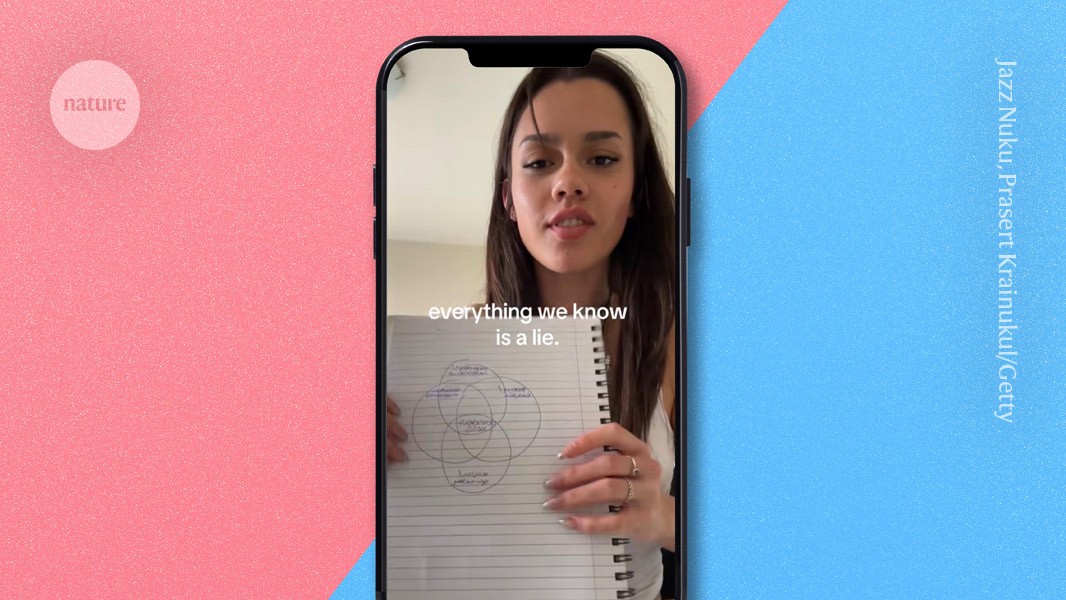

In October last year, psychology student Jazz Nuku posted a video to the social-media platform TikTok explaining the overlap that she had observed between evolution, physics, psychology, religion and the perception of reality.Credit: Jazz Nuku, Prasert Krainukul/Getty
One evening a few months ago, I opened an e-mail from a former student. She had made a short video about consciousness and perception and posted it on the social-media platform TikTok. It had gone viral, racking up four million views and thousands of comments since its release in October, many of them serious discussions about the ideas she had shared.
I watched it expecting something polished. Instead, I saw hand-drawn pictures: overlapping circles showing how consciousness might sit at the intersection of quantum physics, evolutionary biology, psychology and religion. Her language was unscripted. Her leaps were bold. She was trying to convey something I remembered feeling as a psychology student myself — the moment when the gap between perception and reality truly hits home, and you realize that your own mind is not what you thought it was.
What moved me wasn’t her scientific precision. It was the wonder in her voice. She wasn’t explaining for marks. She was marvelling, out loud, to strangers on the Internet and somehow that marvel had travelled through the screen to millions of people, who stopped scrolling and started thinking.
TikTok was perhaps the last place I expected to find serious discussion about biological psychology and consciousness. But here it was. And watching her, something clicked for me: maybe what we can offer as science educators is not information itself, but the excitement and meaning we derive from the topics we teach. And we can hope that our students will carry that wonder with them into the world.
Teaching through personal stories
Over the past three years, since the public release of OpenAI’s artificial-intelligence chatbot ChatGPT, I have been rethinking the strategies that I use to keep the students in my large undergraduate courses engaged, and prioritizing what they might gain from learning with a human. A staff meeting made me realize that I wasn’t alone in re-evaluating my teaching methods: my colleagues and I gathered to share how our experiences of teaching had changed since the use of generative AI models became widespread.
In the meeting, the mood was heavy. One colleague was visibly upset. A student had told him that they trusted an AI-generated explanation more than his own. ‘I don’t know what to do any more’ was a sentiment that was shared by most of us, including myself. We all felt that students were slipping away. The engagement that I used to take for granted had become harder to find.
I teach courses on biological psychology, which many psychology students approach with dread — it’s heavy on technical terms and mechanisms, and the content can feel distant from their lives. Making this material feel engaging was a challenge long before AI models arrived. But the use of these tools has raised the question ‘what can I offer that a chatbot can’t?’. My answer is twofold: I can provide secure assessment formats such as oral exams, and I can encourage students to relate their coursework to their personal values and experiences.
Creating YouTube and TikTok videos is improving my lab leadership
For their final assignment, I ask my students to choose a topic that they personally connect with. A student struggling with insomnia might explore the relationship between sleep and cognition. A student from a particular cultural background might want to investigate a genetic trait that is common in people who share their heritage. The students develop these ideas throughout the year, getting feedback from their tutors and eventually giving a presentation on their topic and answering questions.
I also try to find my own personal connections to the topics I cover in lectures. When I teach reproductive behaviour, I share how fiercely protective I felt of my child after they were born, and that I experienced flashes of aggression, even towards my husband, in those early days. I tell my students about how understanding oxytocin’s role in maternal behaviour helped me to make sense of what was happening in my own brain. They often laugh at these moments. But I think that students also remember anecdotes such as this one long after they’ve forgotten the definitions in their textbooks.

