


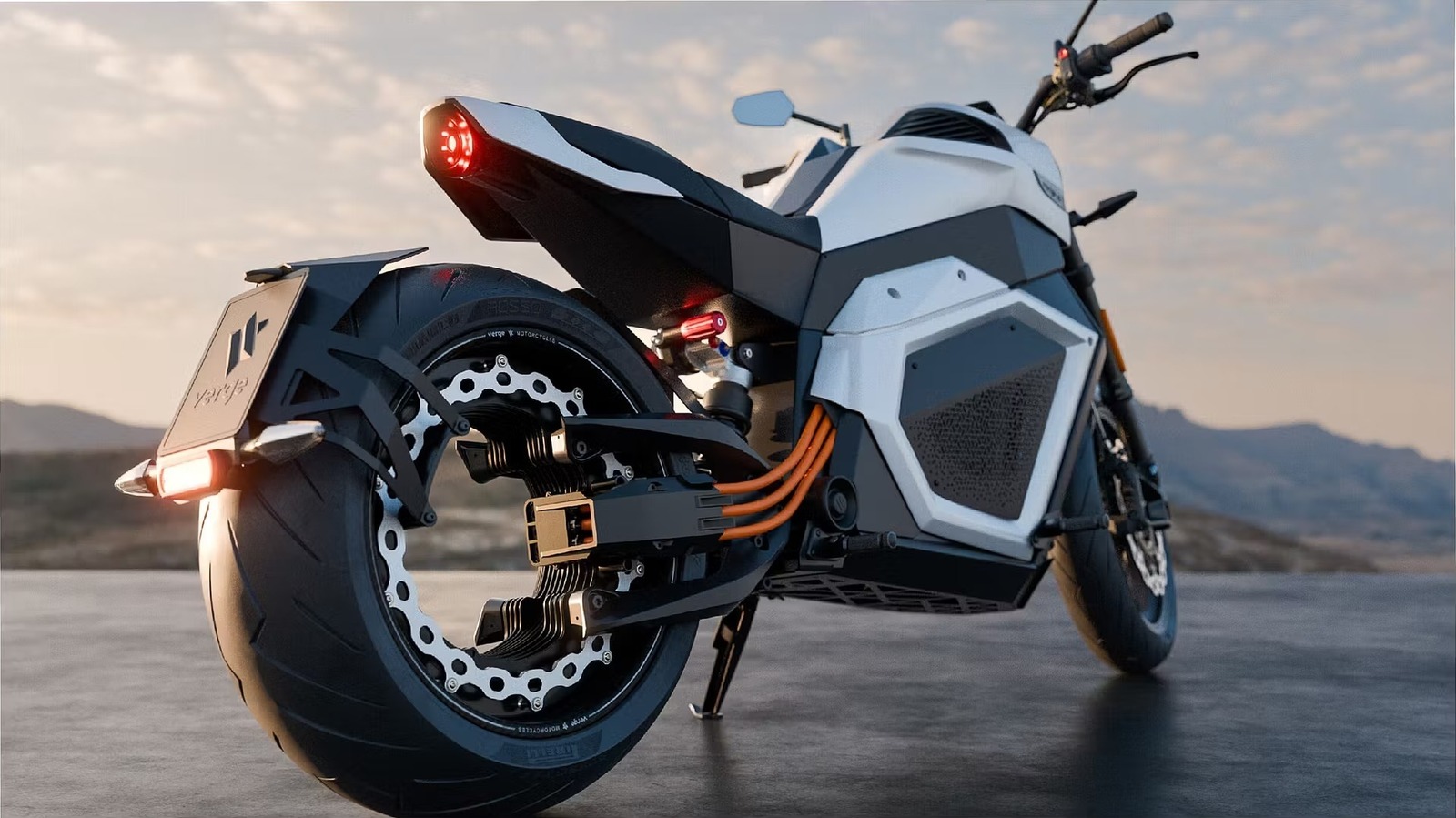
Solid-state batteries are the next big thing for EVs, but mass production has been “just around the corner” for the past several years. We may have finally turned that corner, as Verge Motorcycles and Donut Lab have announced not only the first production electric motorcycle to use a solid-state battery, but the first production vehicle of any kind. Even better, they are promising the first deliveries to customers in Q1 2026. That’s not the future, that’s now.
Verge has already been building the TS Pro since 2023, and unveiled a second-generation model at EICMA 2025. What Verge didn’t reveal until the joint announcement at CES was that the new version would be equipped with Donut Lab’s new solid-state battery. The previous version already used the Donut hubless motor and electronics, so adding the new battery was likely pretty simple. Electrek reports that the two companies were “founded by the same people.” This could explain their close working relationship since the beginning, and perhaps even their collaboration/conspiracy to keep their solid-state technology secret until they were ready to release it into the world. Its “it’s here, right now” approach is different from every other manufacturer we’ve seen, whose promises always seem to be several years away and/or prototypes that aren’t yet ready for mass production.
The Verge TS Pro
The solid-state-equipped TS Pro boasts some impressive stats. It’s crazy that 737 pound-feet of torque isn’t all that surprising in an EV anymore. That’s more torque than a Dodge Challenger SRT Hellcat in a freaking motorcycle! Verge says the new long-range version can go up to 370 miles on a single charge. For comparison, my Suzuki V-Strom 650 can only go about 200 miles before it needs gas, while a Harley-Davidson Sportster needs a pit stop around 100 miles, in my experience. Even the standard range TS Pro goes about 200 miles between charges, equalling my V-Strom and farther than the Zero S that our own Collin Woodward road tripped so you don’t have to.
Collin’s trip perfectly demonstrated the main problem with traveling on an electric motorcycle today: slow chargers that sometimes took hours to top off the battery. If you can find a 200-kilowatt NACS charger, Verge claims the TS Pro can recharge to 80 percent in ten minutes. Donut Lab’s video announcement claims the battery can charge in as little as five minutes, but Verge slowed it to ten so riders have time to relax and enjoy a latte rather than having to chug an espresso to get back to the bike before it’s finished charging. As long as you can find chargers along your route, which is becoming easier all the time, you’ll be able to ride the TS Pro like a regular motorcycle, if these claims are true. I’m curious how long it would take to charge from a standard Level 2 home charger, but if it can recharge overnight in time for the next day’s ride, it would gain this significant advantage without any of the downsides of short range and long charging times that current electric motorcycles have.
Donut Lab’s solid-state batteries
Verge focuses mainly on the superior range and fast charging, and rightfully so, since those are the biggest issues that would-be electric motorcyclists face. In this video, Donut Lab goes on to claim several additional advantages its batteries and systems offer, not just for motorcycles but for transportation in general. Its solid-state batteries are good for 100,000 charging cycles, compared to 1,000 to 1,500 cycles in standard lithium-ion batteries or 5,000 in high-end versions. Those batteries degrade over time and eventually need to be replaced, but Donut Lab claims its solid-state batteries will last the life of the vehicle, without losing significant range over time. They are also unaffected by temperature changes, still producing 99 percent of their power at -22ºF and 212ºF. Solid-state batteries are not prone to thermal runaway failures, making them safer than lithium-based batteries currently in use. Finally, Donut Lab says that its batteries are eco-friendly, using commonly available elements that can be found and produced anywhere. That means that, although the company is based in Finland, it would be possible to build batteries in the U.S., bypassing tariffs and the higher prices associated with them.
Verge is not Donut Lab’s only corporate partner. It has also worked with Watt Electric Vehicles to build a platform for four-wheeled transportation, available to any automotive manufacturer who wants to buy it, unlike companies like Tesla, whose batteries are proprietary. It has even worked with Cova Power to create an electric drive system for semi-trailers, turning unmodified trucks into instant hybrid vehicles that cut diesel consumption in half. The possibilities are endless.
At least, they are if these bold claims aren’t too good to be true. Perhaps that’s why Verge and Donut Lab waited to make their announcement until the TS Pro was actually going into production. Some companies promise the world and produce nothing but vaporware, but we shouldn’t have to wait long to put it to the test and find out for ourselves how it performs.

