


Vector has introduced the Hammer F1, a foldable quadcopter designed to combine reconnaissance and strike capability in a single, compact platform. The system targets U.S. defense authority requirements and frontline operator needs, with a focus on speed, modularity, and contested-environment performance.
Hammer F1: Designed for the Edge
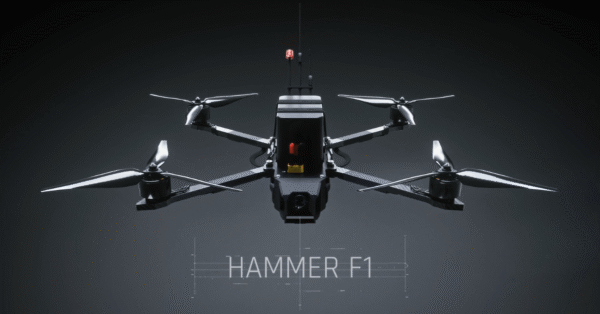
The Hammer F1 is a 10-inch foldable quadcopter developed “by warfighters for warfighters,” with operator input guiding requirements and configuration. The platform is fully NDAA compliant and integrates advanced sensing with precision strike payloads for missions in demanding environments. It packs into and deploys from a single bag, supporting rapid movement and setup for small units.
Optimized for both day and night operations, the Hammer F1 supports modular camera configurations. Native Android Tactical Assault Kit (ATAK) integration allows operators to stream live video and sensor data into existing digital mission tools for shared situational awareness.
Performance and Modularity
Vector specifies a top speed of up to 97 miles per hour and an operational range of up to 25 kilometers, enabling rapid coverage of dispersed battlespaces. By combining intelligence, surveillance, and reconnaissance (ISR) with kinetic effects in one attritable system, the Hammer F1 aims to reduce equipment burden while expanding tactical options.
A modular architecture supports reconfiguration in real time as mission requirements change. Interchangeable sensor packages, a fiber optic connector port, a universal payload interface, and an integrated Picatinny rail enable integration of ISR tools, electronic warfare payloads, and precision strike munitions. This open systems approach is intended to let units field mission-specific builds without new airframes.
Built for Contested Environments
Vector emphasizes U.S. manufacturing and supply chain integrity, with production aligned to U.S. defense acquisition standards. The Hammer F1 undergoes testing for cyber resiliency and operation in contested spectrum environments, addressing electronic warfare threats.
“Warfighters didn’t just inform this system; they essentially built it with us,” said Andy Yakulis, CEO and Co-Founder of Vector. “As former operators ourselves, we understood exactly what they needed to win, and we engineered every inch of the Hammer F1 around those requirements.”
Vector positions the Hammer F1 to transition through US defense procurement channels while meeting the expectations of frontline units that rely on small UAS for both sensing and strike.
More information on Vector is available from their website.
Read More

