


Vector teams with Wrap to create killer-drone system
By DRONELIFE Features Editor Jim Magill
Vector, a Utah-based technology company that specializes in offering defense drone systems as a service, has teamed with Wrap (NASDAQ: WRAP) a developer of non-lethal response technology for law enforcement agencies to develop a low-cost system that uses a UAV to safely bring down another, hostile drone.
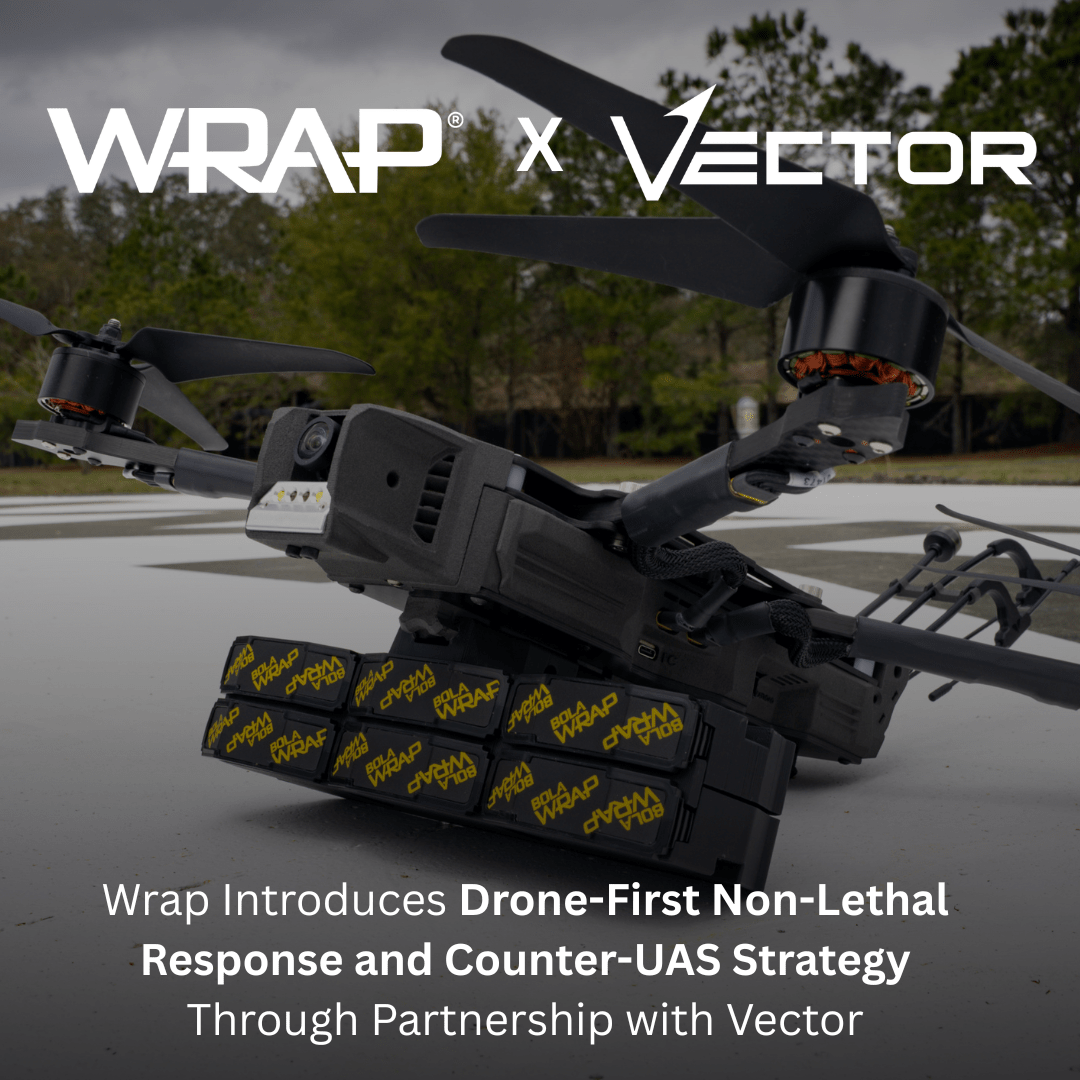
The partnership, announced last month, brings together Vector’s expertise in unmanned tactical hardware development with Wrap’s Non-Lethal Response (NLR) technology to create a drone-on-drone counter-UAS platform in which a “friendly” drone fires a tether that ensnares a UAV posing a threat to infrastructure or people, causing it to crash land without harm to those on the ground.
“We’ve been able to integrate and do a lot of successful drone take-downs by taking a product that they were using for law enforcement, a non-lethal bullet concept like a tether that spins and wraps up an individual that’s trying to run away from police,” Vector CEO and cofounder Andrew Yakulis said in an interview.
Yakulis said Vector and Wrap engineered the tether restraint system to allow it to be mounted on and deployed from the bottom of a Vector drone.
Vector plans to market the concept to U.S. Department of Defense and to federal law enforcement agencies that are investing heavily in counter-UAS technologies, especially in advance of high-profile, mass-attendance events such as the FIFA World Cup tournament and the America 250 celebrations. The company would offer the service to be deployed by federal law enforcement officers authorized in the use of drone-mitigation systems, Yakulis said.
“We could train them as a service and provide our products under these service contracts to take down drones to protect soccer stadiums, football stadiums, power infrastructure grids, the border, airports, things like that,” he said.
The development of the system comes at a time when law enforcement agencies and operators of mass-gathering venues and critical infrastructure sites are looking for solutions to the problem of safety mitigating UAVs flown by hostile actors or criminals.
“I think counter-UAS is just an incredibly large problem. Operation Epic Fury in Iran has shown how many unmanned systems can be used in a conflict, but even one drone over the right airport or over the right soccer or football stadium can have a very dramatic impact,” Yakulis said.
The Vector-Wrap platform could represent one facet of a multi-layered counter-UAS system to defend against the incursions of problematic drones. The system offers a low-cost kinetic drone-mitigation solution that can be deployed in situations in which electronic options to disable or bring down drones may be problematic.
“A lot of people ask us ‘Why wouldn’t you just jam the drone’s electronics and take it down that way?’ But you can’t jam a drone over a domestic U.S. airport because you would jam all the electronics on the airplanes and the air traffic control,” Yakulis said. “It would be very hard to jam a drone even at a soccer stadium or a football stadium because you’d be jamming a lot of the communications used by those in attendance.”
Defense drone systems as a service
Vector was launched to provide drone systems as a service, principally to the U.S. military, said Yakulis, who is himself veteran with 18 years of experience in the Army in special operations and in defense innovations.
“I saw this gap in the market where no one was really applying the lessons learned of what we call attritable advanced systems, attritable being this concept of consumable technology,” he said. Prior to its partnership with Wrap, Vector had largely focused on the development of one-way attack drones for the military.
Because drone technology in this space is continually being updated, Yakulis said the best way to continuously provide an updated variant of such products for military use is through a service-based contract.
“We developed this unique business model,” he said. “We do a lot of tactical drone training, technical instruction on how to build a drone and do modifications on drones for the military, and then we do a lot of just the delivery of our drone products as well.”
Yakulis said the company’s business structure helps it to easily integrate its products with those of other companies, such as in its partnership with Wrap, where the latter company’s technology is installed on the bottom of a Vector drone.
“Our drones are very modular; they’re very easy to integrate with because of how we’ve designed the drone with a very open architecture,” he said.
The Vector-Wrap system has undergone a great deal of testing in a controlled environment and is ready to be put on the market for use by federal agencies and other potential customers.
“We have validated the technology and are looking forward to being able to present this to DHS and other law enforcement elements in the very near future,” Yakulis said. “We are in deep conversations with different elements of the government about how Vector, working within the Wrap partnership path, can help provide a defensive capability against the various drones over FIFA stadiums.”
Vector is currently working with another partner, which the company has not yet identified, to develop technology to help locate and identify drones occupying a given airspace, known as tipping and queuing. Working with this partner, Vector is developing an integrated drone-defense system that would be able to locate and identify a hostile drone and direct the killer-drone on where to fly, before it is taken over by a human pilot, who performs the final maneuver to take the malevolently operated drone out of the sky.
“What we have done with Wrap is provide just one layer, but really the defense of the homeland needs many layers, of many different capabilities, to provide a sort of counter-drone shield,” Yakulis said. “We’re very excited to provide just one small element of the overall counter-drone defense of the homeland.”
Read more:

Miriam McNabb is the Editor-in-Chief of DRONELIFE and CEO of JobForDrones, a professional drone services marketplace, and a fascinated observer of the emerging drone industry and the regulatory environment for drones. Miriam has penned over 3,000 articles focused on the commercial drone space and is an international speaker and recognized figure in the industry. Miriam has a degree from the University of Chicago and over 20 years of experience in high tech sales and marketing for new technologies.
For drone industry consulting or writing, Email Miriam.
TWITTER:@spaldingbarker
Subscribe to DroneLife here.

