


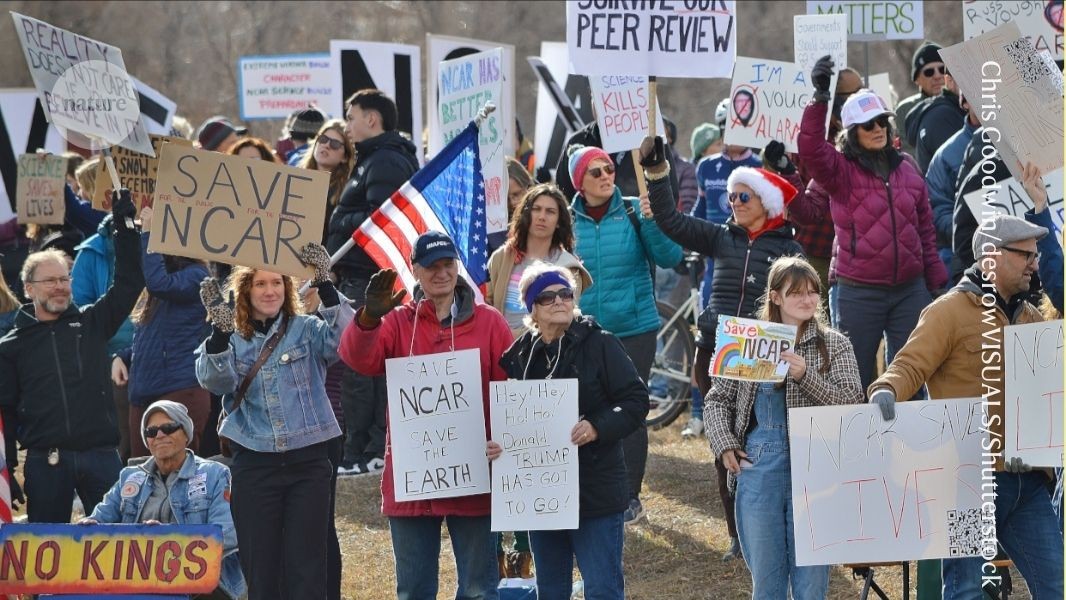
The first year of US President Donald Trump’s second administration delivered a steady pulse of federal-agency lay-offs, grant terminations and funding cuts to universities. “The speed, the scope and the severity of the attacks on science are beyond anything we’ve ever seen,” says Gretchen Goldman, president and chief executive of the Union of Concerned Scientists (UCS), a non-profit advocacy organization in Washington DC.
‘Every aspect of my work life has changed’ — scientists reflect on a year of Trump
The UCS began tracking what it views as attacks on science and scientific integrity by the US federal government during the George W. Bush administration, beginning in 2001, says Goldman. In 2025, it documented 536 actions or decisions, such as altering science-informed guidance on the US Centers for Disease Control and Prevention’s (CDC) ‘Autism and Vaccines’ web page. That’s more than double the 207 incidents it recorded throughout Trump’s entire first term covering 2017–21. Furthermore, scientists — especially those studying climate change, vaccines, issues faced by people from sexual and gender minorities (LGBTQ+) and health disparities — report increased online harassment and intimidation.
Science-reform advocates are trying to find positives. “Wherever there is disruption, there is opportunity,” says Brian Nosek, executive director of the Center for Open Science in Charlottesville, Virginia, a non-profit organization in Washington DC that promotes transparency and reproducibility in science. “The challenge is that there is so much distress now and there are actors that seem very clear in their behaviour to not actually have good intentions for improving science,” he says.
Goldman, in contrast, uses the word “shattered” to describe both the scientific career pipeline as well as federal job stability. Some researchers are leaving the country to continue their research (see ‘Upended careers’), a trend highlighted by an analysis of the Nature Careers jobs board that seemed to signal the start of a brain drain.
At federal agencies such as the US Geological Survey (USGS) and the US Environmental Protection Agency (EPA), new scientific output has declined sharply and its use in policymaking has sometimes been called into question, according to some agency researchers — who, like several interviewed by Nature, wish to remain anonymous for fear of career reprisals. They say that the loss of expertise is disrupting areas such as environmental protection, public health and safety. Examples cited include the narrowing of long-standing hepatitis B and other childhood-vaccine recommendations by the CDC to the EPA requesting to revert to less stringent 2020 levels of soot pollution.
Critics see these disruptions as exacerbated by the deep cuts to federal funding, which total tens of billions of dollars, that underwrites academic research and researcher training. “The beauty of academic research is that people could stick with hard problems for a long time to make progress,” says Goldman. “We can’t create experts overnight.” At the same time, many foreign scientists face an uphill battle in securing visas to study or work in the United States.
Some scientists have spoken out, filed lawsuits and pushed back against what many say is a dismantling of what has long been the world’s leading science power. In May 2025, the Center for Open Science criticized the administration’s Restoring Gold Standard Science executive order for “positioning policymaking to ignore scientific evidence by holding it to unachievable standards”. Nosek says his organization has a duty to push back against any administration attempts to “sow distrust and undermine the whole process” of science-research reform.
The US Congress has the power to determine which agencies are funded to what extent, and earlier this month, both houses of Congress voted to mostly reject the Trump administration’s proposed deep budget cuts for 2026 for a subset of science agencies including NASA, USGS, EPA and the National Oceanic and Atmospheric Administration (NOAA). The future remains far from certain — especially as China makes steady gains in global scientific leadership.
Nature’s careers team interviewed researchers to find out what a year of Trump administration policies has meant for their research and careers, and looked back at how Trump’s first year was covered by Nature.
Unprecedented federal-agency cuts
Since last February, thousands of federal scientist positions have been eliminated because of lay-offs, budget cuts and workforce restructuring. Jobs were cut at the National Institutes of Health (NIH), EPA, NOAA, CDC, Food and Drug Administration (FDA) and across national laboratories — losses compounded by the longest federal government shutdown on record, which lasted from 1 October to 12 November 2025. Government agencies continue to operate under temporary funding until all bills to fund government operations for the 2026 fiscal year are signed into law by the president.
The USGS, which oversees research and monitoring of natural resources and natural hazards, is one flashpoint. The administration’s 2026 budget proposed to cut roughly US$300 million supporting around 1,000 positions in the agency’s Ecosystem Mission Area (EMA), considered the agency’s biological research arm. Congress has voted to rescue $294 million of EMA’s budget. However, it’s unclear whether researchers there, who say they have not been permitted to conduct long-term environmental monitoring if it incurred travel expenses, will be allowed to return to their jobs as usual.

A USAID worker leaves with their belongings as the agency was closed in February 2025.Credit: Aashish Kiphayet/NurPhoto/Shutterstock
“We can’t pay conference or publication fees”, which limits how USGS researchers share their analyses with colleagues, says one employee. Another describes how they have been in “triage mode”, because their 2025 funding was frozen and they lost 25% of their staff. “Funded projects are being cut short because we can’t fill positions, projects have been delayed by at least a year, and we’re wasting time and taxpayer money,” they say. “We’re not allowed to talk about the future with leaders from tribes or other agencies. It’s been super frustrating.” Requests for a response from USGS were not returned.
Some scientists are voting with their feet. One researcher in a biodiversity leadership position at NOAA is desperate to find a job outside the country. “You have to deal with the constant rhetoric that you are worthless, unnecessary. It’s so abusive,” they say. “We’re still staggering along, but I don’t know for how much longer. I don’t have the energy any more.” As their number of field instruments was cut in half and projects were scaled down, “it’s been a giant waste of time and money and resources.”
Halted research and shrunken labs
More than 7,800 grants from the NIH and US National Science Foundation (NSF) were disrupted in 2025 — and 2,600 of those that were not reinstated total a loss of almost $1.4 billion. Furthermore, 607 terminated grants from EPA totalled more than $28 billion, according to Grant Witness, a crowdsourced database tracking terminated federal research grants.
US science in 2026: five themes that will dominate Trump’s second year
At the NIH, grant-termination decisions lacked transparency, says Jenna Norton, a programme director at the National Institute of Diabetes and Digestive and Kidney Diseases (NIDDK) in Bethesda, Maryland, who is speaking in a personal capacity. “People called them drone strikes. You didn’t know which grants were going to get terminated,” she says. Some that she thought would be on the list weren’t, and others, such as one on transgenic mice, were. (Norton, a signatory of the June 2025 Bethesda Declaration, an open letter signed by 484 NIH employees protesting about the perceived politicization of scientific research, was placed on non-disciplinary administrative leave in November without explanation.)
The Department of Health & Human Services (HHS), which oversees the NIH, responded that grant-termination decisions are not made arbitrarily. “Any decision to terminate extramural funding is based on careful consideration of whether the research continues to align with NIH’s mission to enhance health, lengthen life, and reduce illness, as well as current agency priorities and available appropriations,” a HHS public-affairs spokesperson responded.

