


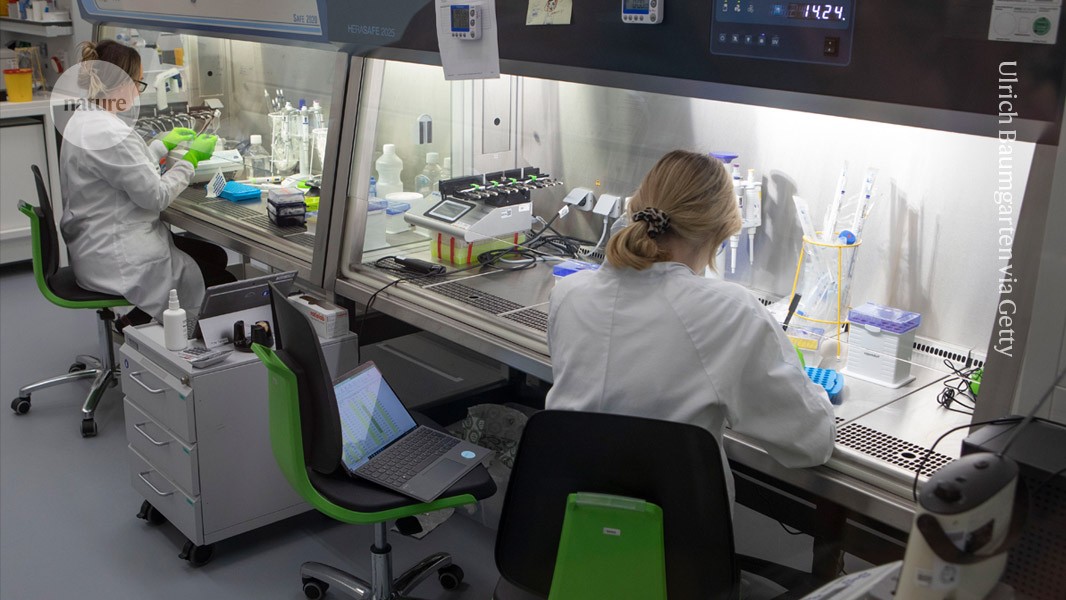

Money could become harder to come by for European scientists if the overall European Research Council pot does not dramatically increase.Credit: Ulrich Baumgarten via Getty
The number of US-based researchers applying to prestigious grants that would see them relocate to Europe has more than doubled in the last year.
According to data from the European Research Council (ERC), applications from the United States for its starting, consolidator and advanced grants to individual researchers — each worth up to €2.5 million (US$5.3 million) over five years — rose by 120% in its most recent round of calls, compared to an overall rise in applications of 17% (see Choosing Europe below).
These are the first three funding calls in which researchers moving to Europe were eligible for an extra €1 million in relocation costson top of their research grant and funds to establish their laboratories. “We have seen a clear increase in interest from US-based researchers in these new opportunities,” a spokesperson for the ERC told Nature.
Some US researchers want to leave the country. Can Europe take them?
The surge in demand could be another sign that a brain drain might be underway out of the United States, where thousands of research grants have been cut in the year since President Donald Trump returned to the White House. “No doubt the uptick is a direct result of the Trump administration’s science policy, and in particular, its attacks on universities and academic freedom.” says Kenny Evans, a researcher in science policy at Rice University in Houston, Texas.
Advanced grants — for established principal investigators — saw the greatest leap in applications, nearly quintupling from 23 to 114 applications. The ERC does not routinely publish information on the nationalities of applicants, but Kieron Flanagan, a science-policy researcher at the University of Manchester, UK, says that he suspects many of these senior researchers are Europe-born or Europe-trained, and are “opting to use the ERC grant as a mechanism to escape the US system”.

But it is not clear that Europe has the funds to absorb these extra researchers without increasing competition for existing staff. In the advanced-grant category, where overall applications to the ERC rose by 31%, success rates will fall to 8%, down from 11% in the previous year. The body expects similar percentage-point falls in the consolidator and starting grants. Applications to the 2025 call for Marie Skłodowska-Curie Actions (MSCA) Postdoctoral Fellowships, which closed in September, also grew by 65% on the previous year.
The surge in applications for EU funds has been celebrated as a success for Europe, “but it is also a clear warning signal that the system is under strain”, says Nicola Dengo, president of the Brussels-based European Council of Doctoral Candidates and Junior Researchers (Eurodoc). “Demand is growing faster than available resources.”

