


You have full access to this article via your institution.
Hello Nature readers, would you like to get this Briefing in your inbox free every day? Sign up here.
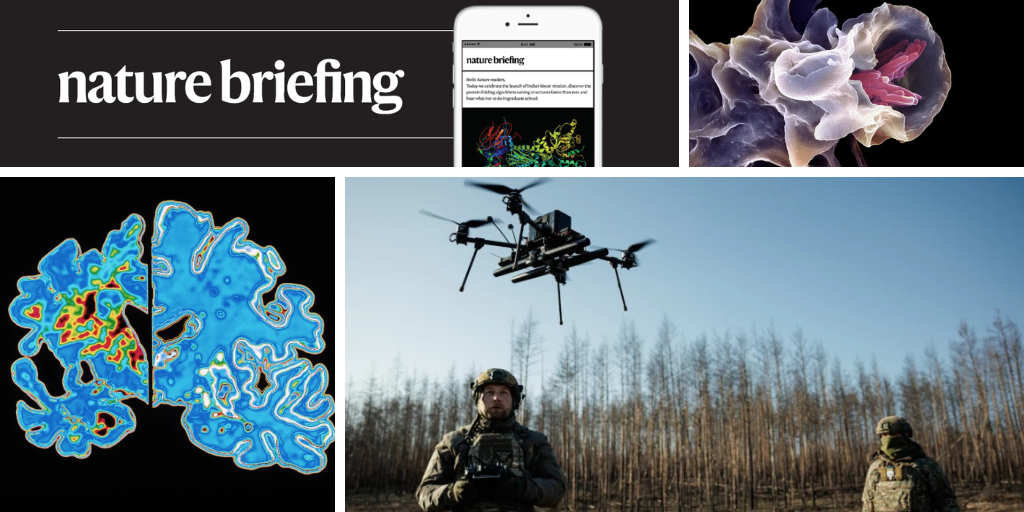
Abnormal tau proteins can form tangled fibres that accumulate in the brains of people with Alzheimer’s (slice on left). (Brain without Alzheimer’s shown on right.)Credit: Alfred Pasieka/SPL
A simple blood test that measures the levels of an abnormal form of the protein tau’ might one day serve as a molecular ‘clock’ that predicts not only whether someone will develop Alzheimer’s disease — but when. If validated in larger studies, the test could provide a way to intervene in the neurodegenerative disease at an earlier stage, when treatment is more likely to be effective. It could also provide a measurable biological marker, or ‘biomarker’, to make clinical trials of potential Alzheimer’s disease treatments easier and cheaper.
Reference: Nature Medicine paper
A nasal-spray vaccine can provide mice with protection from a variety of bacterial and viral pathogens — including SARS-CoV-2 — and respiratory allergens for at least three months. The vaccine works by revving up the innate immune system, which has a much broader reactivity than does the adaptive immune system — the one conventional vaccines utilize. If the spray proves safe and effective in humans, such a ‘universal vaccine’ could be offered to everyone at the start of each winter — and perhaps provide a first line of defence against future pandemics.
US President Donald Trump plans to nominate biotechnology investor Jim O’Neill to be the next leader of the National Science Foundation (NSF), a White House spokesperson confirmed to Nature. If confirmed by the Senate, O’Neill would become the first non-scientist or engineer to lead the NSF, which has been without a director since April 2025. “His background is very different from that of his predecessors,” says former NSF director Neal Lane. “That will be a major concern of the [science and technology] community.”
Features & opinion
Around the world, many countries — notably China, the United States and other members of NATO — are increasing their defence and security budgets. But nations have considerable leeway to decide what to fund with these pots, which can include research and development funding. Backed by bigger military budgets, science is likely to become more constrained by ideas of national self-interest, say experts, with collaborations decreasing or realigning to within regional blocs. Shifting funding priorities will also disproportionately benefit certain fields, such as artificial intelligence, while others, such as climate science, might be left behind, they say.
An unexpected notification reminds our narrator that they’ve been through this before in the latest short story for Nature’s Futures series.
A team of scientists at Microsoft have created a data-storage system that uses lasers to etch information into glass. These glass tiles, roughly the size of a DVD, could keep terabytes of data safe for around 10,000 years or more. With this method, “there’s no or very little ongoing cost as a result of keeping the data”, says computer scientist Richard Black, who led the project. “It means that once you decide to keep something, there’s almost no reason to ever delete it.”
Nature Podcast | 21 min listen
Subscribe to the Nature Podcast on Apple Podcasts, Spotify or YouTube Music, or use the RSS feed.
Today Leif Penguinson is enjoying the views over Pirunkuru gorge in Savukoski, Finland. Can you find the penguin?
The answer will be in Monday’s e-mail, all thanks to Briefing photo editor and penguin wrangler Tom Houghton.
This newsletter is always evolving — tell us what you think! Please send your feedback to [email protected].
Thanks for reading,
Jacob Smith, associate editor, Nature Briefing
• Nature Briefing: Careers — insights, advice and award-winning journalism to help you optimize your working life
• Nature Briefing: Microbiology — the most abundant living entities on our planet — microorganisms — and the role they play in health, the environment and food systems
• Nature Briefing: Anthropocene — climate change, biodiversity, sustainability and geoengineering
• Nature Briefing: AI & Robotics — 100% written by humans, of course
• Nature Briefing: Cancer — a weekly newsletter written with cancer researchers in mind
• Nature Briefing: Translational Research — covers biotechnology, drug discovery and pharma


