


U.C. Irvine researchers thwart target-tracking drones with umbrellas
By DRONELIFE Features Editor Jim Magill
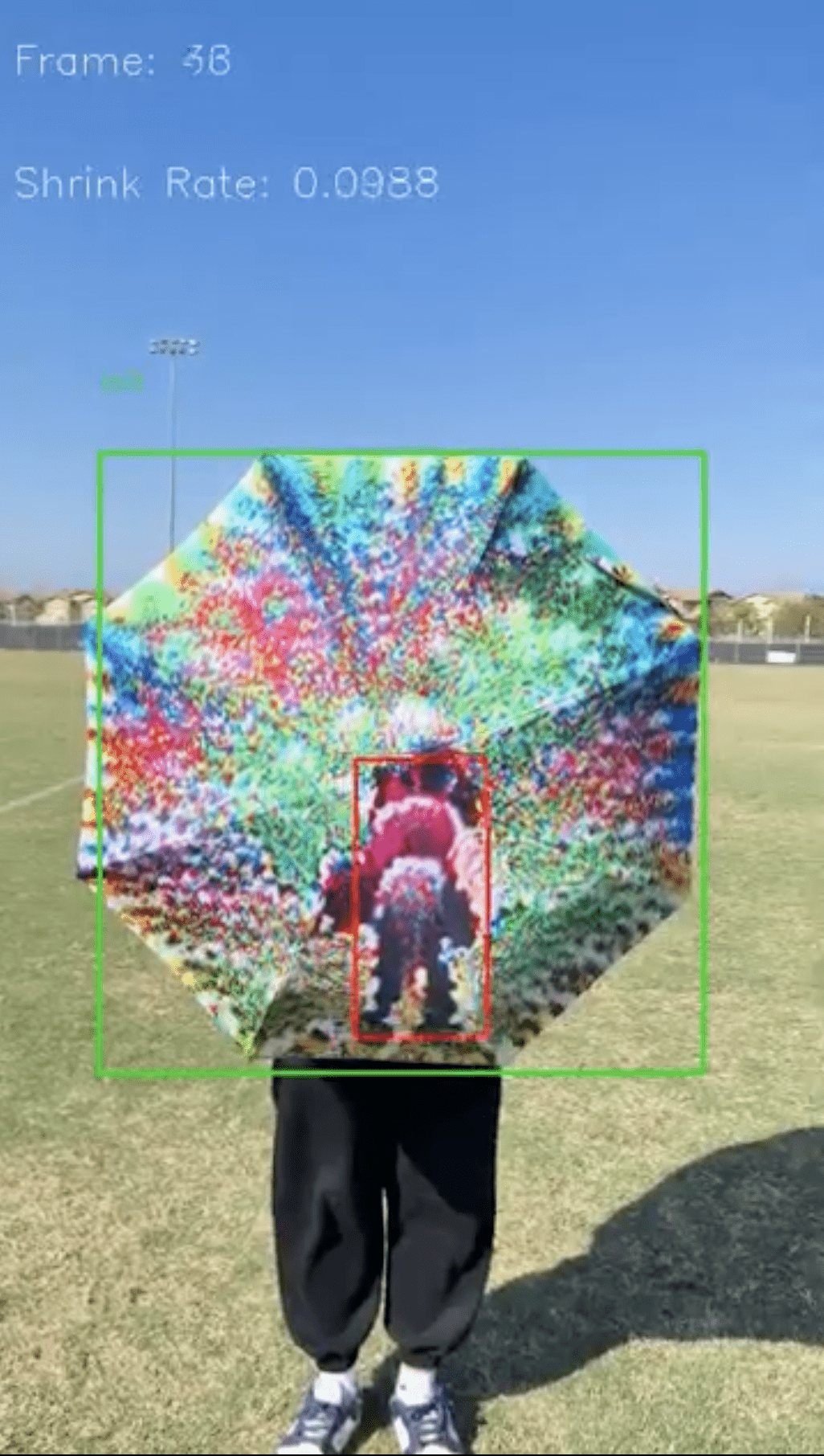 A team of scientists at the University of California Irvine has discovered a flaw in the design of AI-enabled autonomous target-tracking (ATT) drones, such as those used in border security operations, that could allow the tracked person to defeat the UAV using a tool as simple as an umbrella.
In a counter-UAS technique known as a distance-pulling attack, the targeted person unfolds the umbrella, which is imprinted with specially designed patterns that are able to fool the drone into thinking the stationary targeted person, is actually moving further away. This causes the UAV to continuously move closer to the person, until it gets close enough to where it can be brought down by a net or simply swatted out of the sky.
The vulnerabilities the researchers discovered could be exploited both by criminals trying to evade drone-assisted capture by law enforcement, as well as by individuals seeking to thwart illicit surveillance or stalking by drone.
Shoyuan Xie, a U.C. Irvine computer science graduate student, said the counter-UAS technique that the scientists discovered, dubbed FlyTrap, exploits weaknesses in the drone’s camera-based autonomous target-tracking software.
“Existing drones are widely deploying models in their products to perform autonomous operations like tracking behavior, Xie said. “The AI model is well-known to be vulnerable to attacks where the attacker can make a unique visual input or other human-generated ‘noise’ to the input to mislead the AI model to output anything.”
In other words, the person being tracked can trick the drone’s AI-generated pedestrian-detection capability, in order to manipulate the flight orders the software gives to the drone.
“By manipulating the input, we can directly control a drone’s autonomous operation behavior to draw the drone closer to the umbrella,” he said. “That’s the technology we developed by exploring the vulnerability of the end-model itself.”
The researchers successfully tested the effectiveness of the Flytrap drone-defense technique against three commercial drones, the DJI Mini 4 Pro, the DJI Neo and the HoverAir X1, and reported the vulnerabilities they discovered to the two drone manufacturers.
Alfred Chen, an assistant professor of computer science at U.C, Irvine and one of the leaders of the research team, said the team’s discovery of the vulnerability of the AI models to deception can have both positive and negative effects in real-world applications.
“Just like any technology, it’s a double-edged sword. This discovery itself is neutral in its indications,” he said.
The research could have negative implications for law enforcement agencies that use target-tracking drones to aid in the apprehension of fleeing suspects. For example, the technology is used extensively by federal agencies to track the movements of immigrants and drug smugglers in the US. border regions.
On the other hand, the research could lead to the development of products that could be used by potential victims of stalking by drone, Chen said. He cited numerous news reports of the use of drones to conduct illicit surveillance of women and members of other vulnerable populations.
“It can mean self-protection for normal people, who are victims of this drone technology,” he said. “Personally, I just became the father of a girl. That’s why for me, this is also something I feel is very critical.”
Members of the research team recently presented their findings in an academic paper at the Network and Distributed System Security Symposium in San Diego, one of the most prestigious computer security conferences in the nation.
Through novel progressive distance-pulling strategy and controllable spatial-temporal consistency designs, FlyTrap manipulates ATT drones in real-world setups to achieve significant system-level impacts,” the paper states. “Results demonstrate FlyTrap’s ability to reduce tracking distances within the range to be captured, sensor-attacked, or even directly crashed, highlighting urgent security risks and practical implications for the safe deployment of ATT systems.”
Read more:
 Jim Magill is a Houston-based writer with almost a quarter-century of experience covering technical and economic developments in the oil and gas industry. After retiring in December 2019 as a senior editor with S&P Global Platts, Jim began writing about emerging technologies, such as artificial intelligence, robots and drones, and the ways in which they’re contributing to our society. In addition to DroneLife, Jim is a contributor to Forbes.com and his work has appeared in the Houston Chronicle, U.S. News & World Report, and Unmanned Systems, a publication of the Association for Unmanned Vehicle Systems International.

Miriam McNabb is the Editor-in-Chief of DRONELIFE and CEO of JobForDrones, a professional drone services marketplace, and a fascinated observer of the emerging drone industry and the regulatory environment for drones. Miriam has penned over 3,000 articles focused on the commercial drone space and is an international speaker and recognized figure in the industry. Miriam has a degree from the University of Chicago and over 20 years of experience in high tech sales and marketing for new technologies.
For drone industry consulting or writing, Email Miriam.
TWITTER:@spaldingbarker
Subscribe to DroneLife here.

