


D

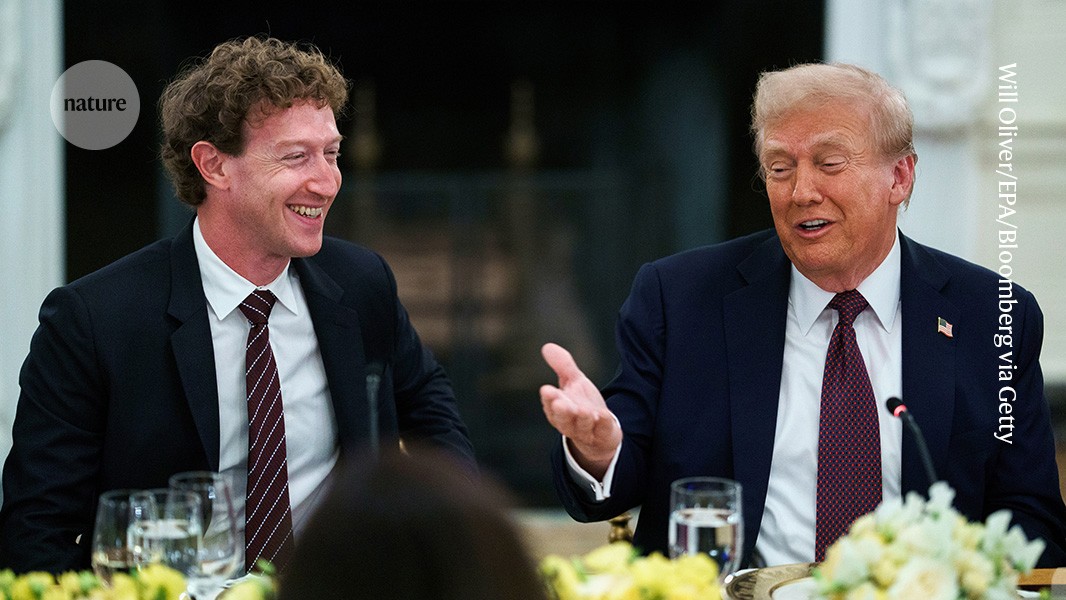
Facebook co-founder Mark Zuckerberg (left) has been named to President Trump’s science and technology advisory council. Credit: Will Oliver/EPA/Bloomberg via Getty
US President Donald Trump has named 13 people to his panel of science advisers — and all but one is a leading technology executive. The President’s Council of Advisors on Science and Technology (PCAST) now includes a single university researcher and at least nine billionaires.
Among the new members are Mark Zuckerberg, the chief executive of Meta, the parent company of Facebook; Larry Ellison, the executive chairman of software giant Oracle; and Sergey Brin, the co-founder of Google. There are also chief executives of tech hardware companies — Jensen Huang of NVIDIA, Lisa Su of Advanced Microdevices and Michael Dell of Dell Technologies. The corporate chiefs have a combined wealth in excess of US$900 billion.
Three of the chief executives have earned PhDs from the Massachusetts Institute of Technology (MIT) in Cambridge. Su’s degree is in electrical engineering. Jacob DeWitte and Bob Mumgaard, who both head nuclear-energy start-up firms, have degrees in nuclear engineering and applied plasma physics, respectively.

Trump’s chief science adviser faces a storm of criticism: what’s next?
The sole academic researcher is John Martinis, a quantum physicist at the University of California, Santa Barbara, who shared the Nobel Prize in Physics last year for observations of macroscopic quantum phenomena. “I am honoured to be on the committee,” Martinis told Nature.
Laura Greene, a physicist at Florida State University in Tallahassee and a member of PCAST during the administration of president Joseph Biden, praised Martinis and Su as being “outstanding, both in science and technology”.
But others are critical of the committee’s make-up. “Not a single biologist and only one university researcher on PCAST,” Vaughan Cooper, an evolutionary biologist at the University of Pittsburgh in Pennsylvania, said in a post on Bluesky. “This leaves the country unbelievably ill prepared for an age of biotechnology, a race we are already beginning to lose.”
The balance could yet change: under the terms of a presidential order Trump issued in 2025, he could name as many as 11 more members to the committee, says Kenny Evans at Rice University in Houston, Texas, who is a specialist in science policy and co-founder of the White House Scientists Archive.
The White House did not immediately respond to a request for comment.
Gather the council
PCAST makes science-policy recommendations to the White House on topics such as improving nutrition science and bolstering the scientific workforce. It also reviews cross-agency programmes that are already under way, such as the Networking and Information Technology Research and Development initiative. Most of PCAST’s work is done by subcommittees, and its reports are largely prepared by staff from the Science and Technology Policy Institute, a federally funded research and development centre in Washington DC.

