


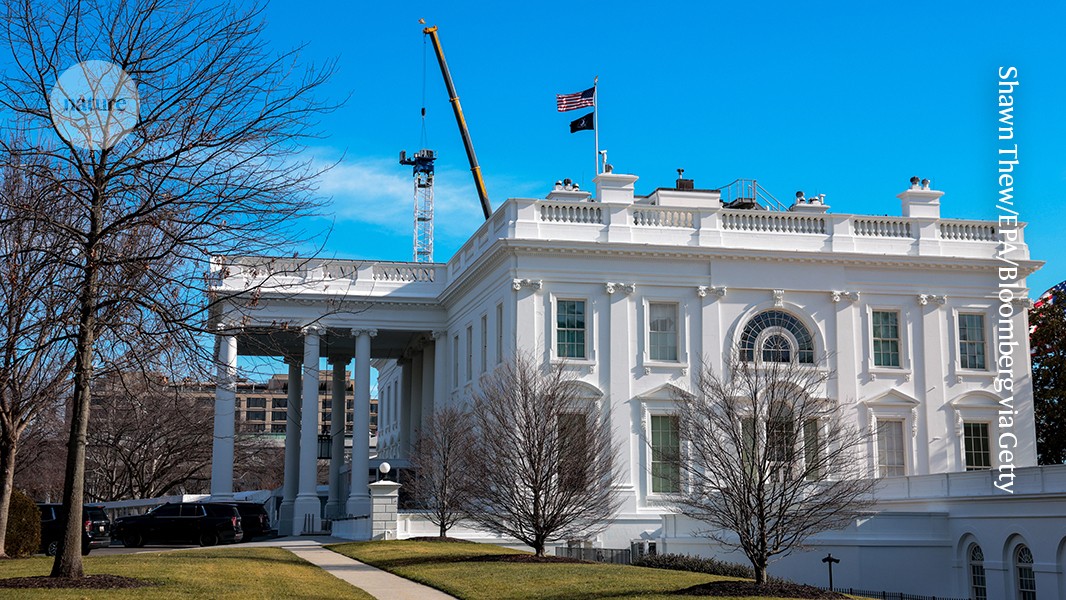

Soon after he retook the White House (now under construction) in 2025, US President Donald Trump issued an order to remove job protections for some government employees. Credit: Shawn Thew/EPA/Bloomberg via Getty
The administration of US President Donald Trump moved forwards last week with its plan to make it easier to fire some government workers — including scientists — overriding objections from the public that this would lead to further political interference in US science.
US science after a year of Trump: what has been lost and what remains
On 5 February, the US Office of Personnel and Management (OPM) finalized a rule that it proposed last year to create a new class of government employee called ‘Policy/Career’. This class would reassign career civil servants who influence government policy — a potentially broad category — and strip them of the job protections that they usually have under US law. (Career civil servants are hired through a competitive, merit-based system and hold their jobs for years, unlike political appointees who typically remain for one administration.)
According to the new rule, Policy/Career employees could be fired for “subverting Presidential directives”. Agencies in the US Executive Branch including the National Science Foundation (NSF) and the National Institutes of Health (NIH) — the main federal funders of science in the country — have already assembled lists of workers to convert to the new category. The OPM recommended considering positions involved in awarding research grants at such agencies. On the basis of those lists, the OPM estimates that the rule will reclassify around 50,000 federal employees.
NSF staff members who spoke to Nature are apprehensive about the rule, which is set to take effect in early March. “We’re expecting it to be unpleasant,” says one programme officer who requested anonymity out of fear of reprisal.
Opponents of the policy say they are planning to sue. The government is “rebranding career public servants as ‘policy’ employees, silencing whistleblowers, and replacing competent professionals with political flunkies”, Everett Kelley, the national president of the American Federation of Government Workers (AFGE) in Washington DC, said in a statement.
Responding to a query from Nature, the OPM pointed to a press release and blog post from its director, Scott Kupor. The new rule, he said, will make it so that “the Executive Branch will once again be accountable to the electorate — not to career bureaucrats who may choose to pursue their own objectives.”
Taking control
Towards the end of his first presidency, from 2017–21, Trump issued an executive order establishing the job category Schedule F, which could have replaced hundreds of thousands of career civil servants with political appointees aligned with the president. The plan was not implemented before Trump left office.
‘One of the darkest days’: NIH purges agency leadership amid mass layoffs
Just hours after his second term began last year, Trump signed an executive order restarting Schedule F, which was renamed Policy/Career. On 23 April, the OPM released a revised version of the plan, which did not include the dramatic conversion of career positions to political appointments — as Schedule F would have done. But the new plan still removes job protections and some whistleblower protections to “allow agencies to quickly remove employees from critical positions who engage in misconduct, perform poorly, or obstruct the democratic process by intentionally subverting Presidential directives”.
The proposed rule was opened to the public for comment and garnered 40,500 responses; by the OPM’s own count, 94% of these were critical of the plan. Many commenters, including Namratha Kandula, a physician and epidemiologist at the Feinberg School of Medicine, in Chicago, Illinois, objected to the potential inclusion of government scientists, particularly those involved in awarding research grants. “Equating agency grant making and scientific peer review with policy decisions erodes the fundamental distinction between objective evaluation and political advocacy,” she wrote.

