


You have full access to this article via your institution.
Hello Nature readers, would you like to get this Briefing in your inbox free every day? Sign up here.

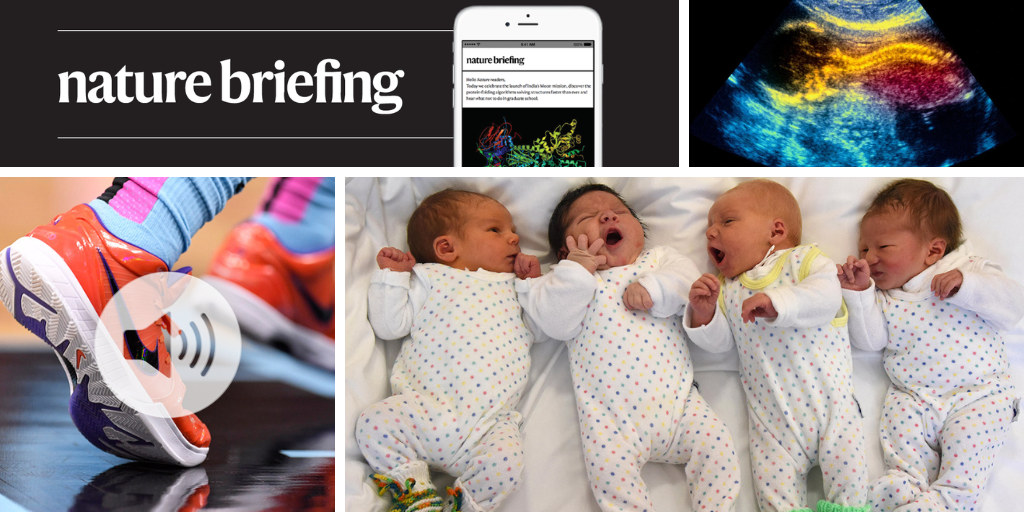
Babies tend to have the same probability to be born biologically male or or female — but family genetics could skew those odds in either direction. Credit: Waltraud Grubitzsch/dpa via Alamy
Researchers have found the first clear evidence that humans might have genes that distort the sex ratio of offspring from roughly 50:50. By scouring an anonymized genealogy database, researchers have discovered a family in Utah that has had twice as many boys as girls for seven generations, which suggests the presence of genes that skew the odds. “The signal in this family is very strong,” says evolutionary geneticist and study co-author James Baldwin-Brown. But some other researchers aren’t convinced that other explanations have been ruled out.
Reference: bioRxiv preprint (not peer reviewed)
Stem cells applied to the exposed spinal cords of fetuses in utero could treat infants with spina bifida — a severe birth complication in which the spinal cord is not properly enclosed during gestation. A small trial including six pregnant women showed that the treatment is safe, and can reverse a complication of spina bifida that blocks the circulation of cerebrospinal fluid. Although the results are positive, it’s still too early to know whether the treatment will be beneficial in the long-term.
Reference: The Lancet paper
Adults whose brains still produce neurons at high levels seem to have better memory and cognitive function than do those in whom neuron production has tailed off. In particular, researchers found that ‘super agers’ — people older than 80 with exceptional memory — had a higher number of new neurons than did other groups, and significantly more than did those with Alzheimer’s disease. The findings support the idea that adults’ brains continue to generate neurons, and suggest that drugs that induce neurogenesis could help people with cognitive decline, researchers say.
On 27 February 1996, game designer Satoshi Tajiri released the first ever Pokémon games for the Nintendo Game Boy. Thirty years later, the fictional world of Pokémon has found its way into science and academic research in fields such as ecology, evolution, biodiversity, education and even calling out predatory journals. To celebrate, Nature spoke to scientists from around the world about how their work has been shaped by Pokémon, from motivating one researcher’s pursuit of the study of fossils to inspiring others to name newly discovered species after the pocket monsters.
Weeks after lawmakers in the United States rejected massive cuts to US science budgets for 2026, much of the money still isn’t flowing to researchers. The National Institutes of Health has so far not received approval to spend any of the research funding allocated in a budget bill signed into law on 3 February. The National Science Foundation was authorized to spend its funding just last week. And NASA has had its full funding authorized for release, but with an unusual restriction that limits spending on ten specific programmes. One reason is that the White House Office of Management and Budget (OMB) has been slow to authorize spending. “It’s a way for the White House to assert more control over how agencies spend their money,” says Samuel Bagenstos, who was the top lawyer for the OMB under former US president Joe Biden.
Infographic of the week

Source: Analysis by J. Savage, Fathom, Bristol, UK.
To understand the urgency of emissions reductions, policymakers and citizens need a full analysis of what is at stake, argue a group of climate experts. “For example, policymakers might realize that sea-level rise requires spending more money on flood defences, yet neglect the possibility that parts of large cities such as London, New York City or Mumbai might have to be abandoned,” they write. “Yet, astonishingly, there has never been an internationally mandated global assessment of climate-change risks.” (Nature | 11 min read) (Source: Analysis by J. Savage, Fathom, Bristol, UK.)
Features & opinion
The casual sexism and misogyny in unguarded e-mails exchanged between prominent scientists and sex offender Jeffrey Epstein are a chilling confirmation of the ‘boys’ club’ in elite academia, say some observers. “That sense that you’re not in the club was real,” says political scientist Dannagal Young. “The notion of the meritocracy is completely revealed to be gendered bullshit.”
The Chronicle of Higher Education | 23 min read (free registration required)
Andrew Robinson’s pick of the top five science books to read this week includes a powerful and pessimistic rallying cry to get global warming under control, the story of Bronze-Age letters written on clay tablets and a way out of the “dead end” of current treatments for mental-health disorders.
Abandoned lab equipment allows a caretaker to remember the past, present and future in The future perfect continuous passive and other transitive disorders of the mind.
To better understand why some soft objects sliding on rigid surfaces — such as basketball shoes on a gym floor — make squeaking noises, a team of researchers used high-speed photography to record a rubber block sliding across a hard acrylic sheet. The results surprised them — and ultimately gave them a level of control that allowed them to play a very squeaky version of the Imperial March from Star Wars on the Nature Podcast.
Nature Podcast | 19 min listen
Subscribe to the Nature Podcast on Apple Podcasts, Spotify or YouTube Music, or use the RSS feed.
Today Leif Penguinson is taking a stroll along a shoreline trail in Jasmund National Park, the smallest national park in Germany. Can you find the penguin?
The answer will be in Monday’s e-mail, all thanks to Briefing photo editor and penguin wrangler Tom Houghton.
This newsletter is always evolving — tell us what you think! Please send your feedback to [email protected].
Thanks for reading,
Flora Graham, senior editor, Nature Briefing
With contributions by Jacob Smith
• Nature Briefing: Careers — insights, advice and award-winning journalism to help you optimize your working life
• Nature Briefing: Microbiology — the most abundant living entities on our planet — microorganisms — and the role they play in health, the environment and food systems
• Nature Briefing: Anthropocene — climate change, biodiversity, sustainability and geoengineering
• Nature Briefing: AI & Robotics — 100% written by humans, of course
• Nature Briefing: Cancer — a weekly newsletter written with cancer researchers in mind
• Nature Briefing: Translational Research — covers biotechnology, drug discovery and pharma


