


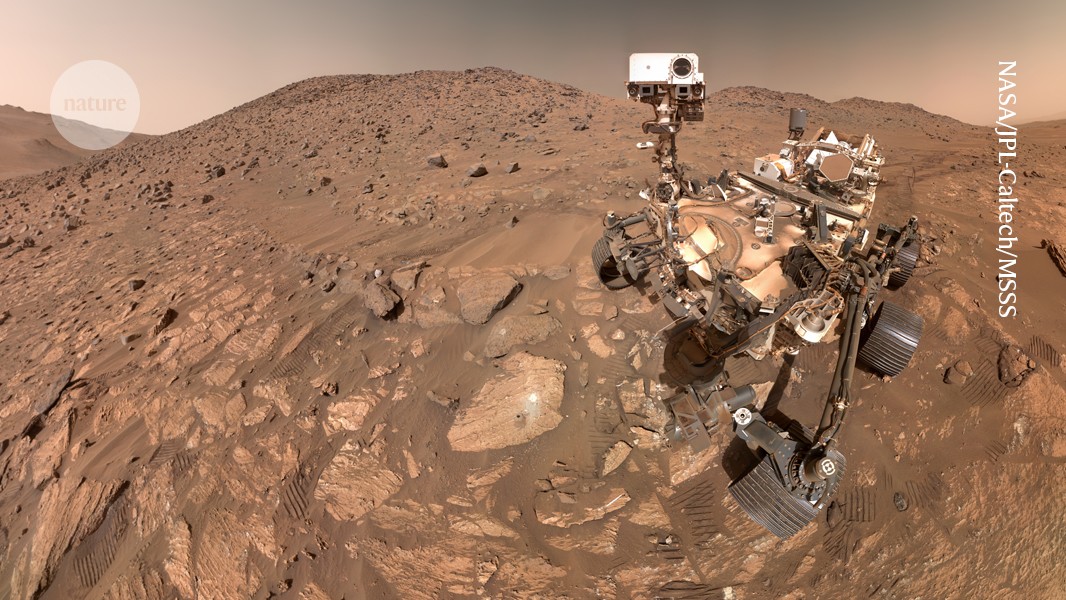

NASA’s Mars Perseverance rover poses for a selfie after drilling a sample from Cheyava Falls, the arrowhead-shaped rock in the centre of this picture. Credit: NASA/JPL-Caltech/MSSS
Far away on desolate Mars, a set of dust and rock samples awaits a ride that might never come.
After years in limbo, NASA’s groundbreaking Mars Sample Return (MSR) programme, which was supposed to ferry Martian material collected by the Perseverance rover to Earth, looks set to be cancelled. Earlier this week, a bipartisan group of US lawmakers passed a spending bill that axes the MSR programme, which would have been the first mission to bring Martian samples to Earth.
Mars rocks await a ride to Earth — can NASA deliver?
The mission’s demise did not come out of the blue. The ambitious project’s estimated cost has ballooned, reaching US$11 billion in 2023 — similar to the amount it cost to build the James Webb Space Telescope. And early last year, NASA conceded that it still had no concrete plan to return the Martian samples to Earth. The administration of US President Donald Trump sought to cancel the MSR project and many other NASA science missions.
Happily for many scientists, the bill restores funding for the vast majority of NASA space science missions that the administration’s budget proposal had placed on the chopping block, such as the Habitable Worlds Observatory space telescope, which would search for signs of life on planets outside the Solar System. As a result, the bill, which still requires Senate approval, “is ultimately a good bill for NASA science”, says Casey Dreier, chief of space policy at the Planetary Society, a non-profit organization in Pasadena, California.
But many scientists were disappointed by MSR’s fate. “I was certainly disheartened to hear the news,” says Ryan Ogliore, a planetary scientist at the University of Central Florida in Orlando. “But I wasn’t surprised because of what we’d been hearing these last couple years.”
Asked for comment, NASA did not respond before publication.
Here Nature looks at the scientific opportunities that will be lost because of the programme’s cancellation and the prospects for a mission revival.
Biosignature bargain
Among the most tantalizing samples collected by Perseverance is number 25, taken from a rock called Cheyava Falls. In September last year, NASA announced that the rover had discovered spots on the surface of the rock that contained two chemical compounds, which are found on Earth around decaying matter and are produced by certain microbial life1. These compounds, researchers suggested, could be a fingerprint of ancient microbial life.
Mars rover makes epic climb to explore some of the oldest rocks in the Solar System
But, these compounds can also be produced without the involvement of living things. So long as the Cheyava Falls sample remains on Mars, scientists can’t fully analyse it to learn about its origins. “That sample is worth several billion dollars with what it can answer about this existential question humans have been asking since the dawn of time,” says Ogliore.

