


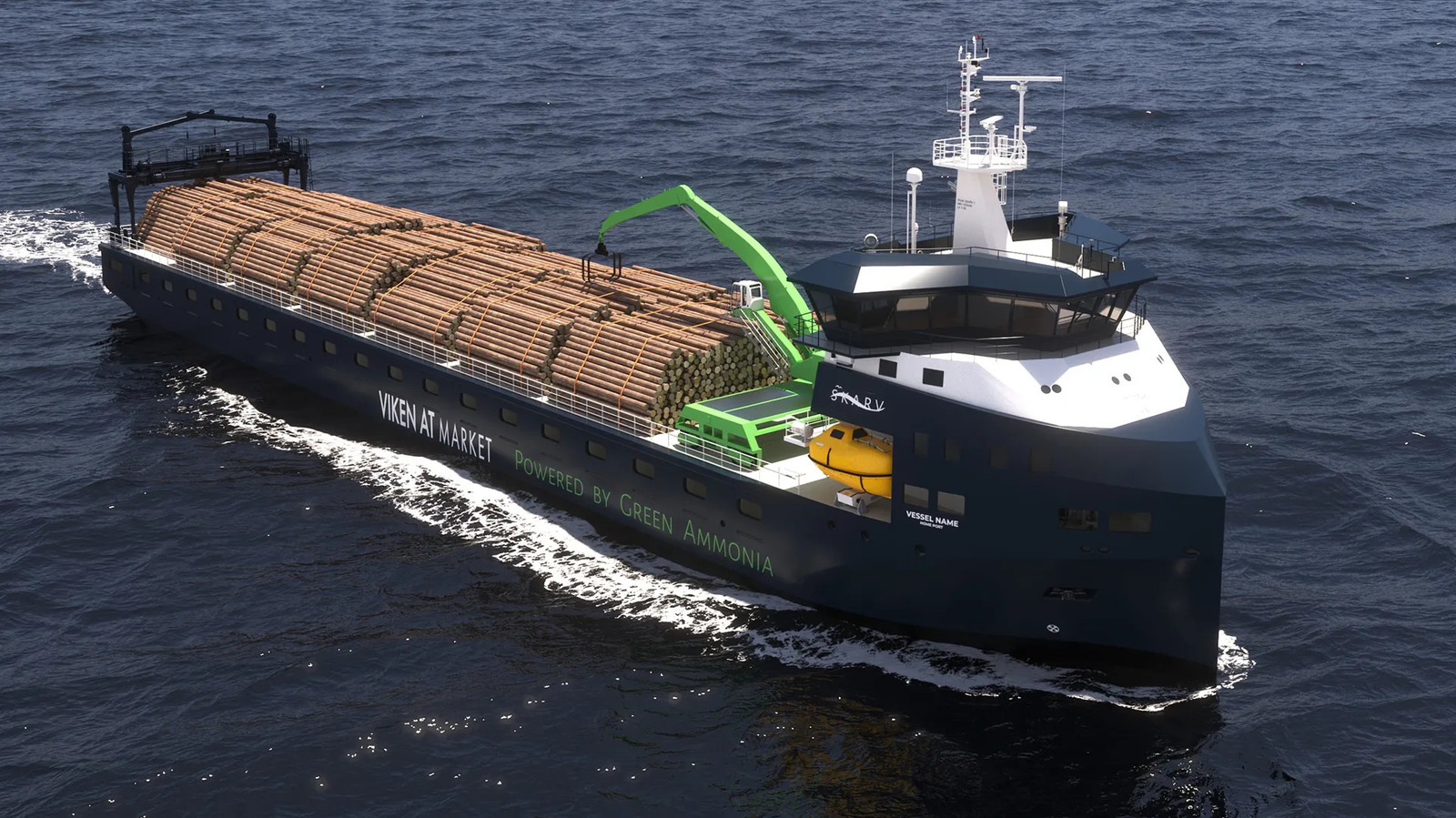
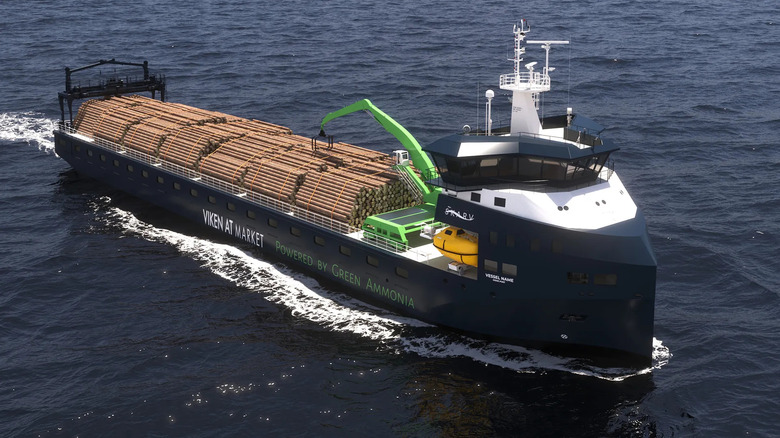
When we talk about alternative fuels, you probably think of things like hydrogen fuel cells or the various biofuels that corporations still pretend are something other than a distraction. Maybe hydrogen will eventually work for commercial trucking, but most of the time, they never go anywhere. Which is also why it’s particularly interesting that the Maritime Executive reports a Norwegian shipping company has ordered a new timber carrier that will run on ammonia.
According to the report, the ship won’t launch until next year, but it’s being built to use an ammonia-powered engine made by Wärtsilä, a Finnish company that bills itself as “a global leader in innovative technologies and services shaping the decarbonisation of marine and energy” for Viken AT Market, a Norwegian timber exporter. The ship itself will reportedly be built in Huanghao, China, based on a design from Skarv Shipping Solutions.
At least for now, Skarv says the ship will be optimized for lower speeds, so don’t expect ammonia-powered ships to cross oceans just yet. But it also doesn’t need to cross the Pacific without refueling, since the plan is to use it to move timber from Norway down to continental Europe. Still, it should run far cleaner than a conventional timber transport, which the Europeans who have lungs will probably appreciate.
Wait, like Windex?
If you’re mostly familiar with ammonia as a window cleaner or fertilizer, it might be hard to wrap your mind around the idea of using it to power a ship, but it can also be used as a fuel source, and ammonia-powered engines date back much futher than you probably assumed. As mentioned in this paper, Sir Goldsworthy Gurney developed the first ammonia engine in 1822. Modern ammonia engines are a little more advanced than they were in the early 1800s, but using ammonia as fuel is nothing new.
Also, no, that name’s not a joke. All the way back in 1793, Mr. and Mrs. Gurney really did look at their precious newborn baby boy and give him the name “Goldsworthy.” That’s not entirely relevant to the post, but I promise he was a real guy who even has his own Wikipedia page.
Anyway, if you want a better understanding of how this new ammonia-powered ship will run, the video above has a great explanation. Basically, ammonia is three hydrogen atoms attached to one nitrogen atom, so when you burn it, there’s no carbon to emit. In practice, running an engine on ammonia isn’t 100% carbon-free, but it’s far cleaner than conventional ship engines. The problem is that ammonia don’t burn as easily as other fuels, so to make an engine viable, they currently use a small amount of what’s known as pilot fuel to initiate combustion.
You also need a much larger volume of fuel compared to a ship running a conventional engine, and there’s also the issue of emissions. While MAN claimed in the video above that its ammonia engine’s emissions were between 85% and 90% lower than what you’d see from an engine running on heavy fuel oil, but the combustion process still produces nitrogen oxides and nitrous oxides, neither of which is good for humans or the planet. Tuning can reportedly take care of the vast majority of nitrous oxide emissions, but dealing with the nitrogen oxides requires what’s basically a really big catalytic converter.
Will ammonia engines take over the shipping industry in the next couple of years? Probably not. But that doesn’t mean it isn’t cool to see a ship finally being built with an innovative new engine that really does have the potential to be the next big thing. Sorry, algae.

