


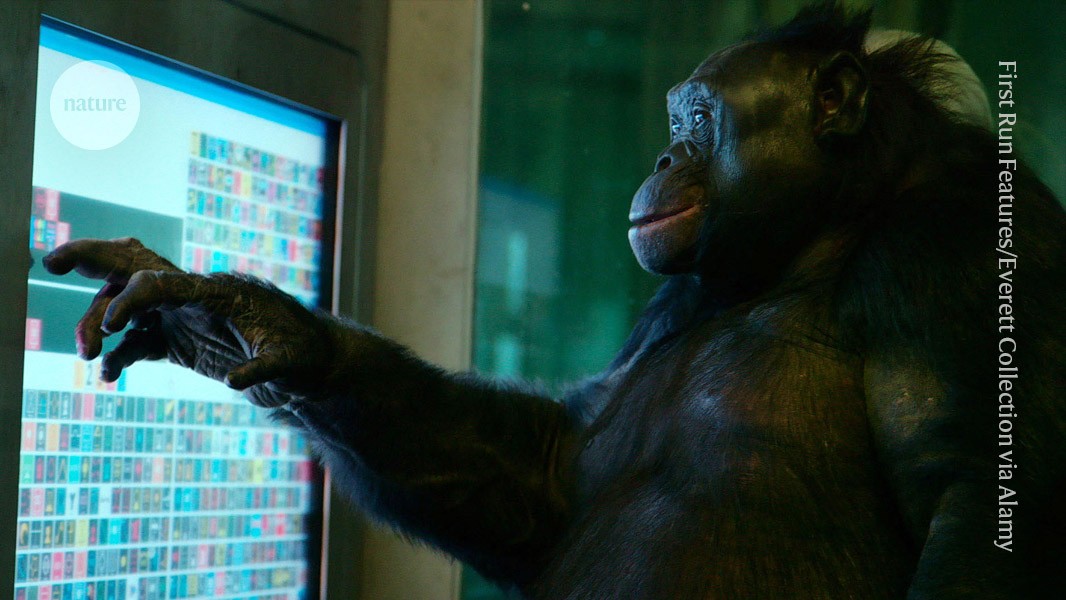

Kanzi the bonobo, pictured in 2016.Credit: First Run Features/Everett Collection via Alamy
A male bonobo called Kanzi is the first non-human animal to clearly grasp the concept of make believe. In experiments reported today in Science, the ape favoured a cup that scientists had pretended to fill with juice over one they had pretended to empty1.
The study adds to evidence that some animals, including humans’ closest relatives, can conceive of objects, events and individuals that aren’t “in the here and now”, says Amalia Bastos, a comparative psychologist at the University of St Andrews University, UK, who co-authored the study with cognitive scientist Christopher Krupenye at Johns Hopkins University in Baltimore, Maryland.
“It tells us that maybe they have a richer inner mental life than some people might have given them credit for or expected,” she adds.
Imaginary blueberries
Researchers have observed behaviour that resembles pretending in chimpanzees (Pan troglodytes) as well as bonobos (Pan paniscus) and other great apes. A captive bonobo named Panbanisha was observed making a plucking motion to a picture of blueberries and then moving her fingers to her mouth, as if to eat the imaginary fruit2. Researchers have also documented wild chimpanzees carrying logs like dolls, especially in young females3.
To explicitly test whether apes can exhibit pretence, Bastos and Krupenye adapted a ‘tea party’ task used in children, who usually start to imagine pretend objects around the age of 2–3 years. The test was made easier, because Kanzi — who died in 2025 aged 44 — can understand hundreds of English words and use symbols known as lexigrams, to communicate. “We were all a bit starstruck because Kanzi has been a celebrity for a very long time in the field of animal cognition,” Bastos says.
Once Kanzi learnt to choose a transparent cup filled with actual juice over an empty one, the researchers moved onto the tea-party task. An experimenter showed Kanzi two cups and then pretended to fill them from an empty jug. After inverting one cup — to ‘empty’ its imaginary contents — Kanzi was asked to pick a cup. The ape selected the ‘full’ cup in 34 of 50 trials, which is well above the number of times expected if his choices were random. In a similar task involving grapes, Kanzi went for pretend fruit in 69% of trials.

