


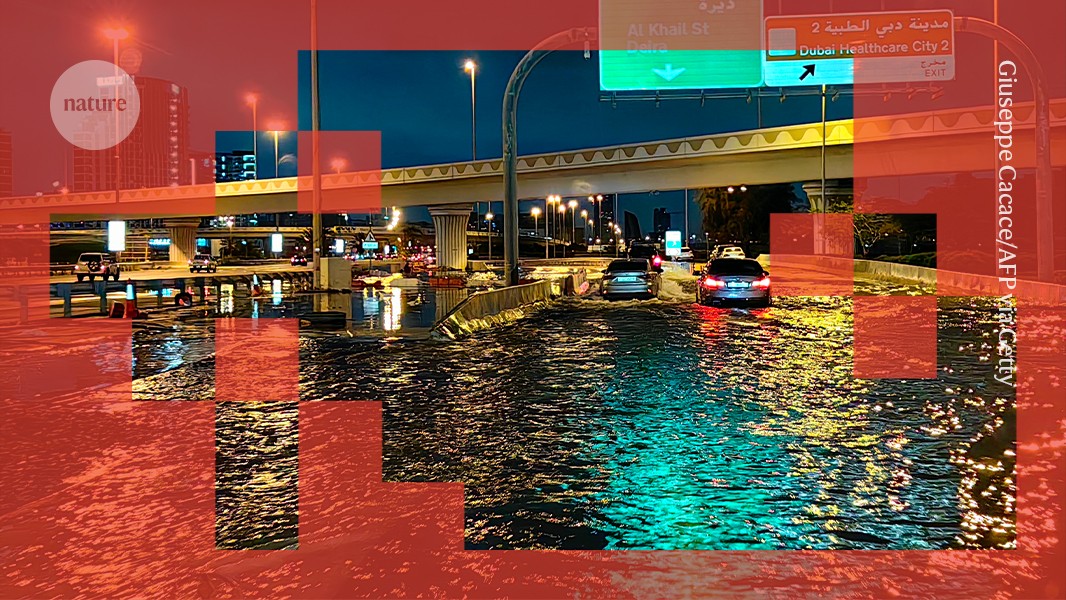

In April last year, more rain fell in Dubai in a single day than would normally be expected to fall in an entire year.Credit: Giuseppe Cacace/AFP via Getty
Artificial-intelligence tools have transformed weather forecasting, thanks to their ability to learn past patterns from observations and predict how future patterns might unfold. But until now, models have sometimes struggled to forecast extreme weather events that they’ve never seen before, but that are happening more frequently as the planet warms.
It’s like trying to “forecast the future with yesterday’s climate”, as Jacob Landsberg, a data scientist at Boston University in Massachusetts, puts it.
One new approach that’s showing success combines an artificial-intelligence (AI) model with a conventional climate model, plus mathematical tools that describe rare events, to forecast weather extremes more effectively. In early tests, this hybrid approach simulated the probabilities of extreme heatwaves as accurately as the older, non-AI method, which takes much longer to run1.
“We think this is the way forward,” says Pedram Hassanzadeh, a climate physicist at the University of Chicago in Illinois who is involved in several of the early studies. Team members posted the results in a series of preprints on arXiv this year, and will discuss the work at upcoming conferences, including the American Geophysical Union meeting this month.
Limited training data
Extreme weather can be particularly dangerous when it goes beyond what people usually experience. Examples include the deep freeze in Texas in 2021 that killed hundreds of people, and the 2010 heatwave in Moscow that killed more than 10,000. But it’s hard to reproduce the statistics of such rare events and to accurately predict how they might change in the future, Hassanzadeh says. AI models might be working with only 40 years of training data but need to forecast a weather extreme that happens just once every 1,000 years.
Consider the unprecedented rains that hit Dubai in April 2024, when more than a year’s worth of rain fell in a day. Researchers led by Qiang Sun, an atmospheric scientist at the University of Chicago, and Hassanzadeh analysed the event with two AI models. They were surprised and impressed to find that one of them, the GraphCast model developed by Google DeepMind in London, would have accurately forecast the event eight days before it occurred2.
But things didn’t work as well when the scientists looked at tropical cyclones. A different AI weather model, FourCastNet developed by NVIDIA in Santa Clara, California, struggled to forecast the strongest tropical cyclones when it had no extreme storms in its training set3.
That seemed like bad news, but the researchers did spot a glimmer of hope. The model seemed to be able to learn from storms that occurred in one ocean basin, such as the Atlantic, and apply that learning to other ocean basins, such as the Pacific. It could basically improve its regional forecasts by translating information to different parts of the globe. “The fact that they can do that gives them a lot of power,” Hassanzadeh says.
Hybrid approach
In their latest work, the researchers found a way forwards with yet another AI model, Pangu-Weather developed by Chinese firm Huawei Cloud, in Shenzhen. The scientists combined it with a physics-based global climate model, plus a mathematical method for analysing the statistics of rare events, to see whether they could predict mid-latitude heatwaves.

