


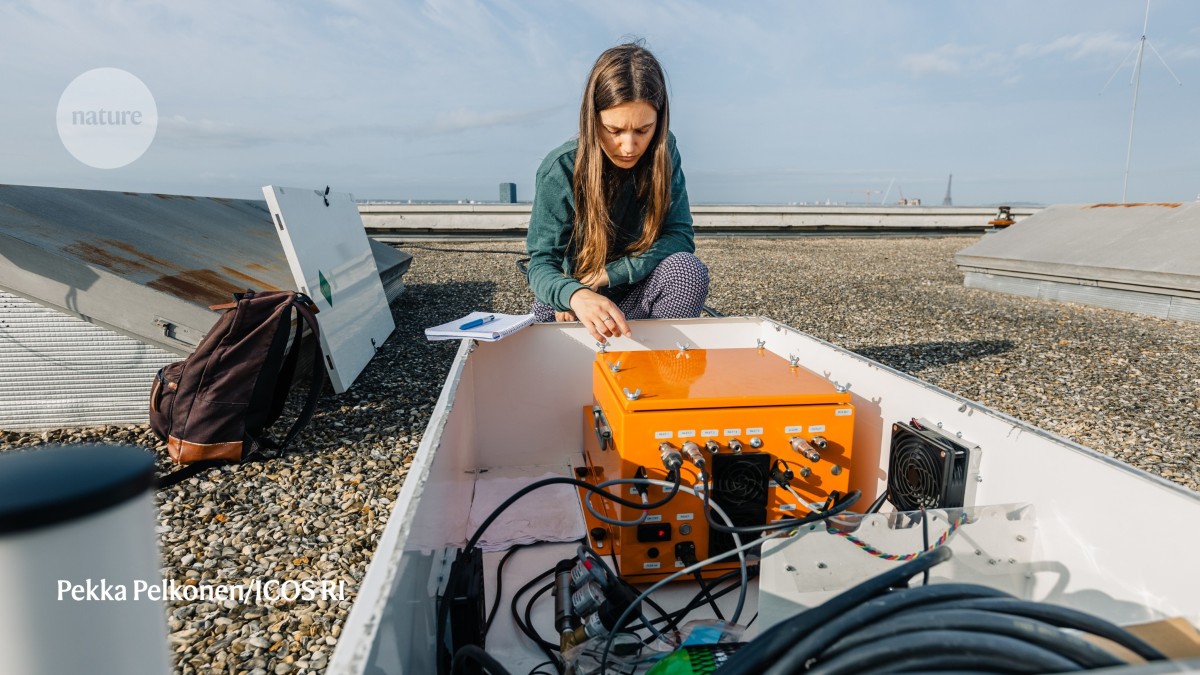

Carbon dioxide sensors on top of the Opéra Bastille building in Paris will help to measure atmospheric emissions in the city.Credit: Pekka Pelkonen/ICOS RI
In 1950, only around one in five people lived in a city. Now, that figure is close to one in two. Thirty-three of these urban centres have achieved megacity status, meaning they are home to more than 10 million people. One of the largest — Tokyo, which has more than 33 million residents — is a behemoth of modern technology. Its major train station in Shinjuku is the world’s busiest, with an average of 2.7 million people passing through it every day.
Such a large city ecosystem cannot be studied at a single glance, whether it be from space or at street level. Understanding its inhabitants and how it functions requires scientific instruments that can capture changes over time and in several dimensions and locations, from subterranean structures to the noisy, polluted streets and the skies above. Here are four innovative scientific initiatives that are using sensors to explore how the constantly shifting cityscape affects the creatures it was created for: people.
Beating the heat
Summers in Ahmedabad are hot. In this city of more than nine million people, in the western Indian state of Gujarat, average temperatures in May hover at around 40 °C. This is well above what is deemed comfortable, and approaches levels that are dangerous for humans to live in. Those in the tightly clustered slums of the city are particularly vulnerable, inadequately protected from the heat by poorly built housing that is not well maintained.
Nature Spotlight: Sensors
The solution could be as simple as a coat of paint on the roof. Solar reflective paints have already been shown to reduce daytime indoor air temperatures by up to 2.7 °C (see go.nature.com/3t8mjq2). So, in 2023, an international study was launched to investigate the benefits of this low-cost approach, using a range of sensors to track the health outcomes of a group of residents in Ahmedabad, as well as people in locations in Burkina Faso, Mexico and the Pacific island of Niue. “What we are trying to see is the effect of intervention primarily on the health,” says Abhiyant Tiwari, the health and climate resilience lead at the National Resources Defence Council India, based in New Delhi, who is one of the investigators working on the trial.
Participating households have been equipped with an indoor thermometer to measure the direct effect on temperature, and one occupant in each residence has been given a smartwatch to track the physical effects of heat on heart rate, sleep patterns and activity levels. Heat exposure has significant health consequences, especially for young children and older people, as well as people with chronic health conditions, such as heart disease. This can be particularly severe during heatwaves in which hotter nights prevent the body from cooling down during rest. Globally, heat-related deaths in adults aged older than 65 years more than doubled between 1990–99 and 2014–23 (see go.nature.com/4butmft).

Reflective paint helps to keep buildings cool in Ahmedabad, India.Credit: Ajit Solanki/AP Photo/Alamy
“The other outcome would be to also understand how such interventions don’t just benefit people’s health, but also improve their productivity and reduce their energy demand for cooling,” Tiwari says.
The study, which was launched in 2023, is an intensive undertaking. The data from the indoor thermometers and smartwatches have to be downloaded manually, so researchers must visit households on a regular basis. It’s too early to see whether the cooling paint has had any effect, but Tiwari says early data and anecdotal reports from participants suggest that it’s beneficial. “Psychologically, people do feel the benefit, [but] in terms of health, we will only be able to tell when we have all the data collected.”
Checking the numbers
Urban spaces are concentrated sources of greenhouse-gas emissions, accounting for around 70% of all global emissions. But quantifying those emissions is challenging, given the many and varied sources in a typical city.
In Switzerland, France and Germany, researchers working on the Integrated Carbon Observation System (ICOS) Cities initiative are trialling what’s called ‘top-down’ monitoring of emissions in Zurich, Paris and Munich.
“Typically, to look at emissions from a country or a city, you do inventories, you do statistics. That is called bottom-up,” says Lukas Emmenegger, head of the Laboratory for Air Pollution and Environmental Technology at the Swiss Federal Laboratories for Materials Science and Technology (Empa) in Zurich. That means counting the number of cars, the number of industries, the amount of land used for agriculture, how much and what type of heating is used, for example, and multiplying each of those by an emissions factor that represents the rate of greenhouse-gas emissions for that activity, Emmenegger says. “That’s the standard proceeding within the international protocols,” he says.

Motion-activated cameras track wildlife.Credit: Melinda Hurst Frye
One of the goals of the ICOS Cities project is to determine just how accurate this protocol is. To do that, researchers have deployed three levels of sensors to build up a comprehensive 3D picture of emissions in the cities over time.
At the low-cost end are street-level, battery-powered carbon dioxide monitors that are placed close to major sources of pollution, such as roads. The next level in both cost and altitude are carbon dioxide sensors that are placed up high, sometimes on antennas on the roofs of buildings. The most expensive sensors are ground-based spectrometers that use sunlight to analyse the concentration of atmospheric carbon dioxide above the city.
So far, the results have revealed that the extrapolated inventory in Zurich is remarkably close to reality. “That has to do with the fact that Zurich, I would argue, has one of the best inventories in the world, so they do an outstanding job, they know every single heating, they know every single road, they measure the traffic,” Emmenegger says. Munich and Paris showed reasonable, but not total, agreement with extrapolated figures. One surprise contributor was a Munich brewery that generated particularly high levels of carbon dioxide from its fermentation processes.
The project is now being expanded to 12 more cities across Europe. Emmenegger says the results could help to build confidence in net-zero initiatives. “If we reach net zero, that’s something you should be able to observe in the atmosphere, and we argue that this really adds another level of confidence in the system.”
On the prowl
The US city of Seattle in Washington is surrounded by abundant wilderness. With a population of more than 750,000, it is wedged between Lake Washington and Puget Sound, in sight of three national parks and not far from the snow-capped Mount Rainier.
Therefore, it’s hardly surprising that humans aren’t the only mammalian predators that call Seattle home. Its population also includes raccoons, bobcats, coyotes, mountain lions and even bears, and researchers at the Seattle Urban Carnivore Project want to understand how these residents interact with the human ones.
The project began from a desire to explore the understudied ecosystem of urban areas, with a particular focus on carnivores. “Mammalian carnivores, particularly coyotes in Seattle, are one of the areas of coexistence and conflict issues,” says Mark Jordan, a biologist and environmental scientist at Seattle University. Local media is rife with stories about unpleasant encounters between humans, their pets and coyotes, which often result in the coyote being trapped and killed to avoid any more conflict.

A coyote (Canis latrans) photographed by a motion-activated camera as part of a project to track Seattle’s urban carnivores.Credit: Seattle Urban Carnivore Project

