


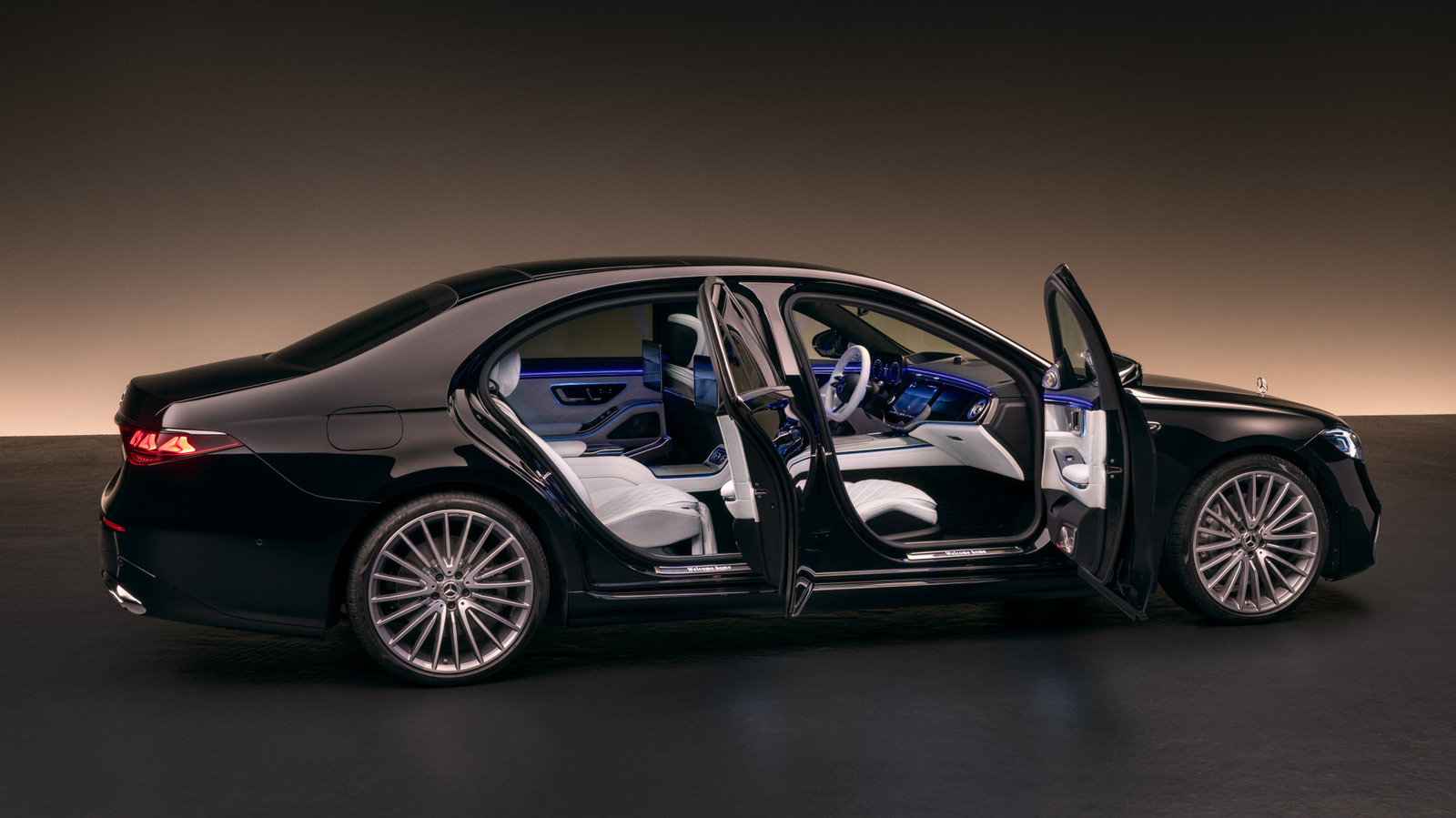
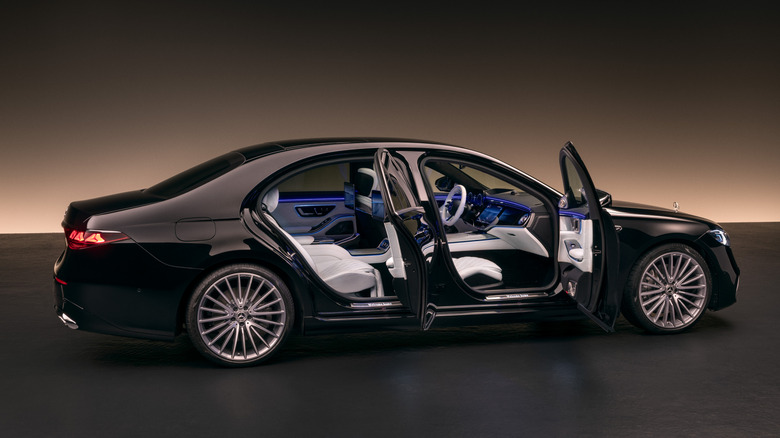
Mercedes-Benz typically uses new generations and mid-cycle refreshes of its S-Class flagship sedan to introduce new safety innovations, design elements, and technology and convenience features, and that’s certainly true of the recently unveiled 2027 S-Class facelift. The automaker says it changed over 2,700 parts, more than half of the car. There’s one new feature on the updated S-Class that seems frivolous at first, but is really quite clever.
For the first time in any car, the 2027 S-Class offers heated seat belts as an option. High-end Benzes already have lots of different heating features, from heated seats and steering wheels to heated door panels and armrests, and of course the Airscarf feature on convertibles. Oh, and who could forget the hot-stone massage function? Mercedes says the heated seat belts “provide a soothing warmth, delivering a gentle, reassuring embrace for front passengers — transforming cold mornings into moments of pure comfort” and “adding a subtle touch of indulgence.” But this is more than just a silly luxury touch — the heated seat belts are actually a safety feature.
A gentle embrace
Mercedes first showed off the idea with its GLE-based Experimental Safety Car concept in 2019, and supplier ZF has also been working on its own heated belt tech for a few years now. Using thin filaments like electrical conductors, the heating wires warm the seat belt up to 111 degrees Fahrenheit. Like other heating features, the front passengers can either turn the heated belts on or off using the seat heating buttons, or they can be set to automatically activate when it reaches a certain level of cold outside, and when you first get into the car.
Sounds lovely, but how does this make you safer? It should get people to take off their winter coats and other bulky cold-weather gear when they get in the car, ideally before they even set off. Warming up the seat belts will both make wearing a coat while driving less necessary, and also remind you that you’ve still got it on when you start feeling really hot. If you get into an accident, or even if you almost do and thus set off the pretensioners, seat belts are safer and more effective if you aren’t wearing a big coat.
You can get airbags in the seat belts, too
Swedish automaker Volvo introduced the first three-pointed seat belt in 1959, opening up the patent so that car companies around the world would also implement the life-saving technology. Volvo has continued to be a safety innovator in all sorts of different aspects of automotive engineering; most recently, it debuted an adaptive seat belt for the EX60 that customizes its fit and operation based on the occupant.
Mercedes was the first to introduce seat belt tensioners with the W126 S-Class in 1980, and it became standard equipment on every Benz by 1984. It was triggered by the same sensors as the airbags, tightening up the seat belt within milliseconds by using a propellant charge. In 1995 Mercedes combined the tensioners with force limiters that control how much slack is allowed on the belt, and in 2002 it added an electronic tensioner to the existing pyrotechnic one with the new Pre-Safe system, which tightens the belts in anticipation of a crash and can also loosen them back up if a crash never happens.
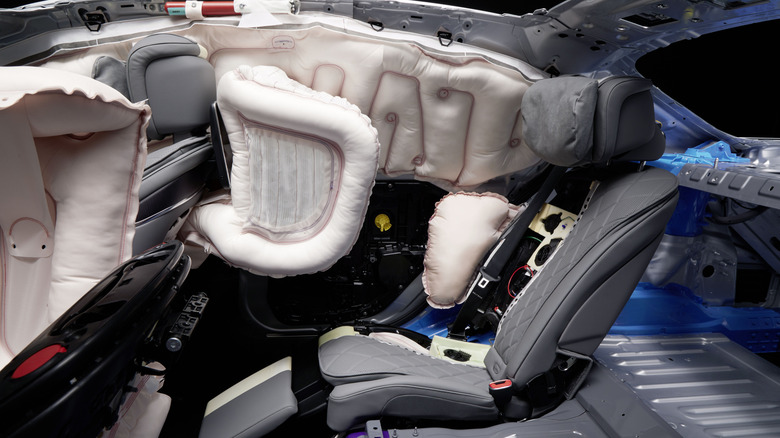
In 2009 Ford introduced the industry’s first seat belts with built-in airbags on the redesigned Explorer, a technology adopted by other Fords and cars like the Lexus LFA and, of course, the Mercedes S-Class. The current S-Class has inflatable shoulder belts for second-row occupants when you get one of the fancier rear seat setups, tripling the area across the chest, and the S-Class is currently the only car on the market with airbags that deploy from the front seatbacks to better protect occupants in the rear.

